Portuguese
  Spanish


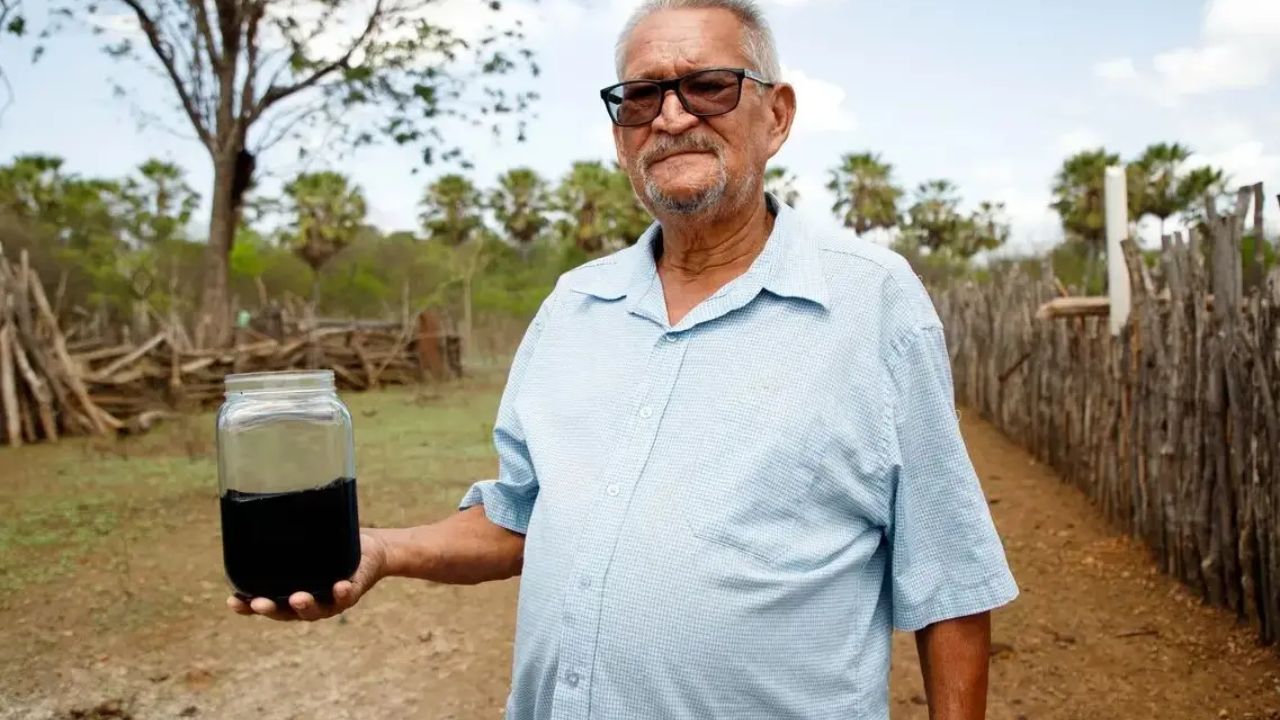

The ANP confirmed oil on a site in Tabuleiro do Norte (CE). The farmer Sidrônio was drilling an artesian well when he found the black liquid in 2024.
A farmer from the municipality of Tabuleiro do Norte, in the interior of Ceará, was drilling the ground on his own property in search of water when a dark, dense liquid with a fuel smell emerged from the hole. The National Petroleum Agency (ANP) concluded, on May 19, 2026, that the substance found is crude oil. The results of the physical-chemical tests were communicated to the landowner on May 20 and also forwarded to the Ceará Environmental Secretariat (SEMACE), which may recommend measures related to the environmental impact of the find, as reported by g1.
How it all began: the search for water that revealed oil
In November 2024, the farmer Sidrônio Moreira hired a team to drill the ground on his site with the aim of creating an artesian well.
Without access to piped water, the family depended on this type of solution for domestic supply.
-
Oil Prices Rise as U.S.-Iran Tensions Heighten Concerns Over Global Supply and Energy Market Stability

-
Explosion at QatarEnergy Plant in Ras Laffan Kills 13 and Injures 66; Investigation Rules Out Sabotage

-
Brazil’s Búzios Oil Field Sets Record with 1.2 Million Barrels Per Day, Strengthening Global Leadership in Deepwater Production
-
Petrobras and Equinor Reach Agreement for 50% Stake in Itaimbezinho Block in Brazil’s Pre-Salt Campos Basin


The drilling reached 40 meters deep when a black and viscous fluid began to gush — and Sidrônio even celebrated, believing it to be water.
Weeks later, given the characteristics of the material, the family sought the Federal Institute of Ceará (IFCE), which began to investigate the case.
Laboratory analyses carried out by the institute indicated that the sample had physical-chemical characteristics identical to those of oil extracted from deposits in the neighboring region, in Rio Grande do Norte.
Even so, official confirmation depended on the ANP.


The family notified the agency in July 2025. Seven months later, on March 12, 2026, after the case gained national repercussion, a team from the ANP visited the site.
According to the agency itself, the find surprised the technicians: it is unusual for a liquid with the characteristics of oil to surface at such a shallow depth.
Where is Tabuleiro do Norte and why the region is not a surprise for the sector
Tabuleiro do Norte is about 210 kilometers from Fortaleza, on the border with Rio Grande do Norte, located in the Jaguaribe Valley.
The region is close to the Potiguar Basin, an area already known and explored by the oil industry, located between the two states. The proximity to this basin helps explain why tests indicated similarity with the oil already extracted in Rio Grande do Norte.
What changes after the confirmation — and what is still far from being defined
With the report in hand, ANP opened an administrative process to evaluate the geological context of the area and estimate the size of possible reserves, as well as the feasibility of potential commercial exploration.

However, the agency was direct in highlighting that there is no defined deadline for the conclusion of this technical evaluation — and that, even at the end of it, there is no guarantee that the region will be explored.
Engineer Adriano Lima, who helped Sidrônio’s family contact ANP, explains how this process works:
“When they gather economic information, environmental impact, they process a framework for that area, as a new block to be put into operation.”
Adriano Lima also warns about the factors that can make exploration unfeasible even after the delimitation of a block: “The cost of setting up a production unit in a region must be equivalent to the return the operation will have. The return must be related to the quality of the oil that will be extracted and the quantity, the duration, the time it will be able to produce.”
Can Sidrônio profit from the oil found on his own site?
The short answer is: maybe — but with many conditions.
The Federal Constitution establishes that the subsoil and its resources, including oil and gas, belong to the Union. Therefore, Sidrônio will not own the material found on his property.
Even so, the legislation ensures the landowner a financial share if the area reaches the commercial production phase. This benefit, however, depends on a series of steps that are still in the early stages:

- The ANP needs to complete the geological assessment of the area, with no defined deadline
- The region must be delineated and transformed into an exploration block
- The block needs to be auctioned and acquired by an interested company
- The winning company must obtain environmental licenses and set up the operation
- Only after effective commercial production does the owner receive their share — which can reach up to 1% of the revenues
The ANP warns that similar cases have already been dismissed because they involved accumulations too small to make exploration viable. The entire process, from discovery to eventual production, can take years.
While waiting for a response, the family struggles for access to water
With the well isolated by ANP’s determination — which also prohibited new sample collections and any access to the site — Sidrônio’s family once again faced difficulties with water supply.
The repercussion of the case ended up having an unexpected practical effect: an old city water main, which had stopped serving the property, resumed supplying the family at the end of March 2026.
Source: g1