









On July 7, 2025, the Brazilian government signed a memorandum with China unlocking one of the most ambitious projects in South American logistical diplomacy: the Manaus–Chancay bi-oceanic corridor, estimated at $18.5 billion and designed to shorten the journey between the Atlantic and the Pacific. According to the Ministry of Planning’s statement, Minister Simone Tebet signed the agreement alongside Infra S.A. and the China Railway Economic and Planning Research Institute, with participation from secretaries Leonardo Ribeiro (Transport), João Villaverde (Institutional Articulation), and Maurício Muniz (Civil House). While the Brazil-Peru-China trilateral project gains momentum, the study of the Brazil–Peru railway has been stuck in technical phases for over 11 years, a dimensional comparison that returns a chapter to the South Atlantic that seemed shelved.
The route stems from an old frustration. For over a decade, Brazil has been discussing a railway connection that would avoid the Panama Canal, but the preliminary study phase dragged on through the last three administrations. The new memorandum sets a five-year deadline to complete technical and environmental feasibility analyses of the section Lucas do Rio Verde (MT), Rondônia, Acre, Peru, and Chancay.

Why Chancay became the key to an $18.5 billion corridor
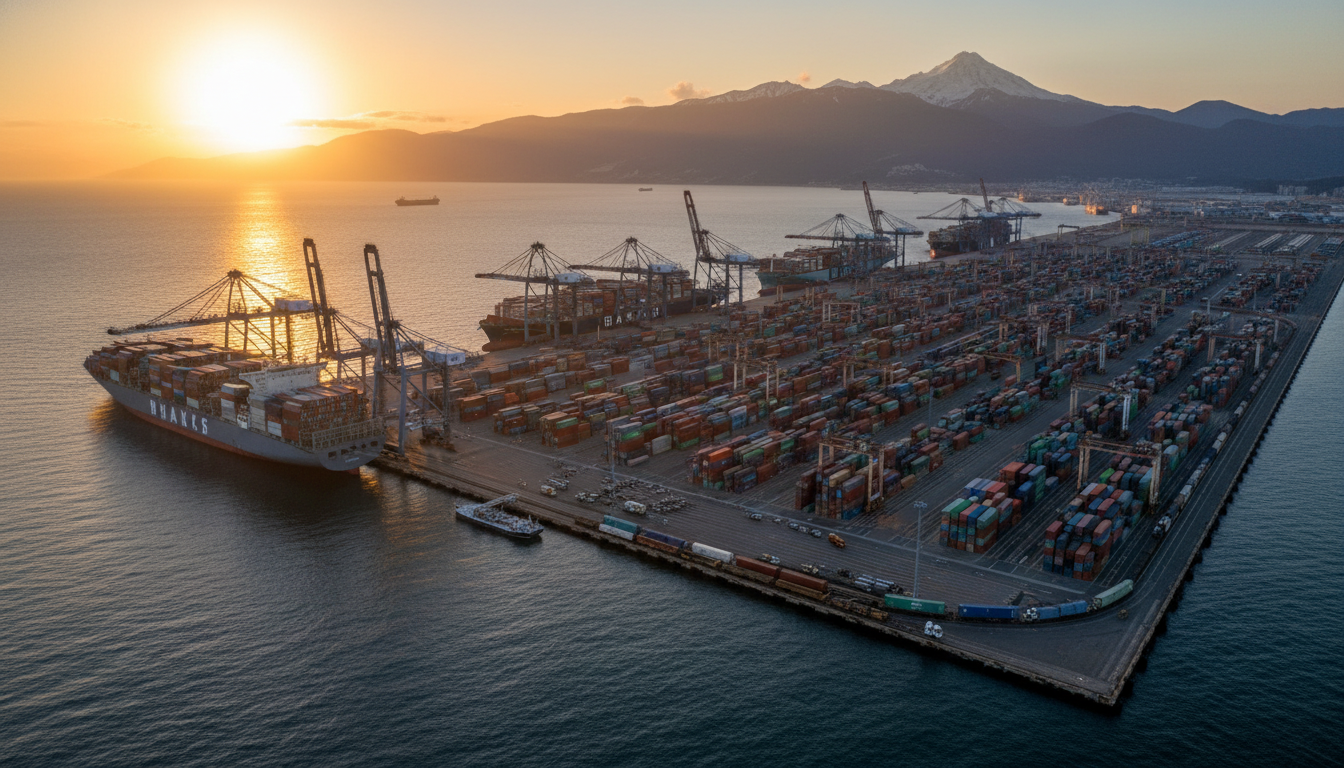
China inaugurated the Chancay megaport at the end of 2024, 70 km north of Lima, with an investment of $3.5 billion in its first phase and capacity to receive ships of up to 18,000 TEUs. The terminal, controlled by Cosco Shipping, shortens the traditional route between the South American west coast and Asia by up to 23,000 kilometers. The missing piece is the railway capable of channeling soy from the Midwest, iron from Bahia, and ore from Mato Grosso do Sul to Chancay.
-
Petrobras Begins Drilling Controversial Oil Well in Brazil’s Equatorial Margin Near the Amazon River Mouth

-
U.S. Women’s History Museum Stalled in Congress Amid Gender Identity and Diversity Debate

-
Petrobras Sets Record with 2.66 Million Barrels Per Day in Brazil’s Pre-Salt Oil Production
-
Petrobras to Double Natural Gas Supply in Northeastern Brazil with New Investment


The memorandum signed in July provides for studies on four axes: railways, waterways, highways, and ports. However, the bi-oceanic railway is in the spotlight. The preliminary route connects Lucas do Rio Verde to Acre, crosses the Andes through the Vilcabamba Range, and descends to the Peruvian coast, totaling about 4,500 kilometers of integrated extension.
To understand the scale: the Tapajós Waterway, currently considered the main logistical corridor for grain export through the North, transported 2.38 million tons in the first two months of 2026, a historical record. The Manaus–Chancay corridor, designed by Cosco, aims for an annual capacity exceeding 35 million tons in its mature phase.
Brazil-Peru rail: the lost decade on the drawing boards
The first memorandums of intent between Brazil and Peru date back to 2014, when former President Ollanta Humala and Dilma Rousseff signed a pre-agreement for bilateral railway cooperation. Since then, three Brazilian governments, Temer, Bolsonaro, and Lula, have discussed alternative routes without delivering a complete geotechnical survey. The estimated cost of the binational transcontinental railway, $3.5 billion, is only 19% of the investment planned for the new trilateral route.
In comparison, China enabled the construction of the Chancay port in less than three years, financed most of the initial $3.5 billion, and already has expansion studies underway for 1.5 million TEUs annually. The difference in pace was evident in an interview with Agência Brasil: Tebet stated that “Brazil has a historical debt with Brazil” and described the country as “the only major nation in territorial extension that is not crisscrossed with railways.”

The technical detail that changes the game: gauge and gradient
Engineers advising the memorandum admit in private conversations that the greatest difficulty is not financial but topographical. The Andean crossing will require tunnels with a maximum gradient of 1.5% to accommodate heavy freight trains, a Chinese standard in the Belt and Road Initiative. The preliminary route foresees 47 tunnels and 211 viaducts, according to a survey by the Institute of Applied Economic Research (IPEA).
Brazil is betting on broad gauge (1.60 m), compatible with North-South, Fiol, and Fico. Peru operates on international standard gauge (1.435 m). The negotiated solution should adopt dual gauge in critical sections, according to the Chinese technical project. Chinese railway engineering has already delivered equivalent solutions on the Mombasa–Nairobi line in Kenya and the Boten–Vientiane railway in Laos.
Who commands on the Brazilian side
Infra S.A., a public company linked to the Ministry of Transport, was tasked with coordinating the studies. Magda Chambriard, president of Petrobras, was appointed to the interministerial committee monitoring the progress of associated logistical works. For China, the China Railway Economic and Planning Research Institute coordinates the technical work, with direct support from Cosco Shipping for port-rail integration.
Paulo Skaf, former president of Fiesp, recalled in a lecture in October 2025 that “logistics is the real Brazil cost,” a phrase that resurfaced behind the scenes of the announcement. The Federation of Industries of Mato Grosso estimates that each additional day of shipment in the Atlantic costs R$ 4.80 per ton of soy exported to Asia.

The risk that Itamaraty does not speak loudly
Chancay Port has an operational exclusivity clause with Cosco for 60 years. Critics point out that Brazil risks becoming dependent on a single foreign operator to export 25% of South American exports to Asia. A report by Gazeta do Povo revealed in November 2025 that negotiations on financing the Brazilian part were still stalled around BNDES and the China Development Bank.
BNDES announced in February 2026 a package of R$ 140 billion for railways, of which R$ 28 billion should be channeled to the Brazilian section of the bi-oceanic corridor. The China Development Bank offered a $12 billion credit line for associated infrastructure, with an eight-year grace period and a 25-year amortization period.
Why this revives the comparison with the Panama Canal
The Panama Canal handles about 5% of world trade and has faced increasing restrictions since the 2023 drought, when the level of Gatún Lake dropped enough to reduce the number of daily crossings from 36 to 22. The average toll rate for a container ship jumped to $750,000 per crossing, a cost that weighs especially on Brazilian grains destined for Asia.
The Manaus–Chancay corridor was described by engineers close to the project as “the new Panama Canal made on land.” The phrase became a catchphrase among logistics executives and gained traction in BRICS reports. For Beijing, the section represents a strategic alternative should the Canal face environmental or political instability.

The near future: 2030 as the minimum horizon
The study schedule runs until 2030. If technical feasibility is approved, construction should begin in 2031 and last more than a decade. The first Brazilian phase, from the Lucas do Rio Verde section to Porto Velho, is budgeted at R$ 35 billion and should be completed seven years after the effective start of civil works. The complete connection to Chancay, including the Andean crossing, should take an additional 12 years.
Experts warn that the schedule is optimistic. The Ferrogrão, the first major railway project in the Brazilian Midwest, has been paralyzed for 16 years. The Fiol, which connects Ilhéus (BA) to Mara Rosa (GO), is in its third stalled construction contract. Still, the July memorandum puts Brazil back in dialogue with Chinese engineering, which delivered 47,000 kilometers of high-speed rail in two decades, a number that highlights the bilateral operational gap.
The next technical round is scheduled for June 2026, in Beijing. Cosco Shipping is expected to present a consolidated project for the multimodal terminal in Chancay, with direct integration for dual-gauge wagons. If the schedule is met, in a decade Brazil could have a new Panama Canal on land. Provided the country can, this time, move from the drawing boards to the tracks.


