






 Portuguese
  Spanish




Free Courses with R$ 850 Scholarship Transform the Routine of Venezuelan Immigrants in Canoas and Show How Technical Education Can Open New Job Opportunities and Integration in Brazil.
Venezuelans who settled in Canoas, in the Metropolitan Region of Porto Alegre, found in the free courses of the Petrobras Autonomy and Income Program, held at IFRS – Campus Canoas, a gateway to the Brazilian job market.
Opportunities with a monthly scholarship of R$ 850 have enabled qualification in different areas and increased the chances of formal employment.
The influx of immigrants to the municipality continues to grow, according to the Directorate of Diversity, Racial Equality, Indigenous Peoples, and Immigrants of the city hall.
-
In the Caucasus Mountains, a Community Preserves a Language So Rare Few Outsiders Can Understand It

-
Slovakia’s Ice Cave Holds Over 110,000 m³ of Frozen Wonders, Boasts Walls Up to 27 Meters Thick, and Was Among the First Electrified Caves Globally

-
Street Cleaner Accidentally Receives $200,000 Transfer, Returns Unexpected Fortune to Rightful Owner
-
Australian Space Agency Investigates Six Mysterious Metal Spheres Found on Queensland Beach, Isolating Area Over Possible Space Debris Risk


In this scenario, eight Venezuelans enrolled in the campus courses represent part of this movement seeking stability, income, and inclusion.
They have diverse trajectories, but share concrete challenges: learning Portuguese, adapting to a new culture, and gaining professional space in demanded sectors.
Technical Training for Quick Job Insertion
Currently, four foreign students are attending the Industrial Painter class, two are taking General Services Assistant, and two others are studying to become Pipe Insulators.
These are short-duration qualifications with a practical focus, structured to accelerate employability.
Teachers observe high engagement in activities.
Professor Evandro Carlos do Nascimento, who teaches subjects in the three classes at IFRS – Campus Canoas, summarizes the students’ attitude: “The students want to understand our language, integrate, learn more about our country. They listen, participate, and seek to learn.”
The testimony reinforces the willingness of immigrants to overcome language and cultural barriers to achieve financial autonomy.
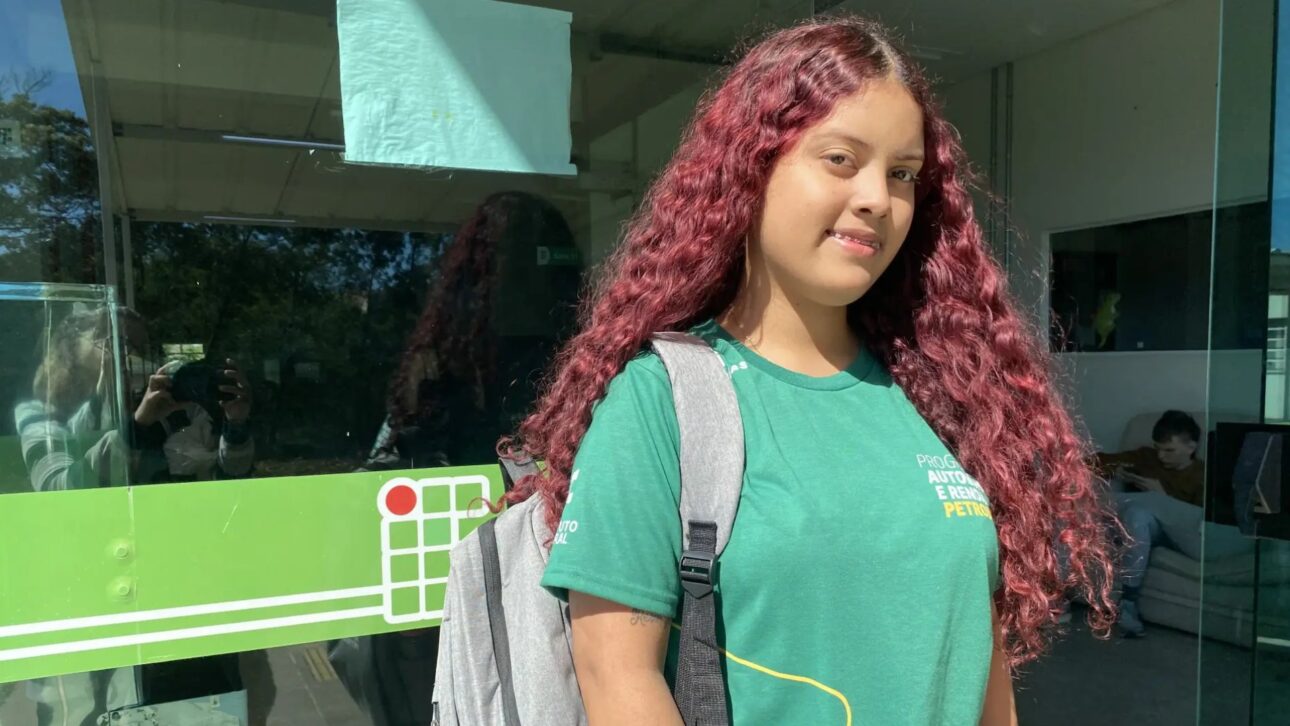
Course Coordinator Bruno Diniz notes that commitment has been evident since enrollment.
According to him, even after the floods that hit Rio Grande do Sul in 2024, students maintained their study plans and attendance in classes.
Some still face difficulties with the language, while most report being adapted to Brazilian customs, which facilitates coexistence in the classroom and the work environment.
R$ 850 Scholarship and Viable Routine for Those Restarting
The program offers a scholarship of R$ 850 for participants, a mechanism that helps cover basic expenses during the training period.
For those restarting life in another country, the financial support reduces dropout rates and allows for organizing the routine between study, family care, and occasional work activities.
Venezuelan Raimar Maria Romero Maita, 27 years old, a student of General Services Assistant, has been in Brazil for five years.
In her home country, she worked as a supermarket cashier and in a restaurant; in Canoas, she works as a housekeeper.
She states that the course has been a concrete opportunity for advancement: “I like it here, there is work. I can’t save money, but I can support myself.”
Attentive in class, she plans to seek a formal job after completing her training and dreams of buying her own house to move out of rental with her husband and two children.
Learning Portuguese Accelerates Integration
In addition to the vocational classes, some students attend the free online course of Portuguese Language and Brazilian Culture for Foreigners offered by IFRS.
This initiative complements technical training and reduces barriers to everyday communication and in the work environment.
This is the case of Rosielis Antonella Nazareth Perez Diaz, 20 years old, a student of Pipe Insulator.
She arrived in Brazil in 2020 with her mother and brother in search of better prospects.
In Canoas, she completed high school, had temporary experience in retail, and now wants to enter the technical field: “The course is very interesting. I like to learn new things.”
The progressive mastery of the language has increased her confidence for selection processes and interviews.
Welcoming in Class and Adapted Teaching Methods
The integration between Brazilian and foreign classmates also stands out as a differential.
Keily Rosa Briceno Ferrer, 25 years old, from the Industrial Painter class, reports that the classroom environment is welcoming and that the teaching team adjusts communication to ensure understanding: “It’s been a very good experience. The class is welcoming; the others don’t isolate classmates for being Venezuelan. The teachers are very patient, speak slowly, ask if we understand, and explain again.”
Having lived in Canoas for three years, Keily sees the qualification as a decisive step to broaden formal job opportunities.
In the teachers’ evaluation, active participation in discussions and laboratory practices shortens the adaptation time to technical vocabulary.
Meanwhile, the evaluative activities help identify topics that require reinforcement and, when necessary, encourage complementary study of Portuguese, reading manuals, and safety standards.
Qualification Aligned with Regional Demand
The offered courses respond to the needs of industrial and service sectors in the metropolitan region.
Industrial painting, pipe insulation, and general services are functions that generally have high turnover and require specific knowledge of safety, materials, techniques, and organization.
By preparing workers with practical knowledge, the training reduces the mismatch between available vacancies and qualified candidates, benefiting companies and students.
Although personal stories vary, the common goal is to accelerate re-employment with formal contracts.
For many, the scholarship enables transportation, food, and purchase of materials; for others, it means protected time to study after informal shifts.
In both cases, the combination of financial aid and technical training opens up space to plan for the future with greater predictability.
Reconstruction After the 2024 Floods
The recent context of floods in 2024, which severely affected the state and especially Canoas, impacted the lives of residents and immigrants.
Even so, reports from the coordination indicate that foreign students maintained their study routines and strengthened their commitment to training.
In courses that require practice, such as painting and insulation, regular attendance and discipline count positively both for academic performance and for the impression left on potential employers.
Moreover, the experience in class with students from different backgrounds encourages support networks.
Information about job openings, documentation, and public services circulates more easily when ties are strengthened, and this has contributed to a faster integration into the city and the job market.
Paths After the Certificate
Upon completing the training, participants intend to apply for positions in local maintenance, construction, and assembly companies.
Some already envision continuing their studies, either to deepen technical skills or to improve their Portuguese and expand their chances in selection processes.
Others plan to combine their new occupation with occasional jobs until they stabilize their income.
In the short term, the expectation is that the training and practical experience will result in first formal hires.
In the medium term, the strategy involves consolidating their careers, accumulating work time, and, when possible, seeking specializations.
In all cases, the IFRS diploma and participation in the Petrobras Autonomy and Income Program appear as valuable credentials for those restarting far from home.
How to Enroll and Take a Petrobras Course with the Federal Institute
Enrollment for the courses of the Petrobras Autonomy and Income Program can be done directly at the participating campuses of the Federal Institute of Rio Grande do Sul (IFRS).
Interested parties should monitor the announcements published on the official IFRS website and check deadlines, required documents, and participation requirements. The spots are free and include a monthly scholarship of R$ 850 for those selected during the training period.


