






 Portuguese
  Spanish
 3 min of reading
  3 comments


Bridge Is Finished, but Remains Closed Due to Lack of Access. The Estimated Completion Date for the Works, Initially for 2022, Has Been Postponed. In the Meantime, Residents Continue to Depend on Ferries to Cross the River.
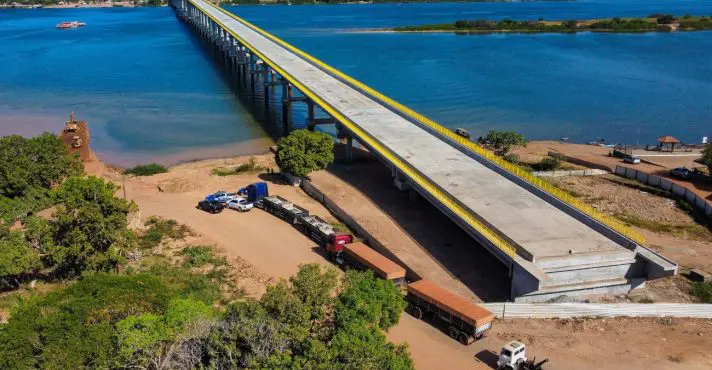
Built to transform the region’s infrastructure and facilitate the flow of agricultural production, a monumental bridge connecting the states of Tocantins and Pará remains inactive.
Although its structure is completed, drivers and residents still rely on ferries to cross the Araguaia River. The reason? The lack of road access, which has not yet been completed, prevents its opening for traffic.
The National Department of Transport Infrastructure (DNIT) reported that the bridge, which is 1.7 km long and has a budget exceeding R$ 200 million, remains closed while the road access works progress.
-
Survivor of 1966 SS Daniel J. Morrell Shipwreck in Lake Huron Recounts 38-Hour Ordeal in Extreme Cold

-
The Greatest Hoax in World Cup History? The Film That Denied Brazil’s 1958 Victory and Exposed How Fake Evidence Can Seem Convincing on TV
-
Fake South Korean Online Stores Offer Shopping Thrill Without Spending Money or Receiving Products
-
Brazilian Joins Homeownership Consortium, Faces Decade of Dual Payments Totaling $141,000, Surpassing Traditional Mortgage


The additional investment for this phase is estimated at R$ 30 million.
Initially scheduled for completion in September 2022, the project delivery was postponed to the second half of 2025, without an exact inauguration date.
Economic and Social Impact of the Bridge
The structure connects Xambioá (TO) to São Geraldo do Araguaia (PA) and is expected to directly benefit approximately 1.5 million people.
The project is viewed as essential for improving the logistics of Northern and Northeastern Brazil, reducing transportation costs, and boosting agribusiness, the local economy, and interstate trade.
Currently, the flow of goods and passengers depends entirely on ferry crossings, a costly and time-consuming process.
The waiting time can reach 45 minutes, depending on the river level and the flow of vessels.
Costs are also high, ranging from R$ 5.50 for bicycles to R$ 294 for ten-axle trailers. A typical car pays R$ 25 for the crossing.
With the bridge’s opening, it is expected that the local economy will strengthen, as cargo transport will be facilitated and new investments may be attracted to the region.
Additionally, tourism may be boosted, especially for riverside cities and natural preservation areas that will become more accessible.
Construction and Challenges Faced
DNIT explained that the bridge construction was carried out by a consortium, while the responsibility for the access roads was assigned to another company.
Currently, 95% of the work is completed, with only paving, signaling, and lighting remaining.
In August 2024, DNIT reported that the main structure was almost finished and that the bridge “would be trafficable by November of that year”.
However, the access roads are still under construction, and land expropriation for the works is ongoing.
The project was designed in 2017, during the government of Michel Temer (MDB-SP).
The service order was signed by DNIT in April 2020, but faced delays during the administration of then-president Jair Bolsonaro (PL).
With the inauguration of Luiz Inácio Lula da Silva, the bridge was included in the new Growth Acceleration Program (PAC), ensuring its continuation.
Bridge Characteristics and Timelines
The bridge’s structure consists of a platform with 12 meters in width, including road lanes, shoulders, and sidewalks of 1.5 meters on each side.
The accesses will have a total length of 2.1 km, with 310 meters on the Pará side and 1.7 km on the Tocantins side.
The hydrological and geoecological projects are still awaiting approval, with delivery expected in the second half of 2025.
Thus, even though the bridge is physically completed, the population will still need to wait until all safety and infrastructure conditions are fully met.
In the meantime, ferry crossings remain the only viable alternative, despite the costs and time involved.
Residents in the area are eagerly waiting for the opening of the bridge, which could transform the local socioeconomic dynamics.
The big question now is: will the bridge finally be opened on the new timeline, or will new delays arise? Share your opinion in the comments!





Cosizem qual a solução. Vc realmente acha que a iniciativa privada vai fazer uma ponte de 200 milhões? Se fizer imagina o pedágio? Fala sério, que o estado é ruim todo mundo sabe, mas a alternativa quando existe tb não e das melhores.
Tudo que vem do governo é desencontro, morosidade, desperdício de dinheiro público, burocracia, politicalha e a total incompetência de sempre. Afinal, nós brasileiros, os verdadeiros donos do dinheiro, somos escravos dos políticos, que cuidam primeiramente de seus interesses ideológicos de poder e em segundo plano realizam obras públicas necessárias, após muitas negociatas e, na maioria das vezes, onerosas, lentas e sempre deixando a desejar. Quando o critério é politicagem e não tecnicidade, os absurdos sempre surgem ao natural, infelizmente para nós, reles escravos deles.
Eu tambem Concordo contigo.
E tudo politicacem.