






 Portuguese
  Spanish
  5 min of reading
  1 comment


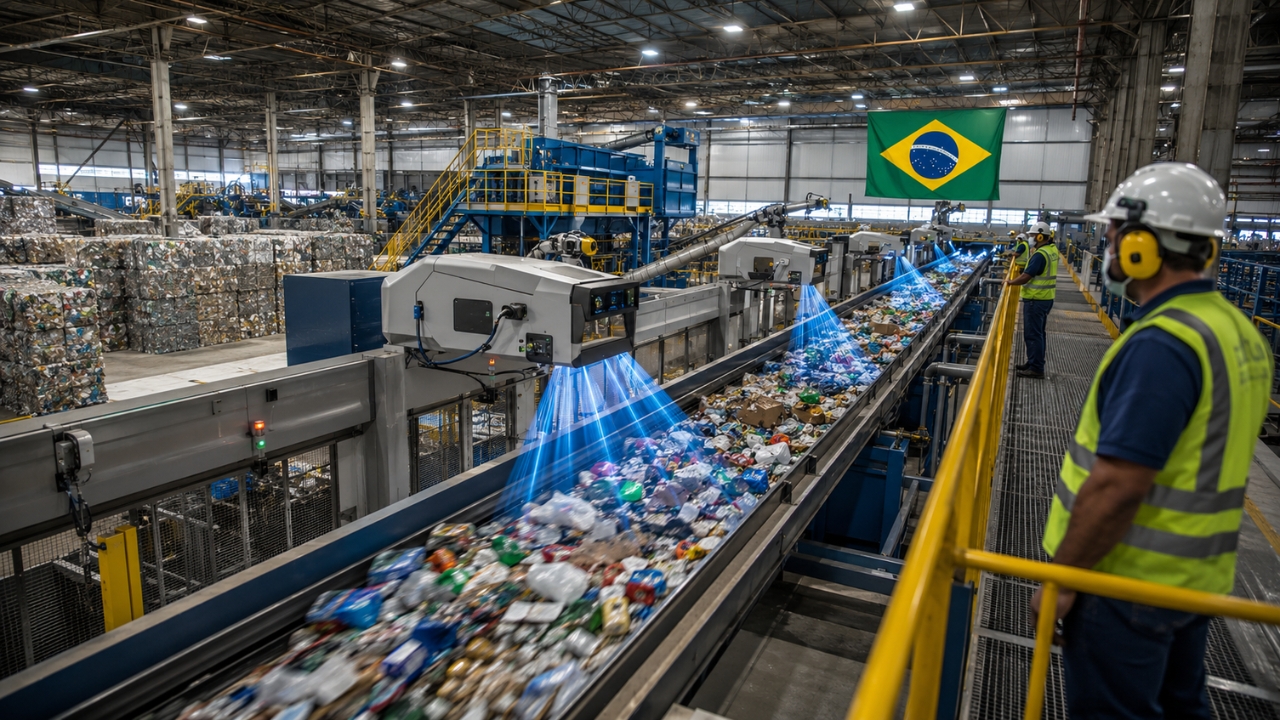


Technology, waste, and industry intersect in Guarulhos, where an automated operation shows how Brazilian recycling is trying to scale up.
A gigantic structure in Guarulhos, in Greater São Paulo, is attracting attention for transforming one of Brazil’s biggest problems into an industrial-scale operation. The Flacipel unit, linked to the Grupo Multilixo, is presented as the largest recycling plant in Latin America and uses artificial intelligence, optical sensors, lasers, and mechanical separators to change the way waste is treated in the country.
The plant has the capacity to process up to 8,000 tons of waste per month and separate more than 130 types of recyclable materials. The number is impressive because it places the Brazilian operation at a rare technological level in a sector that still largely depends on manual sorting and low efficiency.
What once seemed like just a recycling warehouse now resembles an automated industrial line, equipped to quickly and accurately identify paper, cardboard, plastic, glass, ferrous and non-ferrous metals. In a country that still recycles little given the huge volume of waste it produces, the plant has become an example of how technology, sustainability, and industry can work together.
-
Survivor of 1966 SS Daniel J. Morrell Shipwreck in Lake Huron Recounts 38-Hour Ordeal in Extreme Cold

-
The Greatest Hoax in World Cup History? The Film That Denied Brazil’s 1958 Victory and Exposed How Fake Evidence Can Seem Convincing on TV
-
Fake South Korean Online Stores Offer Shopping Thrill Without Spending Money or Receiving Products
-
The War of Jenkins’ Ear: How a Severed Ear Sparked One of the 18th Century’s Most Unusual Conflicts


A giant operation in Guarulhos


The Flacipel plant occupies an area of approximately 20,000 square meters and was designed to operate on a large scale. The unit receives recyclable waste and performs sophisticated sorting, separating materials that can return to the production chain instead of going to landfills.
The big difference lies in the combination of optical sensors, precision lasers, mechanical separators, electromagnets, and artificial intelligence. These systems allow for the recognition of different materials at high speed, reducing errors, increasing productivity, and making the process more efficient.
The operation can classify more than 130 types of materials, a number that shows the level of complexity of modern recycling. It is not just about separating “plastic from paper,” but identifying variations, compositions, and specific categories that have different industrial destinations.
Artificial intelligence enters Brazilian recycling
The presence of artificial intelligence in recycling is one of the strongest points of the operation. Instead of relying solely on human observation, the plant uses automated systems capable of recognizing patterns, differentiating materials, and directing each item to the correct flow.
In practice, this means that sorting gains speed and precision. Materials that could be incorrectly discarded now have a greater chance of being reused. For an industry that needs to deal with tons of waste every day, this difference can represent a huge leap.
The technology also helps to tackle one of the sector’s biggest bottlenecks: the lack of scale. Brazil produces millions of tons of solid waste every year but recycles only a small part. Therefore, automated operations like this draw attention by showing that the problem is not only environmental but also logistical, industrial, and technological.
Up to 8 thousand tons per month

The unit’s capacity is one of the most impressive data. The plant can process up to 8 thousand tons of waste per month, a volume that reinforces its role as one of the most robust operations in the sector in the region.
This number does not mean that all the material automatically becomes a new recycled product, but it shows the plant’s capacity to receive, separate, and prepare waste for different destinations. Some materials go for recycling, and another part can be transformed into Refuse-Derived Fuel, known as RDF, mainly used by the cement industry as an energy source.
This detail is important because it shows that the operation does not work only with traditional recycling. It is part of a broader logic of circular economy, in which waste is no longer treated as mere trash and is seen as raw material or energy resource.
Paper, plastic, metal, and glass on an industrial scale
The composition of the processed materials also reveals the size of the operation. The daily volume is mainly composed of paper and cardboard, which represent the majority of recycled waste. Next come plastics, metals, and glass.
This diversity requires a much more advanced sorting structure. Each material has a different value, destination, and technical requirement. Correctly separating everything is essential for quality reuse and for the industry to receive more standardized inputs.
This is where optical sensors and lasers come in, capable of identifying characteristics that are not easily perceived in common separation. The technology allows recycling to stop being an improvised process and become closer to a high-precision industrial activity.
Brazil recycles little, but technology can change the game
The impact of the plant becomes even more evident when compared to the national scenario. Brazil still recycles a small portion of the waste it generates, despite producing a gigantic amount of garbage every year.
This contrast creates the strength of the story: while the country faces low recycling rates, an operation in Guarulhos shows that it is possible to use automation, artificial intelligence, and reverse logistics to increase scale and reduce waste.
Flacipel also works with the concept of Zero Landfill, which seeks to minimize the sending of waste to landfills as much as possible. The idea is to give a smarter destination to materials, whether through recycling, reuse, or transformation into energy.
A showcase for the sustainable industry
The largest recycling plant in Latin America does not attract attention just for its size. It symbolizes a change in mindset: waste is treated as part of a complex production chain, with economic, environmental, and technological value.
At a time when companies, governments, and consumers discuss sustainability, reverse logistics, and reduction of environmental impacts, Flacipel’s operation in Guarulhos emerges as a powerful showcase. It shows that the recycling of the future does not depend solely on goodwill, but on heavy investment in technology.
With artificial intelligence, optical sensors, lasers, mechanical separators, and capacity for up to 8 thousand tons per month, the plant places Brazil at the center of an urgent discussion: how to transform a monumental waste problem into a real opportunity for the industry, for cities, and for the environment.





The concepts are indeed encouraging, but the lack of details leaves many questions.