Portuguese
  Spanish


Image captured by the International Space Station reveals the hypersaline pink lagoon of Torrevieja, in Spain, and shows how the combination of high salt concentration, microalgae, protected biodiversity, and historical saline activity creates a natural landscape so curious that it looks like an artificial structure seen from space
A natural landscape with strong visual impact was recorded from space in Spain, attracting attention for its almost artificial appearance.
The pink lagoon of Torrevieja, located in the province of Alicante, appeared in an image highlighted by NASA Earth Observatory in April 2022, after being captured by an astronaut on the International Space Station.
The scene drew attention because the huge pink stain looks like a human-made structure, although it is the result of a natural phenomenon linked to the high salinity of the water.
-
The Little-Known Story of a Home-Built Airplane That Promised Freedom but Faced Safety Issues After Numerous Accidents

-
He Didn’t Build a Plane, But Spent Decades Trying to Make Bicycles Fly with Wings and Pedals; Remaining Models Tell This Unusual Story in Germany
-
Roraima Security Secretary Poses as Doctor to Expose Technician Charging $600 for Free Public Health MRI in Brazil; Technician Confessed

-
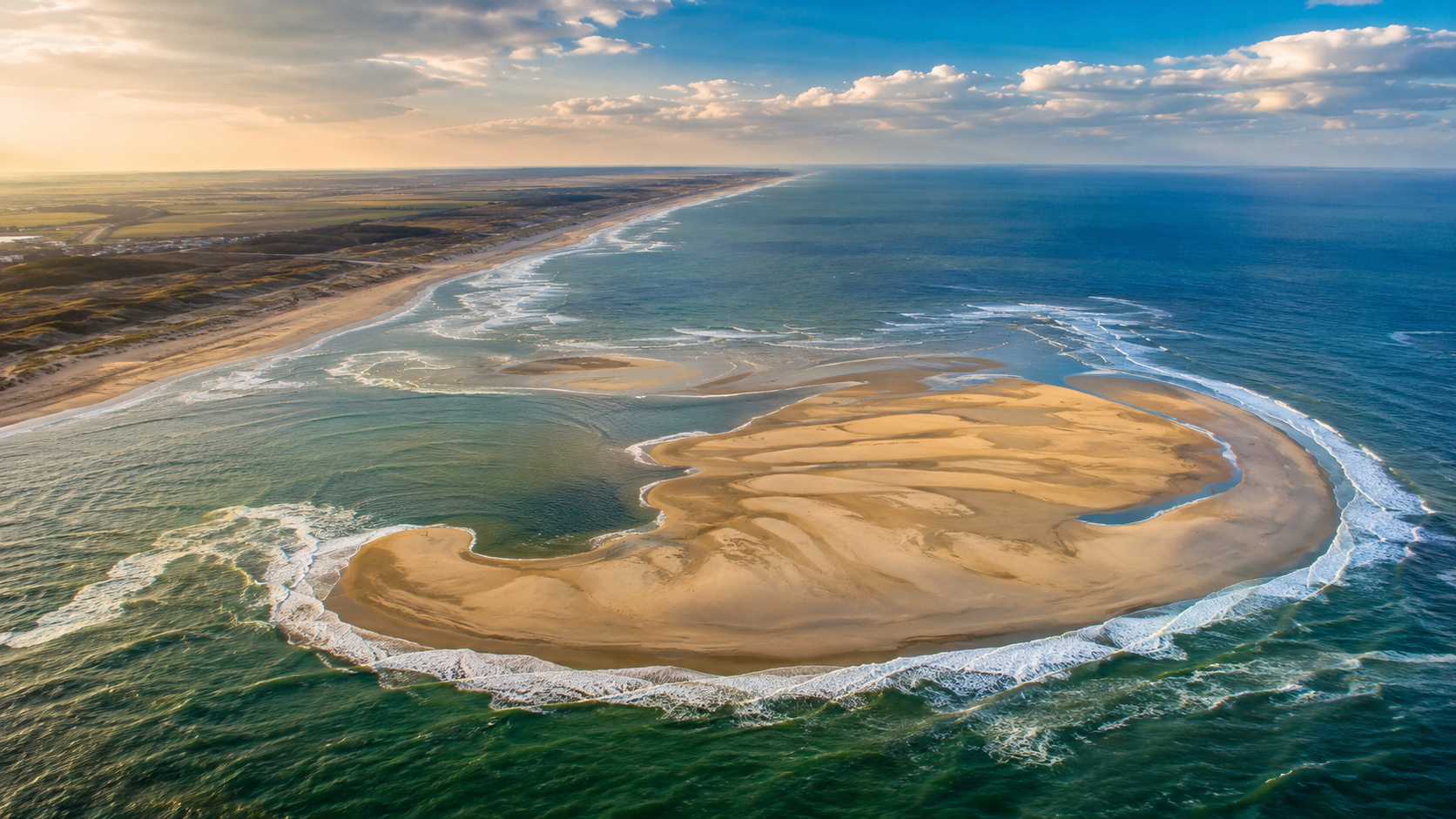
To Protect Its Beaches, the Netherlands Deposits 21.5 Million Cubic Meters of Sand into the Ocean, Letting Nature Reinforce Dunes and Shoreline



According to NASA Earth Observatory, the vibrant color occurs due to the presence of the microalga Dunaliella salina, an organism adapted to extremely salty environments.

Biological phenomenon explains the pink color of the lagoon
The pinkish hue of the Torrevieja lagoon arises from the combination of salt, light, and microscopic life.
As NASA Earth Observatory explains, the high concentration of mineral salts creates ideal conditions for the proliferation of Dunaliella salina.
This microalga contributes to the intense pink tone that transforms the landscape into one of Spain’s most curious natural scenes.
Furthermore, the phenomenon demonstrates how discreet biological processes can form impressive images even when observed from space.
Difference between Torrevieja and La Mata draws attention
Next to the pink lagoon is the La Mata lagoon, which presents greenish tones.
This visual difference occurs because La Mata has a lower salt concentration, due to the receipt of fresh water from nearby mountains.
Thus, two neighboring lagoons display different colors even under the same climatic environment.
While Torrevieja stands out with its intense pink, La Mata reinforces the natural contrast that makes the region even more impressive.

Salt Activity Sustains Local Economic Tradition
The salt exploitation in Torrevieja has a strong historical tradition in the economy of Alicante.
According to the NASA Earth Observatory, the salt factory is located on the southeast shore of the lagoon.
Moreover, data from the European Commission, through the LIFE program, indicate that salt production has shaped this wetland for over two centuries.
This activity combines natural cycles, production technique, and income generation for the local community.
Among the main economic impacts are the creation of direct jobs, the supply of the European salt market, and the strengthening of the province’s trade routes.
Biodiversity Transforms Lagoon into Environmental Refuge
Besides visual and economic value, the region holds great ecological importance.
The area is part of zones recognized by the Ramsar Convention and the Natura 2000 Network, according to data from the European Commission and Spain’s official tourism.
In this environment, small crustaceans known as artemias support part of the food chain.
These organisms serve as food for aquatic and migratory birds that use the wetland as a resting, sheltering, and feeding point.
Among the observed species are flamingos, wild ducks, and black-necked grebes.

Tourism requires rules to protect the ecosystem
Despite the beauty of the pink lagoon, visits must follow strict environmental regulations.
According to Spain’s official tourism portal, swimming in the lagoons is prohibited to avoid impacts on the biological balance.
Therefore, visitors should prioritize marked trails, viewpoints, and bird-watching spots.
Additionally, bringing water, collecting waste, and respecting protected areas are essential measures to preserve the wetland.
What makes Torrevieja so special?
The pink lagoon of Torrevieja combines science, biodiversity, economy, and natural beauty in one landscape.
While the image taken from space impresses with its visuals, the details reveal a sensitive and highly connected ecosystem.
The pink color depends on salinity, microalgae, and environmental preservation.
At the same time, the salt industry shows how nature has influenced the economic history of the region for generations.
In front of a landscape that seems artificial but is entirely natural, how many other hidden phenomena might still surprise when seen from space?