






 Portuguese
  Spanish


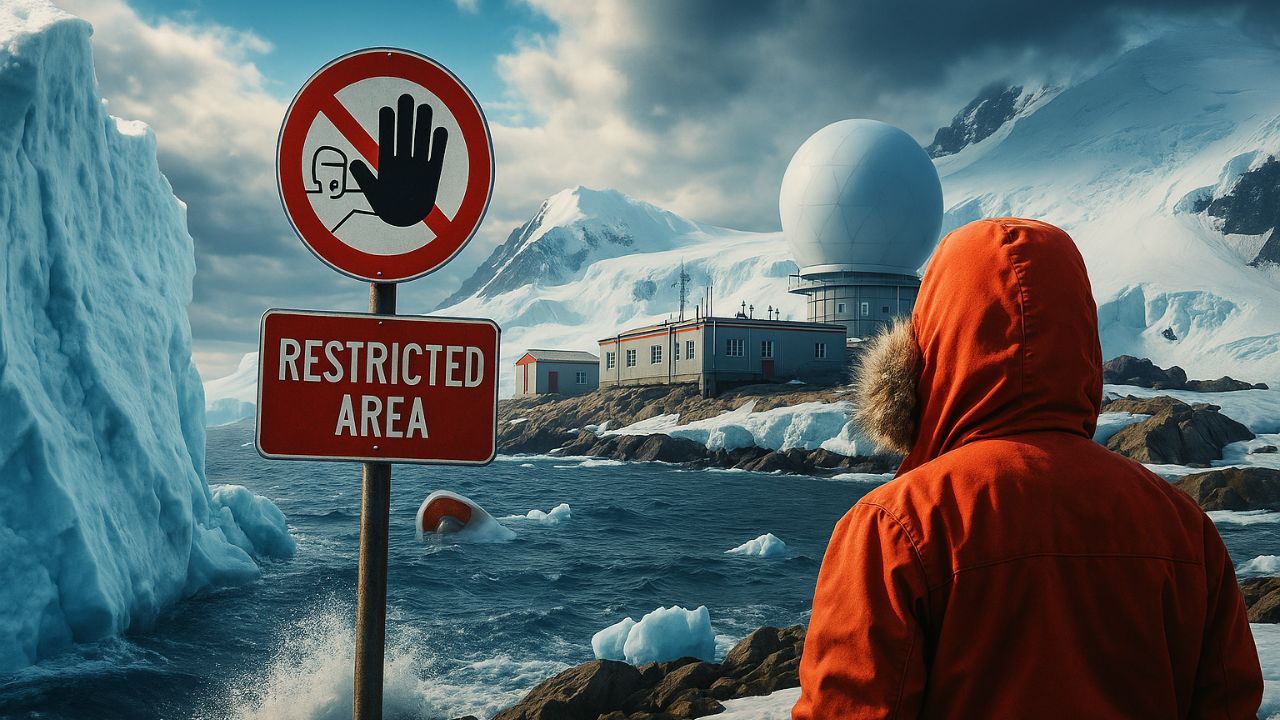


See The Hidden Secrets In The Ice And Understand Why It Is Impossible To Reach Antarctica, The Most Isolated And Protected Continent On The Planet.
If you’ve ever wanted to take a plane to see penguins up close, know that this journey is not simple. In fact, it is practically impossible to reach Antarctica without facing a series of barriers that go far beyond the extreme cold. Access to the continent is completely restricted, protected by laws, international treaties, and life-threatening risks that make the location one of the most isolated and monitored territories on the planet.
Unlike Europe or the Americas, Antarctica was the last continent visited by humanity, a fact that occurred only about 200 years ago. There are no native populations, cities, or a country that serves as a capital. What exists there is a hostile and controlled environment, where nobody lives permanently unless they are working on specific missions, making the human presence an exception and not the rule.
A Territory Without Owners And With Its Own Laws
Legally speaking, Antarctica does not belong to anyone. Thanks to the Antarctic Treaty signed in 1959, the continent has been reserved exclusively for international peace and scientific research. This means that mineral exploration is not allowed, the establishment of military bases, or the construction of urban infrastructures like shopping centers and commercial airports.
-
Top U.S. Bank Executive Fired After Dumping Trash on Street, Taking Bin Home, and Receiving Two Fines

-
Brazilian Man Arrested After FBI Alert on AI-Reported Plot to Harm Son and Attack Schools, Churches, and Officials
-
2,500-Year-Old Bronze Artifacts Unearthed by Detectorist in Eastern Poland

-
Over 5,000 Families Join Brazilian Network Providing 3D-Printed Prosthetics, Founded by Teacher Inspired by Daughter’s Limb Difference



Currently, the location functions as a super natural laboratory. Scientists take advantage of the extremely clean and dry air to study everything from polar ice melting to black holes and dark matter. However, to set foot there, government permission is required. The rules are so strict that they demand training, special clothing, and sterilization of equipment. In certain ecological areas, the preservation is so great that you cannot even sit on the ground.
Scientific Bases And The Structure In The Ice

Although it is difficult and almost impossible to reach Antarctica for regular tourism, the location hosts important bases. Brazil has a presence with the Comandante Ferraz Station, while the United States has the largest local structure, McMurdo Station. This American base includes a hospital, cafeterias, and even an ATM, but access remains restricted to those who have official authorization to work or research.
The Deadly Dangers Of Nature
Even with all the bureaucracy overcome, the environment tries to expel visitors. The cold is brutal, reaching as low as -90ºC in winter, but there are worse risks. The humidity is nearly zero, causing silent dehydration, and the katabatic winds descend from the mountains, reaching speeds of up to 300 km/h. At this speed, equipment and tents easily fly away.
Another terrifying phenomenon is the White Out, where the sky and ground become a uniform white, causing a person to lose all sense of direction. Moreover, the ground hides traps: ice fissures. Often covered by a thin layer of snow, these cracks can open beneath a person’s feet, leading them to fall into chasms up to 30 meters deep.
Theories, Mysteries And What May Be Hidden

The difficulty of access fuels many theories about what really happens there. The fact that it is almost impossible to reach Antarctica generates speculation about hidden secrets beneath the ice. Estimates suggest the existence of valuable resources, such as a reserve of over 500 billion barrels of oil and rare minerals, which would make the region one of the most valuable places in the world if exploration were allowed.
In addition to natural resources, popular imagination is fueled by conspiracy theories. Some say that there are secret Nazi bases since World War II, buried pyramids, or even entrances to the Hollow Earth. Scientifically, there is real concern about prehistoric viruses frozen for millennia, that could be released with the melting of the ice, causing new pandemics.
Antarctica Or Antártica?
To conclude, a common question: what is the correct name? In Portuguese, the correct term is Antártida. The word Antarctica is used in English or for commercial brands. The name has a curious origin in Greek etymology. Arctic comes from árctos, which means bear (a reference to the constellation Ursa Major in the north). Since there are no polar bears in the south, the continent received the prefix of negation, becoming anti-Arctic, or the place “without bears”.
Would you have the courage to face the cold of -90ºC and winds of 300 km/h to explore this mysterious continent?


