






 Portuguese
  Spanish
  3 min of reading
  0 comments


China Inaugurates Its First Third-Generation Nuclear Reactor, A Technological Innovation Capable Of Supplying Millions Of Homes With Clean And Efficient Energy.
Another technological milestone has been achieved by China. The Hualong One nuclear reactor, located at the Zhangzhou nuclear power plant in Fujian Province, has been connected to the power grid and successfully operated for 168 hours.
This Chinese achievement consolidates the country’s position as a leader in implementing third-generation nuclear reactors, a technology that is safer, more efficient, and more reliable than previous versions.
The Hualong One represents the evolution of the nuclear sector. While most power plants operating globally use second-generation reactors, the transition to third-generation is a strategic step to enhance safety and energy efficiency.
-
Humanoid Robot Climbs 6,263-Meter Volcano in Ecuador, Sets Sights on Everest Challenge

-
Physicist Harvests Water from Fog in the World’s Driest Desert, Turning Mountains into Water Traps

-
Wikipedia Blocks AI-Generated Edits, Citing Distrust in Automated Systems and Outlining Plans to Use Technology Without Losing Article Control
-
NASA Tests Rover with Lizard-Like Suspension and Independent Wheel Traction, Aiming for Speed Ten Times Faster than Perseverance on Mars




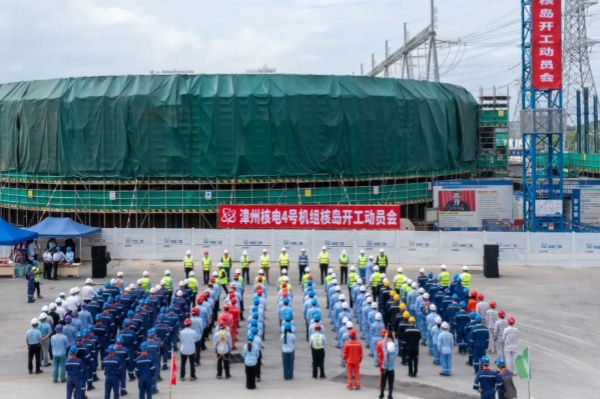
China, with over 30 Hualong reactors in operation or under construction, is at the forefront of this movement.
According to the China National Nuclear Corporation (CNNC), the number of Hualong One units in operation and under construction has reached 33, making it the most implemented third-generation nuclear technology in the world.
Clean Energy As A Strategic Goal
Since 2020, China has pursued an ambitious goal: achieving carbon neutrality by 2060. In this context, Hualong reactors play a crucial role in reducing dependence on fossil fuels like coal.
A single Hualong One reactor can reduce 8.16 million tons of CO₂ emissions and save 3.12 million tons of coal annually.
The Zhangzhou complex is very important for China. With a total of six reactors planned, it will be the largest Hualong One nuclear power base in the world.
Once fully operational, it will have the capacity to meet the electricity demand of approximately 6 million people.
The first reactor is already operational, and the second is expected to start operating in 2025. The project has a budget of US$ 14 billion, making it one of the most ambitious in the global nuclear sector.
The ownership of the project is divided between the CNNC, which holds a 51% stake, and China Guodian Corporation, with 49%.

Comparison With The United States
Although China has made significant advancements, the United States still leads in nuclear energy production. In 2023, the U.S. generated over 779,000 gigawatt-hours (GWh) of nuclear electricity, almost double China’s production during the same period, which was 406,484 GWh.
In terms of infrastructure, the U.S. has 94 operational reactors, while China has 56.
However, most American reactors were built between 1970 and 1990, which means many are still using second-generation technologies.
In contrast, Japan was the first to inaugurate a third-generation reactor in 1996, marking the beginning of this technological evolution.
In China’s case, the CNNC states that 33 of the reactors in operation or under construction use Hualong One technology.
Some of these reactors are located outside the country, such as in Pakistan. This reflects China’s strategy of not only expanding its internal capacity but also exporting advanced technology.
Chinese Nuclear Reactor — Global Impact And Future Perspectives
China’s advancement in the nuclear sector not only strengthens its position as a technological powerhouse but also signals changes in the global energy landscape.
The transition to safer and cleaner technologies is a priority for many countries, and the Chinese example may serve as a model.
The expansion of Hualong One reactors represents a concrete step towards sustainability. In addition to meeting the growing demand for energy, reducing carbon emissions reinforces the commitment to a more sustainable future.
While the United States still leads in total nuclear energy capacity, China is betting on the future with cutting-edge technologies.
The rapid deployment of third-generation reactors may eventually place the country in a global leadership position, both in innovation and installed capacity.
The connectivity of the first Hualong One reactor in Zhangzhou marks only the beginning of a broader and more ambitious project.
With continuous advancements, China demonstrates that it is ready to shape the future of nuclear energy.







-

-

4 people reacted to this.