






 Portuguese
  Spanish


Bold Experiment With Balloon And Silk Transformed Theory Into Practice And Changed The Human Relationship With Great Heights Forever
A high-risk scientific experiment marked the end of the 18th century and took a central place in the history of aviation.
On October 22, 1797, in Paris, André-Jacques Garnerin performed the first documented successful parachute jump, according to French historical records and scientific accounts of the time.
The feat occurred from a hydrogen balloon, at about 700 meters altitude, and practically inaugurated controlled free fall.
First Jump Proves Parachute Viability
Garnerin’s jump represented a break from centuries of only theoretical attempts.
Until then, inventors had proposed concepts, but none had demonstrated the actual functionality of the equipment.
The parachute used was made of silk, had no rigid structure, and no central opening for stabilization.
Still, the device reduced the speed of descent and allowed for a safe landing, even with strong oscillations during the fall.
This result confirmed, for the first time, that air could be used as an element of controlled lift.
Previous Experiments Existed Only On Paper
Before 1797, there were historical references to airborne descent projects.
Among them, stand out the sketches by Leonardo da Vinci, dated 1485, which described a pyramid-shaped device to slow descents.
However, unlike the French experiment, there is no record of actual jumps carried out by Leonardo or other earlier inventors.
Therefore, aviation historians consider Garnerin’s jump the first proven practical experiment.
-
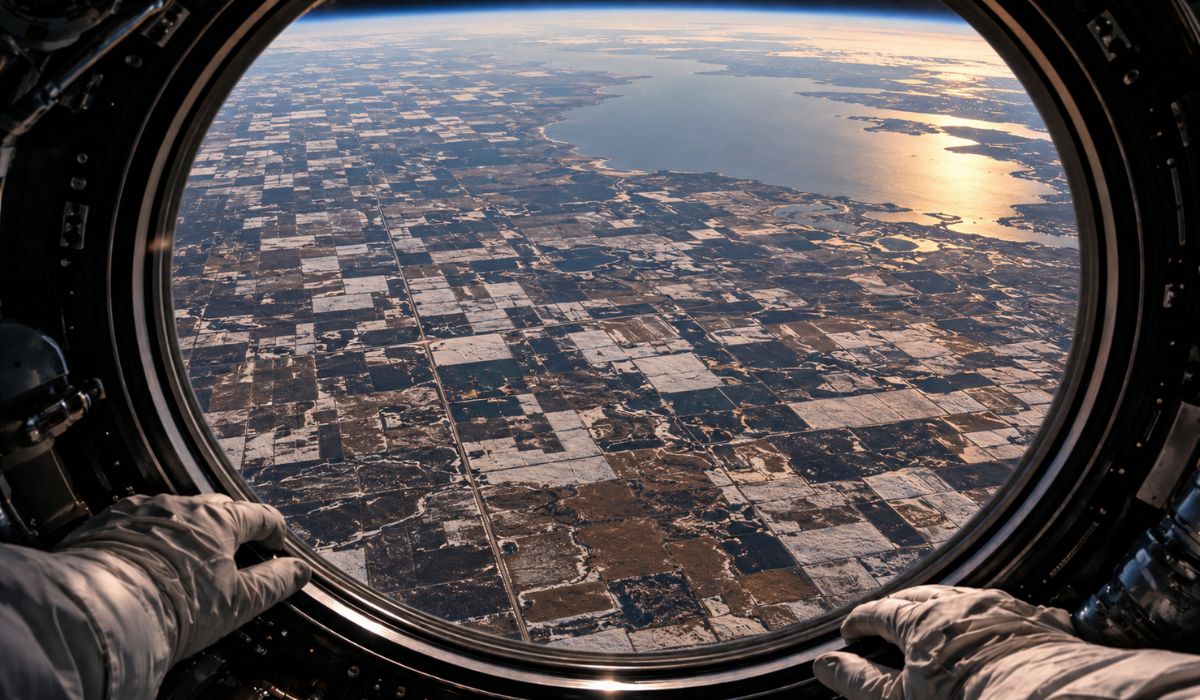
Seen from space, an astronaut captures in Canada a geometric carpet of crops drawn over the backdrop of a ghost lake that disappeared 12,000 years ago, was once larger than all the Great Lakes combined, and left a scar of fertile mud that still sustains agriculture.

-
Billionaire says the most valuable skill will help overcome job elimination caused by AI, following Bill Gates’ fears

-
A Dutchman created a ‘box’ that makes trees grow in the desert almost without water and without irrigation: the invention has already brought seedlings to dozens of countries and achieves up to 90% survival where common planting did not exceed 10%.

-
Abandoned warehouse hid a giant collection of rare computers, with over 2,000 artifacts from the 1930s to the 1980s.



Public Demonstrations Expand Historical Impact
After the initial success, Garnerin began to perform new public jumps in the early 19th century, in different cities across Europe.
These presentations reinforced the credibility of the parachute and expanded scientific interest in the subject.
In 1802, the advancement reached a new historical milestone when Jeanne-Geneviève Garnerin, his wife, became one of the first women to parachute, according to French records.
This movement consolidated parachuting as a functional technique and not just an experimental curiosity.
From Scientific Curiosity To Practical Use
As decades passed, the parachute ceased to be just a scientific spectacle.
In the 20th century, it began to be incorporated into military operations, rescue missions, and aerial training, according to records from European aviation museums.
Later, the technology also became the basis for adventure sports, broadening its social reach.
Despite the evolution of materials and stability systems, the central principle remained unchanged.
Technical Legacy Crosses Centuries
Today, parachutes use synthetic fabrics, ventilation systems, and automatic opening mechanisms.
Even so, the fundamental concept remains the same as tested in 1797: controlling air resistance to reduce the speed of descent.
This technical legacy directly connects modern equipment to the experiment conducted in the 18th-century Parisian balloon.
The Jump That Redefined Human Limits
By gathering dates, historical records, and nominal sources of European aviation, it becomes evident that André-Jacques Garnerin was the first person to successfully parachute in 1797.
The episode not only proved the viability of the equipment but also redefined the human relationship with height and risk.
In light of such a simple yet bold experiment, how many of today’s technologies still rely on the courage to turn ideas into real action?




