Portuguese
  Spanish


The American bet on disposable drones indicates a change in the way of planning wars, combining large-scale production, public procurement, military training, and technological competition around small and lethal aircraft.
The Pentagon has started treating small drones as mass-use items in the United States’ military planning.
The Drone Dominance program foresees industrial-scale purchases, focusing on one-way attack unmanned aircraft, reduced unit cost, and accelerated delivery to combat units.
In the first public formulation of the plan, the Department of War mentioned about 340,000 units in two years; in parallel, the US Army reported that it intends to reach 1 million drones in a period of two to three years.
-
U.S. Air Force Launches Air-to-Air Missile Project with Range of Up to 1,850 km for Indo-Pacific Operations

-
Australia to Deploy Up to 8 Nuclear-Powered Submarines in Indo-Pacific, Establishes Billion-Dollar Naval Chain Through AUKUS, Joining Elite Group Capable of Extended Underwater Missions

-
Indonesia Begins Construction of 2,000-Ton Scorpène Stealth Submarines with Advanced Weaponry and French Steel

-
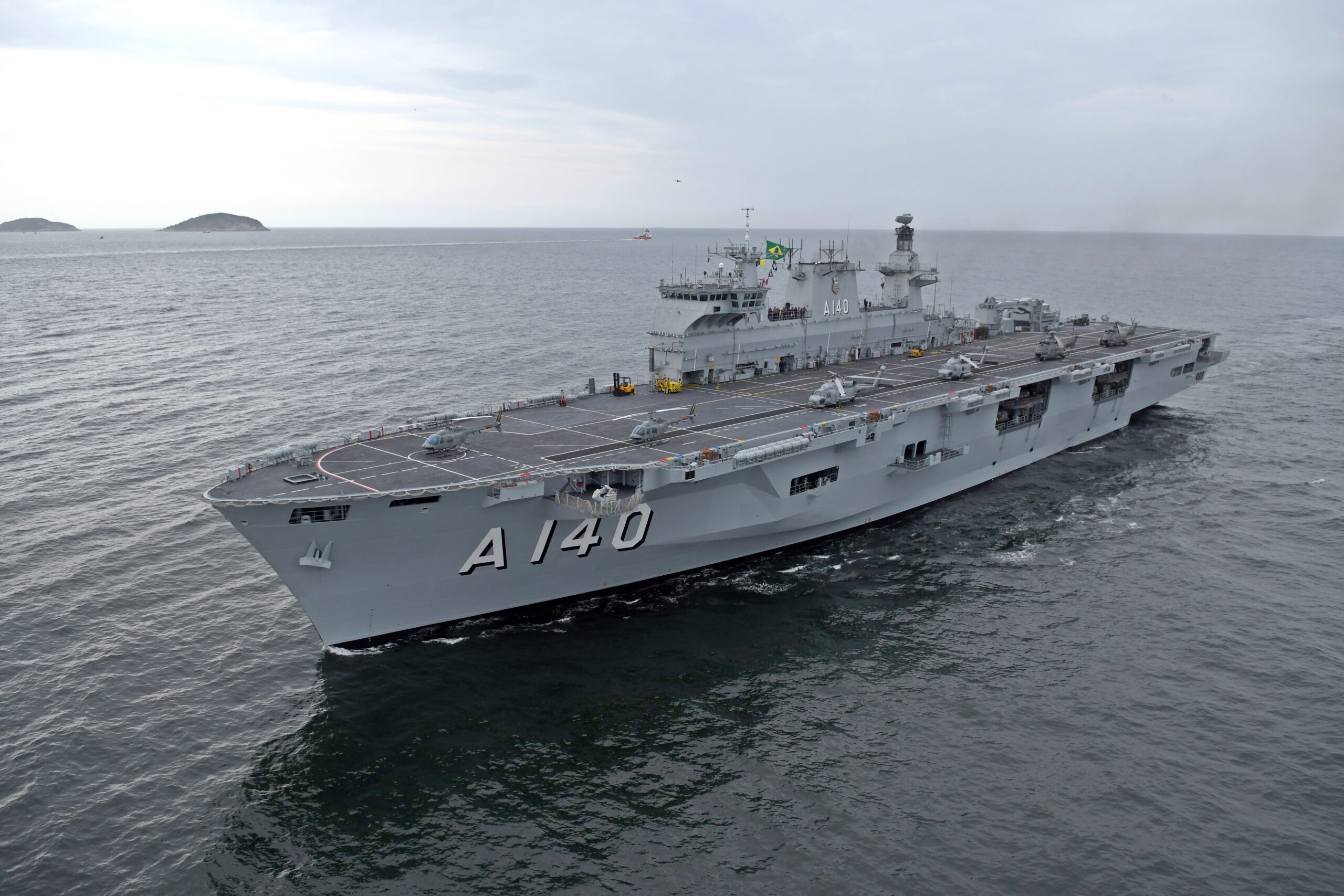
Brazil’s Largest Navy Ship, NAM Atlântico, Transforms into Field Hospital During National Crises




The strategy is linked to the American government’s attempt to expand the drone industrial base within the country and reduce dependence on expensive, low-scale production systems.
According to official documents, the goal is to place small, lethal, and quickly replaceable aircraft in the hands of troops, in a model closer to consumable munitions than traditional military platforms.
The executive order “Unleashing American Drone Dominance,” signed by Donald Trump on June 6, 2025, mandated the acceleration of the safe commercialization of drones, the integration of these systems into national airspace, the increase of domestic production, and the expansion of exports of trusted American technologies.
The text also guided federal agencies to reduce regulatory barriers for the sector.
Disposable drones change the military logic of the USA
For decades, military drones were associated with larger, high-cost platforms operated by specialized structures.
The new focus is on small unmanned aerial systems, known by the acronym UAS, which can be manufactured in greater quantities, transported by smaller units, and adapted to different missions on the battlefield.
This change accompanies advances in compact electric motors, batteries, lightweight cameras, sensors, and navigation software.
With these components, small aircraft have come to be used in tasks that include reconnaissance, limited precision attacks, and direct impact missions against military targets.
The assessment appears in documents from the Department of War itself, which attributes the recent technological evolution to the expansion of the role of drones in current conflicts.
In the memorandum “Unleashing U.S. Military Drone Dominance”, dated July 10, 2025, Pete Hegseth stated that drones are “the greatest innovation on the battlefield in a generation.”
The document also states that American units were still not equipped with the small lethal drones required by the combat scenario described by the U.S. government.
The war in Ukraine appears as a recurring reference in American military discussions.
In material presented to the Senate Armed Services Committee, Owen West, nominated to head the research and engineering area of the Department of Defense, stated that small one-way attack drones have come to account for a large part of the casualties in the conflict.
The statement was used in the document to advocate for changes in how the U.S. buys, tests, and distributes this type of equipment.
How the Drone Dominance plan works
The request sent to the American industry structured the program in four stages, called “gauntlets.”
In these, manufacturers present solutions that are evaluated by military operators before possible orders.
In the first phase, the forecast was to select 12 suppliers to produce, together, 30,000 drones at a cost of $5,000 per unit, in a purchase estimated at $150 million.
In the following phases, the design presented by the Department of War foresaw a reduction in the number of suppliers and an increase in the volume of drones purchased.
The goal indicated in the initial communication was to reach a stage with 150,000 units and a price around $2,300 per drone.
According to the Pentagon, regular and predictable purchases would act as a demand signal for private companies to invest in production lines, components, and supply chains in the United States.
Hegseth stated that the Drone Dominance program should “reduce costs and elevate capabilities.”
In another statement, he said that the U.S. “cannot afford to shoot down cheap drones with $2 million missiles” and that they need to make large quantities of attack drones available to the armed forces.
The statements were released by the Department of War when presenting the initiative.
The program was described by the government as a $1 billion effort to purchase small and lethal drones in two years.
The public schedule cited by the Department of War indicated the start of competitions in 2026 and the delivery of tens of thousands of drones in the first year, with an expansion of quantities in 2027.
There is a difference between the numbers disclosed at different times.
The initial communication mentioned approximately 340,000 small UAS over two years.
In a later publication, the War Department began to speak of about 300,000 drones for the force by 2027, following the selection of 25 suppliers announced in February 2026.
American Army aims for a fleet of 1 million drones
At the same time, the American Army began discussing its own expansion.
The Secretary of the Army, Daniel Driscoll, told Reuters that the force intends to purchase at least 1 million drones in two to three years.
According to the agency, the current volume is about 50,000 units per year, indicating a significant increase in the acquisition rate.
The Army’s initiative was associated with the SkyFoundry program, described by a force spokesperson as a public-private partnership to stimulate the American industrial base, expand access to critical materials, produce lower-cost components, and deliver drones for immediate needs.
The information was published by Breaking Defense, a media outlet specializing in military coverage.
Driscoll described the goal as a large but achievable task, in a statement reproduced by specialized media.
The mentioned scale involves more than just the assembly of the aircraft: it includes engines, batteries, sensors, chips, explosives, communication systems, production lines, trained operators, employment doctrine, and safety rules for handling and storage.
At the center of this change is the classification of drones as consumable items.
When a single-use attack aircraft is treated as ammunition, it becomes dependent on production volume, quick replacement, and cost compatible with frequent use.
This is the logic described by Driscoll to Reuters in advocating that drones should not be seen only as high-value military assets.
Drone production exposes industrial and operational challenge
American policy also seeks to reduce dependence on foreign components.
Government documents and statements cited in Senate hearings indicate concern with engines, batteries, sensors, and critical materials used in drone manufacturing.
The official guidance is to strengthen national suppliers and prioritize equipment that meets U.S. defense legislation requirements.
This point is directly related to replenishment in prolonged conflicts.
Small drones can be shot down, suffer electronic interference, lose signal, or be destroyed upon impact with the target.
Therefore, American military authorities have advocated that stockpiling, maintenance, and rapid replacement should be treated as part of operational planning, not just as a stage of equipment purchase.
The training of the troops is also part of the program.
Hegseth stated that he expects to see drone capabilities integrated into combat exercises, including simulations of confrontations between forces equipped with unmanned aircraft.
The July 2025 memorandum also transferred more authority to unit commanders to accelerate the adoption of these systems.
In practice, the strategy changes how the U.S. plans to purchase and use small unmanned aircraft.
Instead of relying solely on sophisticated and long-lasting platforms, the Pentagon has started to combine bulk purchases, supplier competition, domestic production, and training focused on scenarios with interference, equipment loss, and the need for constant replacement.
The adoption of disposable drones still depends on budget, suppliers, testing, operational security, and integration with military doctrine.