Portuguese
  Spanish




Rare Fossil Found Alongside Ceramics and Coins, With Wear Marks Indicating Symbolic Use in Domestic Rituals of Ancient Rome
Researchers Made an Uncommon Discovery at the Roman archaeological site of “The Cibdá of Armea,” located near the city of Ourense in Spain. During excavations at the site, a fossilized trilobite was found among remains of ceramics, coins, and animal bones. The fossil, about 4 centimeters long, may have been used as jewelry or amulet between the 1st and 3rd centuries AD.
Trilobites are extinct marine animals that lived between 520 and 250 million years ago. They were arthropods, with segmented bodies and a beetle-like appearance.
Despite being well-known to modern science, with over 22,000 described species, fossils of this type in archaeological contexts are extremely rare.
-
Sixth-grader in Miami wins Lemelson Young Inventor Prize for creating water-absorbing concrete using discarded oyster shells and charcoal.

-
Brazilian Researchers Develop Portable, Painless, Radiation-Free Breast Cancer Tracker Using Microwaves, Costing Around $200 and Potentially Replacing $240,000 Mammograms
-
Beer as a Vaccine? Scientist Develops Experimental Method with Live Yeasts, Tests Own Brew, and Publishes Results on Zenodo

-
Brazilian Researchers Develop ‘Rapha’ Device Using Natural Latex and LED Light to Heal Diabetic Foot Ulcers and Prevent 50,000 Annual Amputations


According to the magazine La Brújula Verde, this is the first trilobite found at a site of the Roman Empire.
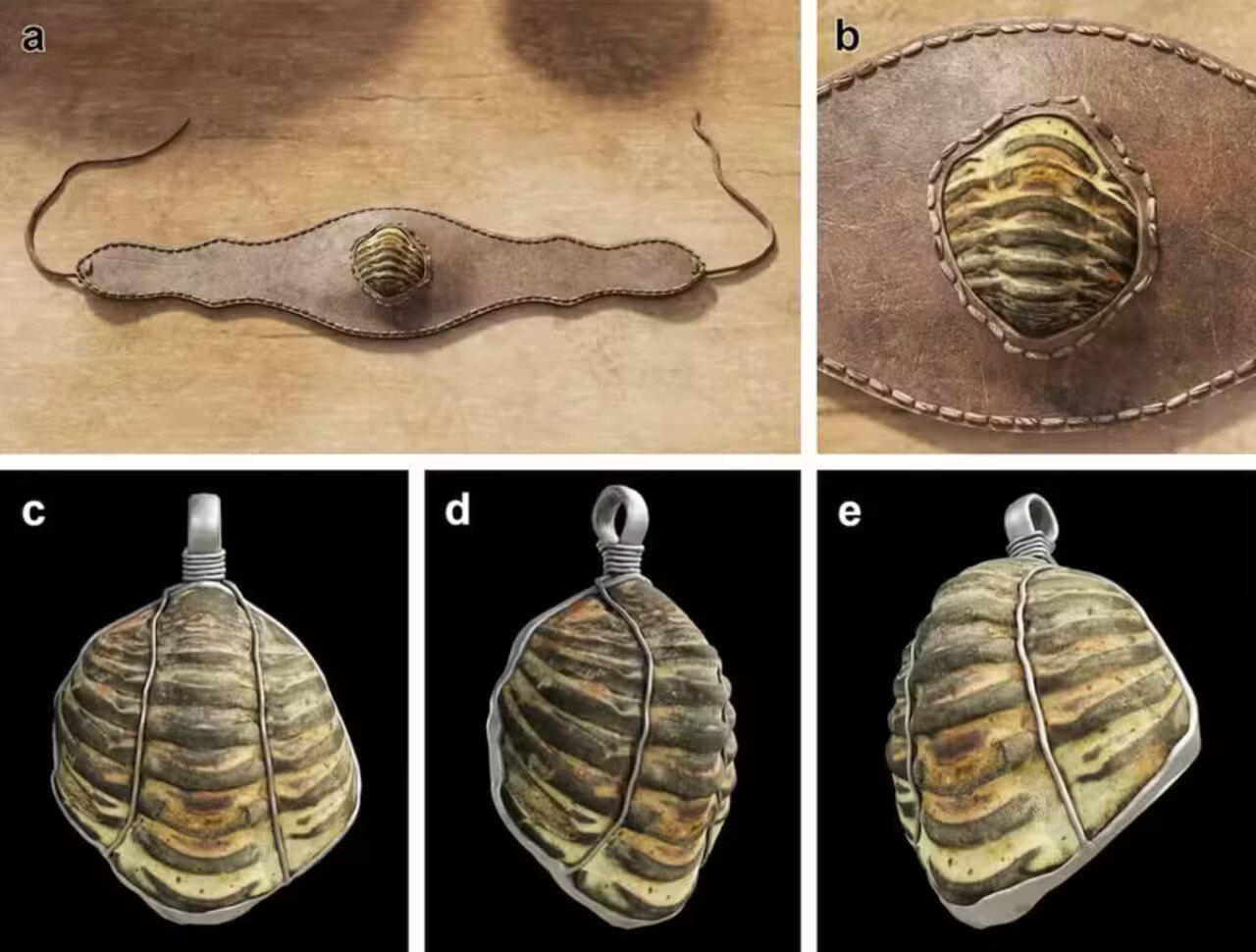
Worldwide, only 11 specimens linked to ancient cultures are known. The item found in Armea stands out for having seven artificial wear marks, located on its underside, indicating that it was adapted for use as a pendant or bracelet.
The article describing the find was published on July 15 in the journal Archaeological and Anthropological Sciences.
The research team concluded that the trilobite belongs to the genus Colpocoryphe sp. and lived during the Ordovician period, about 450 million years ago.
The reddish coloration and fossilization in iron oxide suggest that the fossil did not originate from Galicia, but rather from the central-southern Iberian Peninsula.
Possible origins include regions such as Toledo, Ciudad Real, or Badajoz, over 430 kilometers from Armea.
For researchers, the transportation of this object to the site may be linked to ancient trade routes of the Roman Empire, especially the Silver Way.
This route connected important cities of the time, such as Mérida (Emerita Augusta) and Astorga (Asturica Augusta).
“The trilobite may have traveled with metals and other goods as a unique and exclusive object, valued in Galicia for its protective and healing properties,” states the study.
Another hypothesis is that a visitor from the region of Lusitania brought the fossil, attracted by the mining in the area where it was found.
In Ancient Rome, fossils were often considered mystical objects. Remains of large animals, for example, were associated with mythological creatures.
Fossilized invertebrates, such as trilobites, were regarded as protective amulets against supernatural forces. The team points out that the specimen from Armea likely served this function.
Marks on the base of the fossil suggest that it was attached to some support, like leather or metal, leaving its upper side visible.
The segmented shape and characteristic design may have helped reinforce its symbolic function. One possibility considered is that the item was part of a lararium, a domestic altar used in Roman houses for offerings and rituals.
This use is based on the inscription “MAXSIMVS” found alongside the object. The word may indicate that the site was a sacred space of a high-status house, where the fossil served as a spiritual symbol or protector of the family.
Additionally, researchers note that the shape of trilobites may have influenced a decorative piece typical of Ancient Rome: the necklace bead known as trilobitenperlen.
Made of black glass or jet, these beads mimicked the segmented appearance of the fossil and were popular among women and children.
Although none of these jewels were found in Armea, they reinforce the idea that the trilobite could have had a protective and symbolic role.
The find in Armea expands knowledge about the use of fossils in ancient times and shows how natural objects were repurposed with different meanings in the Roman world.
The presence of the fossil in a dump indicates that at some point, it lost its value or broke and was then discarded.
Still, it is one of the few trilobite specimens with evidence of human modification and symbolic use in a Roman archaeological context.
The discovery raises new questions about the trade of fossils and their spiritual value in different regions of the Empire.
With information from Revista Galileu.