






 Portuguese
  Spanish


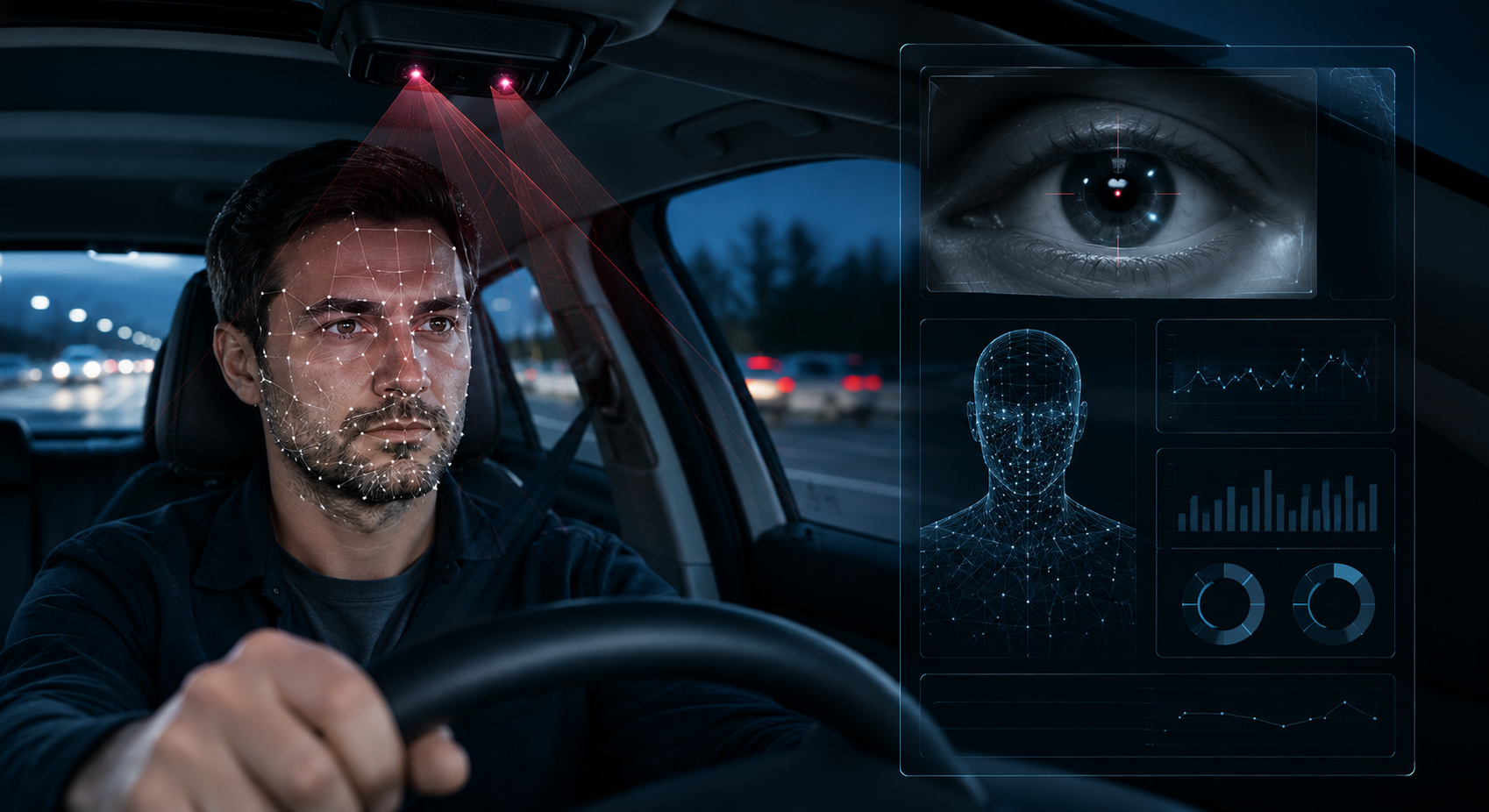
Infrared cameras, breath sensors, and embedded algorithms promise to detect drunkenness and drowsiness in new cars in real time.
According to the State of Surveillance, the Section 24220 of the Infrastructure Investment and Jobs Act of 2021, passed by the U.S. Congress and signed by President Joe Biden, requires the National Highway Traffic Safety Administration, the NHTSA, to finalize rules to mandate the installation of “advanced impaired driving prevention technology” in all new passenger vehicles sold in the United States. This is not a proposal under review: it is a federal law in effect since November 2021.
In practice, the rule provides for systems capable of passively monitoring the driver, detecting signs of drunkenness or drowsiness, and preventing or limiting vehicle operation when there is a risk. Among the technologies considered are infrared cameras installed on the steering column or A-pillar, capable of tracking eye movement, pupil dilation, and attention patterns in real time.
The problem appeared in the report sent by the NHTSA to Congress in March 2026: no available system currently meets the legal requirement for reliable operation. The agency pointed out unacceptable error rates, especially near the legal blood alcohol concentration limit of 0.08%.
-
In the World’s Most Densely Populated Desert, Families Dig Funnel-Shaped Underground Cisterns to Capture Rare Rainfall and Store Drinking Water for Up to Eight Months

-
Smart Glass Revolutionizes Privacy: Touch-Activated Opacity Transforms Windows into Connected Home Features with App and Voice Control

-
Young Innovators from Brazil Turn Discarded Plastic into Eco-Friendly Bricks Using Coconut Fiber, Offering a Sustainable Alternative for Construction
-
Brazilian Scientists Among Team Proposing to Turn Ocean Depths into Giant Gravity Battery Using Cargo Ships and Subsea Cranes




Anti-drunkenness technology in new cars may block sober drivers due to system error
The math that paralyzed the NHTSA is straightforward. Americans drive about 3 trillion miles a year in hundreds of millions of vehicles, and any small error becomes huge when applied to the entire national fleet.


Even a 99.9% accuracy, considered excellent for many artificial intelligence systems, would still produce millions of false positives and false negatives per year. On a national scale, “almost perfect” does not mean the absence of failures.
In practice, this could prevent sober drivers from leaving home, limit a car’s speed on the highway, or let drunken drivers pass. When the system decides on its own whether the car can operate, each error ceases to be a statistic and becomes a real risk for the user.
NHTSA points out unacceptable error rates near the legal blood alcohol limit
The most sensitive point is in the range close to the legal limit of 0.08% blood alcohol concentration. It is precisely there that the system would need to distinguish with extreme precision between a legally fit driver and a driver prohibited from driving.
The NHTSA report indicates that current technology does not yet offer sufficient reliability for this decision. Breath sensors, eye cameras, and behavior algorithms can confuse fatigue, illnesses, poor lighting, or individual variations with drunkenness.
The critical scenarios are simple: a sleepy driver after a shift, a diabetic person with low blood sugar, someone leaving an emergency or evacuating a fire area. The risk is turning ambiguous physiological signals into automatic vehicle blocking.
Infrared cameras in the car can collect driver’s biometric data in real time
The most concerning data from the law is not just the camera, but what it collects. The systems under evaluation can record eye movement, pupil dilation, time spent looking at the phone, attention patterns, drowsiness, and signs of possible impairment while driving.
In some projects, there are also breath sensors to analyze components of the air exhaled by the driver. This information is biometric and physiological data, more sensitive than many common navigation or automotive telemetry data.
The difference is that this data reveals bodily state in real time. The car stops measuring only speed, braking, and location, and starts monitoring how the driver looks, reacts, and behaves inside the cabin.
American law does not clearly define protection for biometric data collected by vehicles
Section 24220 requires the system to passively monitor driver performance and prevent or limit vehicle operation in case of impaired driving. It also mandates that the system operates without requiring direct action from the driver, such as blowing into a breathalyzer.
What the law does not clearly define are privacy protections. The text does not prohibit data sharing with third parties, does not establish detailed storage rules, does not create an explicit right to disable, and does not mandate transparency about record retention.
This gap worries digital defense groups. A vehicle safety mandate could end up creating a national infrastructure of continuous biometric collection without equivalent data governance rules.
Automakers’ history with data sales increases distrust about vehicle surveillance
The concern does not arise in a vacuum. General Motors was prohibited by the FTC, in January 2025, from selling customer driving data after being identified as passing on acceleration, braking, and GPS information to companies like LexisNexis and Verisk.
These companies passed data to insurers, who could increase premiums without the driver clearly understanding the origin of the assessment. The case showed that modern vehicles already function as data collection platforms.
According to a CNN investigation cited in the base text, 90% of new cars already track direction every 3 seconds, and manufacturers can earn up to US$ 100 per vehicle per year by selling this data. With biometrics, the commercial value and risk of abuse increase.
Impaired driving law does not provide a clear option for the driver to disable the system
Another critical point is the absence of opt-out. The law, as written, does not include a clear rule allowing the driver to disable the biometric monitoring system.
It is also not defined whether manufacturers will be able to create options for partial or total shutdown. This will depend on the final rule from the NHTSA, which has not yet been completed after the original deadline of November 2024 was missed.
The Center for Democracy and Technology submitted formal comments calling for strict data collection limits. So far, however, no final protection has been consolidated, while the implementation schedule continues to advance.
Traffic safety supports the backing of entities against drunk driving
The safety argument behind the law is strong. The NHTSA estimates that the technology could prevent between 9,000 and 10,000 deaths per year in the United States, mainly by reducing drunk and drowsy driving.
In 2021, more than 13,000 people died in accidents involving drunk drivers, almost a third of traffic deaths in America. Alcohol-related collisions cost the United States economy about US$ 280 billion annually.
The organization Mothers Against Drunk Driving, MADD, was one of the main advocates of the law. For the group, if the technology saves thousands of lives per year, privacy issues need to be resolved without delaying road protection.
New cars from 2027 may come from the factory with mandatory biometric monitoring
The rule is not expected to affect cars already on the road. The requirement applies only to new vehicles manufactured after the final NHTSA rule takes effect, creating a division between pre-rule and post-rule cars.
Buyers of new cars from 2027 may be acquiring vehicles with continuous biometric monitoring and no clear option to refuse. Those who do not want this system may need to buy a used car or keep their current vehicle longer.
Analysts cited in the base text already anticipate an impact on the used car market. Vehicles prior to implementation may maintain higher value among buyers concerned with privacy, as they are the last generation without mandatory surveillance.
Remote updates may expand surveillance inside vehicles after purchase
Modern vehicle technology is increasingly defined by software. This means that automakers can enhance capabilities after the sale through over-the-air updates, without changing hardware.
A car purchased with eye monitoring in 2027 could receive, years later, additional functions for analyzing breathing, voice, or behavior, if the hardware is already installed and the automaker enables new features through software.
This model is common in smartphones and connected cars, but it takes on a different dimension when it involves biometrics. The function initially installed for safety can become an expandable platform for data collection within the vehicle.
Brazil does not yet have an equivalent rule, but should follow the global debate on vehicle privacy
The American mandate does not yet have a direct equivalent in Brazil. Even so, the global regulatory movement is heading towards more driver monitoring in the name of safety.
Europe is advancing with GSR2, which requires monitoring systems as part of new vehicle safety regulations. Brazil usually follows European rules with a delay, indicating that the debate should reach the country in the coming years.
The central question is not just whether cameras save lives. It is who controls the data, who accesses the information, how long it is stored, and whether insurers, employers, authorities, or third parties will be able to use it.


Be the first to react!