Portuguese
  Spanish


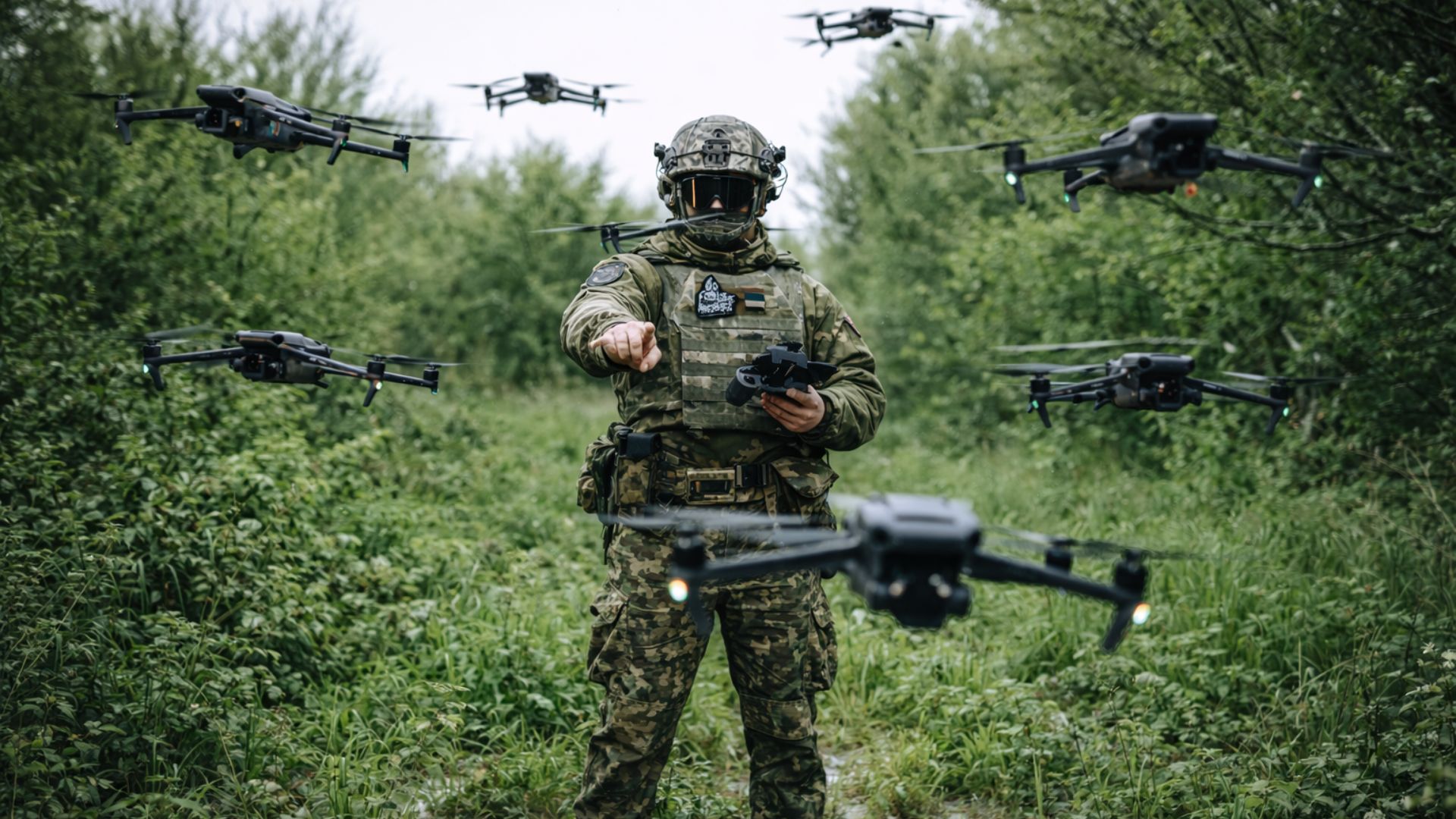

Accelerated advancement of drones with artificial intelligence redefines military strategies, expands operational range, and reduces soldier exposure in the field, while Russia and Ukraine compete for technological dominance with autonomous systems, coordinated swarms, and long-distance remote control in a rapidly transforming scenario.
The drone war in Ukraine has entered a phase where technological advantage depends less on an isolated device and more on the ability to coordinate large numbers of systems simultaneously.
In this scenario, Russia has begun to promote the Orbita, a system that, according to its developers, allows the operation of FPV drones hundreds of kilometers from the front line, with the support of artificial intelligence to identify and track targets, reducing the direct exposure of military pilots.
The central promise of the project is to move the operator away from the battlefield.
-
ChatGPT Creator Bets Big on Fusion Energy Machine Promising Unlimited Power for Microsoft by 2028, But Physicists Skeptical

-
Time Travel Proven Possible by Science, Yet a Mystery Still Challenges Einstein, Quantum Physics, and Top Scientists

-
Pennsylvania Mine Creates Ice in Summer Heat and Melts in Winter, Turning a Mountain Crevice into a Reverse Natural Refrigerator
-
China Accelerates Global Expansion of Robotics: From Smart Vacuums to Industrial and Humanoid Machines, Millions Exported to Over 150 Markets



Instead of remaining in makeshift shelters near the front, subject to artillery, electronic interception, and attacks from rival drones, they would operate from more protected command centers, while soldiers closer to the front would simply launch the devices.
Therefore, the idea of “invisibility” attributed to the system does not refer to physical camouflage, but to the removal of these operators from the immediate risk zone.
This movement occurs at a time when different actors in the war are accelerating the incorporation of autonomy, coordination software, and AI-assisted navigation tools.
In the later stages of the conflict, the discussion has shifted from focusing solely on range, explosive payload, and cost per unit.
The focus has shifted to the combination of mass production, rapid adaptation, and the ability to maintain attacks even under electronic interference.
Swarm war and intelligent drone coordination
The concept gaining traction is not that of a “more advanced” drone acting alone, but of multiple drones operating as a collective.
In such systems, the devices share data, divide functions during the mission, and can reorganize trajectories when obstacles, signal blockages, or changes in enemy defense arise.
In practice, this reduces the human workload and increases pressure on radars, missiles, and anti-aircraft weapons.
The company Auterion presented the Nemyx in September 2025, described as a coordination engine for swarms capable of integrating drones from different manufacturers into a single operation.
Shortly before, in July 2025, the company also announced a Pentagon-backed contract to deliver 33,000 attack kits with AI capabilities to Ukraine.
These systems have been publicized as tools to enhance precision, resistance to interference, and the ability to engage multiple targets.
At the same time, companies linked to the Ukrainian effort have begun to publicly advocate for a doctrine based on collaboration between platforms.
Swarmer claims that its collaborative autonomy software has already been employed in tens of thousands of operations, while Ukraine has opened controlled access to battlefield data for partners to train AI models applied to drones.
The value of this material lies in the volume of real combat images and videos, useful for training visual recognition, navigation, and threat identification.
The change, therefore, is not just industrial. It is a transformation in operational logic.
Instead of relying solely on the pilot to conduct every second of the flight, these systems take over part of the navigation, route selection, and target tracking, leaving the operator with the role of supervision and authorization in the most sensitive stages.
Orbita and the remote control of drones at long distances
It was in this environment that Orbita emerged.
Specialized reports published in 2025 indicate that the system was developed within the CUST ecosystem, an acronym for the Center for Unmanned Systems and Technologies, a structure created to bridge rapid innovation and battlefield demands.
According to this information, the Russian proposal is to unite FPV drones, signal retransmission, and algorithmic support software to enable remote control at long distances.
In demonstrations released by sources linked to the sector, one of the tests reportedly connected an operator in Tula to a drone in flight in the Mariupol region, which fueled the narrative of control hundreds of kilometers away.
Orbita has also been attributed functions for target recognition using neural networks and a drastic reduction in training time, from four weeks to about one hour.
However, these numbers circulate mainly from the developers themselves and analyses from specialized press, without broad independent confirmation.
Still, even with caution regarding the real extent of these promises, the concept is relevant.
If the system can maintain a stable link, reliable retransmission, and automated visual support during real missions, Russia will reduce one of its most well-known vulnerabilities in the use of FPV drones.
Mass production and evolution of Russian drones
Orbita did not emerge in isolation. CUST had already been associated with the Skvorets family of drones, short-range FPV devices used in offensive and reconnaissance missions.
Analyses published in 2025 describe versions with thermal cameras, reusable observation models, and variants with automated target locking features.
There are also references to a naval model, a sign that the intended architecture goes beyond immediate land use.
This history helps explain why Russia is trying to present the Orbita as a leap in systems, and not just as another drone.
The ambition is to connect vectors, relays, and operators in a structure that preserves the scale of use without exposing the most trained personnel.
In September 2025, specialized reports indicated that the ecosystem linked to CUST was already claiming the delivery of more than 30,000 drones to the front by the end of 2024.
Ukrainian Advantage with Data and Artificial Intelligence
The Ukrainian response relies on another advantage.
The country has concentrated a huge volume of operational images captured by drones throughout the war and transformed part of this collection into input for training models.
In March 2026, the Ukrainian government announced the opening of access to secure combat data bases for allies to develop AI solutions.
The declared intention was to accelerate autonomy software and make unmanned systems more effective in intense electronic warfare environments.
This strategy adds to a more open structure of integration between platforms and suppliers.
Instead of relying on long adaptation cycles, companies and units try to incorporate hardware and software in weeks.
The result is an ecosystem where corrections, adjustments, and new functions can be put into use faster than in traditional defense industry models.
In practice, the comparison between the two sides is not limited to who manufactures more drones.
It involves who can transform production into coordinated capacity, resistance to blockades, and distributed decision-making power.
Military Automation and Limits of Human Control
This advancement pressures a debate that goes beyond military effectiveness. As drones begin to adjust routes, choose attack windows, and maintain visual pursuit with reduced human intervention, the line between assisted automation and lethal autonomy becomes narrower.
Western companies operating alongside Ukraine often claim that the final decision on engagement remains under human control.
In the Russian case, however, descriptions of the Orbita suggest an increasingly supervisory role for the operator.
The direct consequence is a war where physical human presence at the point of contact tends to decrease, while the importance of remote command centers, data links, and software capable of reacting in seconds grows.
In this environment, the operator who previously needed to launch and manually guide an FPV close to the enemy may become just a layer of validation within a much more automated chain.