






 Portuguese
  Spanish


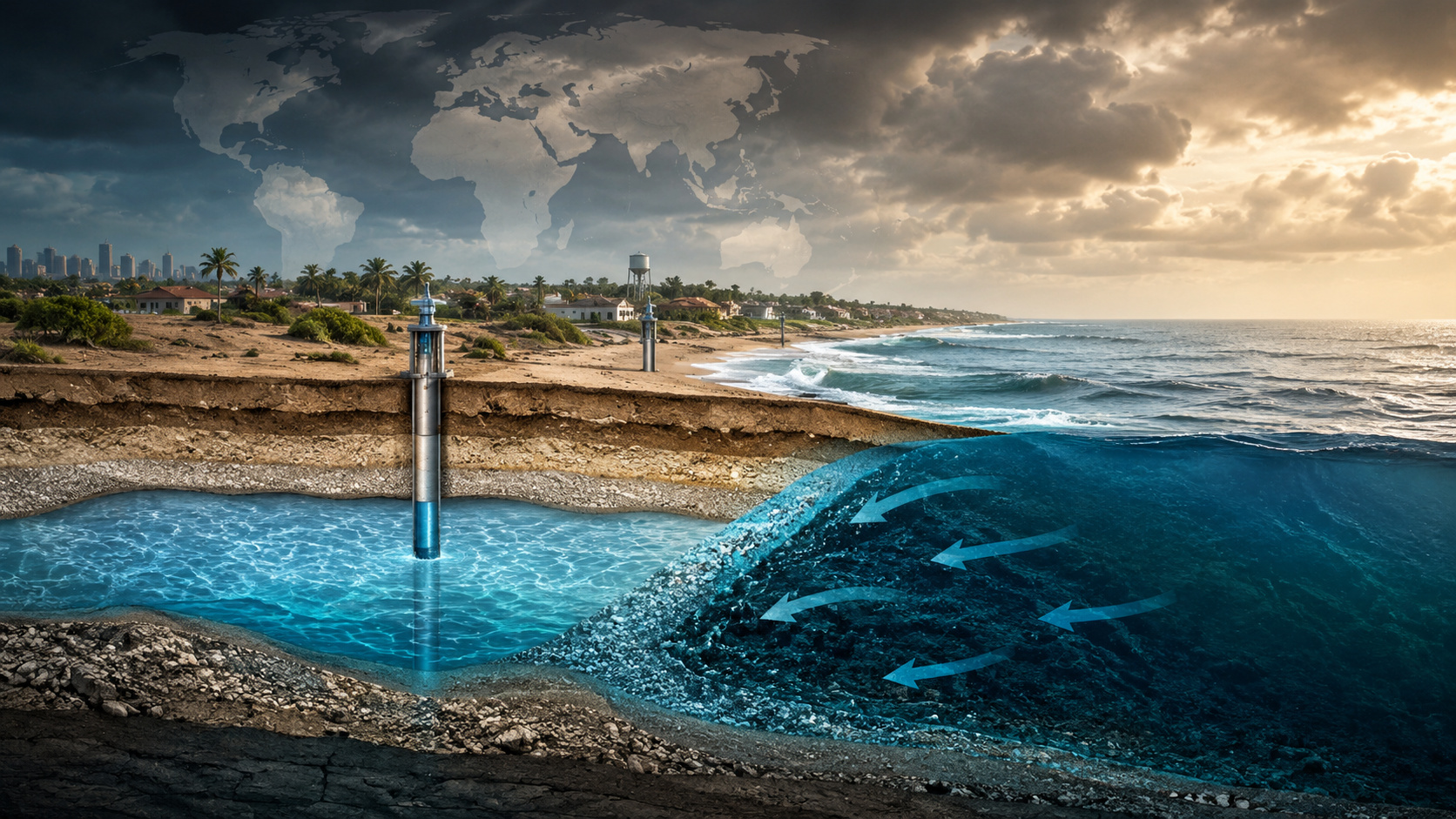

Global study reveals invisible advance of saltwater into coastal aquifers and raises alert for underground freshwater reserves.
On April 14, 2026, a study published in the scientific journal Nature Water revealed a subterranean risk advancing unseen by the population, but which could affect human supply, agriculture, and coastal cities: the increased vulnerability of coastal aquifers to saltwater intrusion. The research, led by Annika Nolte and Robert Reinecke, analyzed data from approximately 480,000 coastal monitoring sites between 1990 and 2024 and indicated that coastal areas in different parts of the world already show significant changes in groundwater levels.
The problem is silent because it doesn’t appear as a traditional flood. When excessive extraction reduces the level of freshwater underground and sea levels continue to rise, saltwater can advance into aquifers, slowly altering reserves used for consumption, irrigation, and urban supply.
According to the University of Mainz, in a statement on April 14, 2026, more than 20% of the analyzed coastal areas showed significant changes in groundwater levels, and in some cases, drops exceeded 50 centimeters per year, a sign of pressure that can favor salinization even before the population perceives the risk.
-
A Brazilian city decided to purchase a piece of the Atlantic Forest with more than 153,000 square meters, and owners of preserved areas will be able to submit proposals to transform the forest into a conservation unit.

-
Brazilian siblings aged 11 and 7 read 240 books in just one year and caught attention on social media: while many children spend hours on screens, they turned their family’s routine into an example of reading, discipline, and curiosity.
-
The legendary oak that, according to the story, hid Robin Hood from the Sheriff of Nottingham, died at the impressive age of 1,200 years in England, and the first chilling sign of its end was that no leaves sprouted on the tree this spring.

-
While the world looks at forests, the UN warns that the Earth is also threatened by the silent degradation of natural grasslands and savannas, ecosystems that cover half of the planet, support billions of people, and can exacerbate water, food, and climate crises.


Study analyzed almost half a million underground points in coastal regions
The research gathered an extremely broad global database of hydrological data. Scientists evaluated approximately 480,000 groundwater monitoring points in coastal areas around the world.
The goal was to understand how subterranean salinity is changing in different regions. According to the authors, this is one of the largest surveys ever conducted on saline intrusion in coastal aquifers.
The scale of the analysis allowed for the identification of global trends invisible in isolated local studies, revealing that the problem occurs on multiple continents simultaneously.
Saline intrusion happens slowly and often goes unnoticed
Unlike a visible coastal flood, saline intrusion occurs underground and gradually.
When the balance between fresh and saltwater is altered, the ocean slowly begins to penetrate aquifers near the coast.

This advance can take years or decades to reach wells, irrigation systems, or urban supply networks. In many cases, residents only notice the problem when the water already has a salty taste or significant chemical alteration.
This makes saline intrusion one of the most silent and difficult environmental processes to detect early.
Excessive groundwater withdrawal increases coastal vulnerability
One of the main factors identified by the study is the intense exploitation of groundwater. When cities, agriculture, or industries pump large volumes of freshwater, aquifer levels drop.
This lowering reduces the natural pressure that helps prevent seawater from advancing into the underground interior.


With less freshwater pushing towards the ocean, saltwater can slowly advance through coastal sediments. In practice, human consumption itself can accelerate subterranean saline invasion.
Sea level rise also increases pressure on aquifers
In addition to excessive pumping, rising sea levels appear as another important factor. As the ocean rises, hydraulic pressure on low-lying coastal regions increases.
This facilitates the infiltration of saltwater into shallow aquifers and underground systems connected to the coast. In very flat areas, small changes in level can produce significant impacts over time.
The problem becomes even more complex because it simultaneously involves climate change, urbanization, and water management.
Agriculture can suffer severe impacts from subterranean salinization
Coastal aquifers supply enormous agricultural areas in different countries. When salinity increases, groundwater can become unsuitable for irrigating various crops.
Furthermore, salt accumulated in the soil reduces agricultural productivity and alters the chemical characteristics of the land. In some cases, entire cultivable areas can lose efficiency over time due to saline contamination.
This means that sea intrusion not only threatens coastal cities but also food security in various regions of the planet.
Coastal cities depend heavily on subterranean aquifers
Many metropolises near the coast partially depend on groundwater for supply. This includes cities in arid regions, islands, and areas where surface reservoirs are limited. When coastal aquifers begin to salinize, the cost of water treatment increases dramatically.
In extreme situations, entire wells can be abandoned. The study shows that part of the world’s water infrastructure may be more vulnerable than previously imagined.
Aquifers function as gigantic invisible reservoirs beneath the soil
A large part of the population does not perceive the dimension of aquifers because they remain hidden underground. These systems store water in microscopic spaces between sediments, rocks, and geological formations.

In several regions, they represent the main strategic reserve of fresh water during prolonged droughts. The problem is that, once contaminated by salinity, many aquifers take decades or even centuries to recover naturally.
This transforms saline intrusion into a potentially lasting threat to future supply.
Some regions already face detectable saline advance
Although the study has a global character, different coastal regions already report known problems of subterranean salinization.
Densely populated countries and coastal agricultural areas appear among the most sensitive cases. In certain regions, scientists already detect a continuous increase in salinity in wells monitored for decades.
Furthermore, extreme events such as prolonged droughts can further accelerate the problem by increasing groundwater pumping. The combination of drought, urbanization, and sea advance creates a particularly delicate scenario for coastal regions.
Scientists advocate continuous monitoring and more rigorous water management
The authors of the study state that the monitoring of coastal aquifers needs to gain priority in public policies.
According to them, many countries still have limited data on the quality and behavior of coastal groundwater.
The researchers advocate more rigorous control of water extraction, protection of recharge areas, and permanent chemical monitoring systems. Without continuous monitoring, contamination can advance for years before corrective measures are adopted.
Problem shows how environmental changes can happen outside human field of vision
Saline intrusion highlights an important aspect of modern environmental crises: many critical processes happen far from the visible surface.
While floods, storms, and erosion appear immediately, subterranean changes can advance silently for decades. The study reveals that part of the water future of coastal cities may be being altered now, in invisible layers beneath the soil.
The ocean does not need to cross walls or flood streets to begin compromising strategic freshwater reserves.
Given studies like this, do you believe coastal cities will be able to protect their aquifers before salinization becomes irreversible, or has the underground advance of the sea already begun to silently change the water supply in parts of the planet?









