





 Portuguese
  English
  Spanish
  4 min of reading
  0 comments


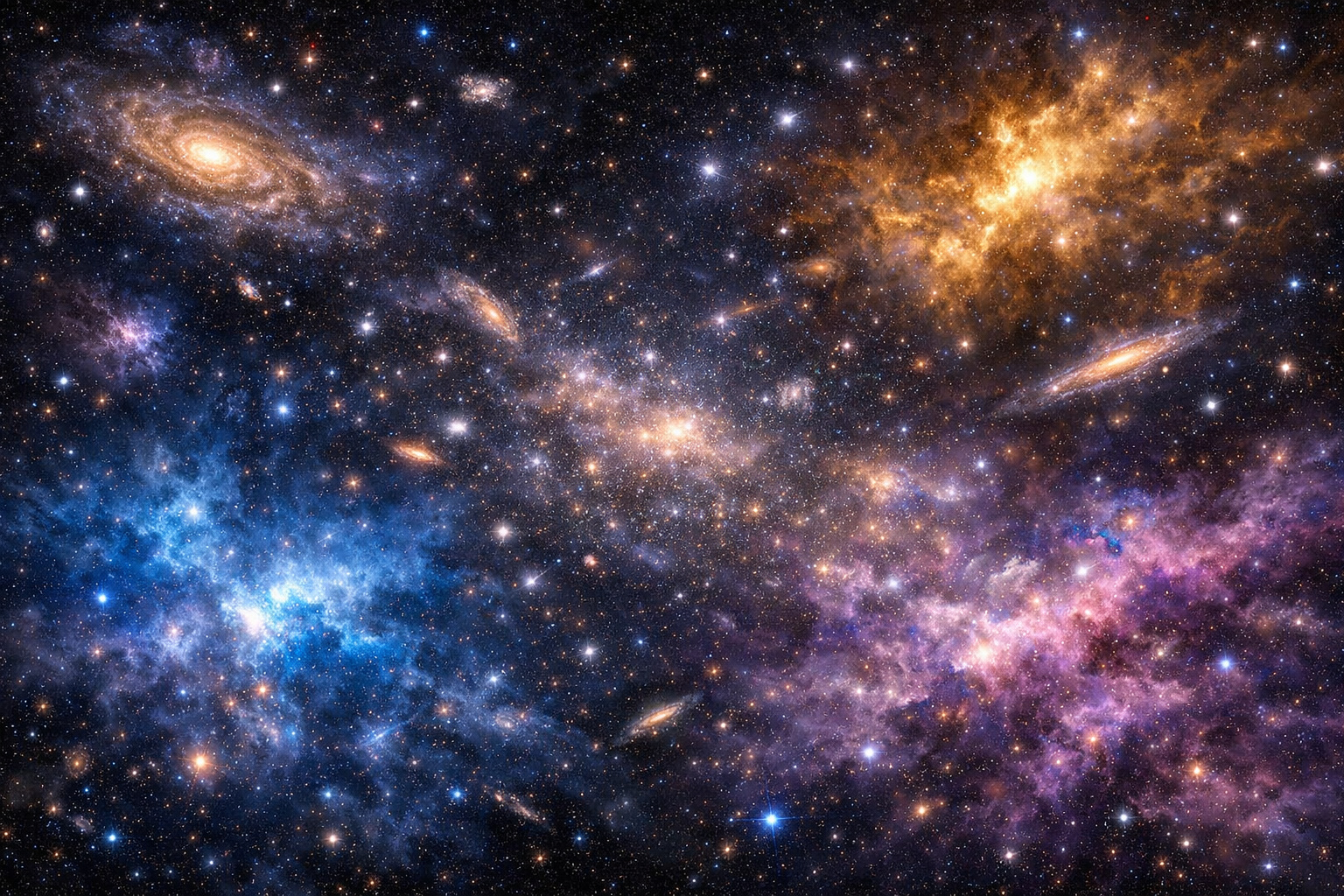
New extremely precise measurement of the expansion of the universe reveals a discrepancy of up to 6 km/s per megaparsec and raises suspicions that something unknown may be altering the laws of the cosmos
Science has just revealed one of the greatest enigmas of modern cosmology — and, at the same time, one of the most unsettling. A new extremely precise measurement of the expansion of the universe confirmed that there is a real, profound, and still unresolved problem in understanding the cosmos.
The information was released by the website ScienceAlert, based on a study conducted by the international collaboration H0DN, which gathered highly advanced data and analyses to redefine one of the most important parameters in physics: the Hubble constant.
According to scientists, the local rate of expansion of the universe was measured at an impressive 73.5 kilometers per second per megaparsec, with an extremely high confidence level of 7 sigma, considered practically definitive in science. However, this value directly conflicts with measurements of the early universe, which indicate a significantly lower rate of 67.24 kilometers per second per megaparsec.
-
Scientists discover that tires are releasing invisible microplastics into city air, raising concerns about what we breathe every day.

-
Scientists have discovered a hidden underwater “portal” beneath the largest glacier in East Antarctica, capable of carrying warm water to the ice base; Totten drains a colossal basin with the potential to raise sea levels by more than 3.5 meters.
-
For the first time in history, scientists are observing the Pacific crust tearing on the ocean floor and revealing the birth of an underwater tectonic division.

-
The largest telescope in Hawaii targets the Crystal Ball Nebula 1,500 light-years from Earth and captures the light that left a dying star at the same time Charlemagne was founding the Holy Roman Empire: the cosmic sculpture was shaped by a pair of stars that dance every 9 years.





And it is precisely this difference that is leaving researchers intrigued.
Understand why the expansion of the universe has become one of science’s greatest mysteries
To understand the gravity of the situation, it is important to remember that the universe emerged about 13.8 billion years ago and has been expanding ever since. The speed of this expansion is determined by the so-called Hubble constant, one of the fundamental pillars of modern cosmology.
Moreover, this constant is essential for calculating the age, size of the universe, and even for understanding the influence of the mysterious dark energy, responsible for accelerating the expansion of the cosmos.
However, despite technological advances, scientists face a curious problem: different measurement methods are leading to incompatible results.
On one hand, measurements of the current universe indicate values between 72 and 74 km/s per megaparsec. On the other hand, analyses of the ancient universe suggest numbers close to 67 or 68 km/s per megaparsec.
In other words, even with highly precise methods, the results simply do not match — a phenomenon that has become known as the Hubble tension.
Measurement network replaces “cosmic ladder” and reinforces that the problem is real
Traditionally, scientists use the so-called “cosmic distance ladder” to measure the universe. This method includes steps such as:
- Parallax (measurement of the position of stars)
- Cepheid variable stars
- Type Ia supernovae
However, to eliminate possible errors, the researchers decided to innovate. Instead of a ladder, they created a true network of distances, combining various techniques simultaneously.
Among them are:
- Cepheid variables
- Stars at the top of the red giant branch
- Mira variables
- Megamasers
- Type Ia and II supernovae
- Surface brightness fluctuations
- Tully-Fisher relation
- Fundamental plane
With this, it was possible to obtain even more robust and interconnected measurements, drastically reducing the margin of error.
Furthermore, the scientists conducted rigorous tests, removing methods individually, altering data, and adjusting assumptions. Still, the result hardly changed.
In other words, everything indicates that the discrepancy is not a calculation error.


Scientists admit: new physics may be needed to explain the cosmos
In light of this scenario, the conclusion begins to gain strength: the problem may not lie in the measurements, but rather in our understanding of the universe itself.
For years, many researchers believed that the so-called Hubble tension could be the result of human errors or technical limitations. However, with this new extremely rigorous analysis, this hypothesis loses strength.
Now, the possibility grows that the universe is revealing something much deeper — perhaps even a new form of unknown physics.
According to the researchers, the current accuracy of the measurements not only reinforces the inconsistency but also exposes limitations in the standard cosmological model.
Moreover, the data suggest that it may be necessary to completely reevaluate what we know about the primitive universe.
The study was published in the scientific journal Astronomy & Astrophysics, and the complete data has been made publicly available for other scientists to test and reproduce the results.
Meanwhile, one thing is certain: cosmology has entered a new era of questioning — and the cosmos may be about to reveal even more surprising secrets.


Be the first to react!