






 Portuguese
  Spanish


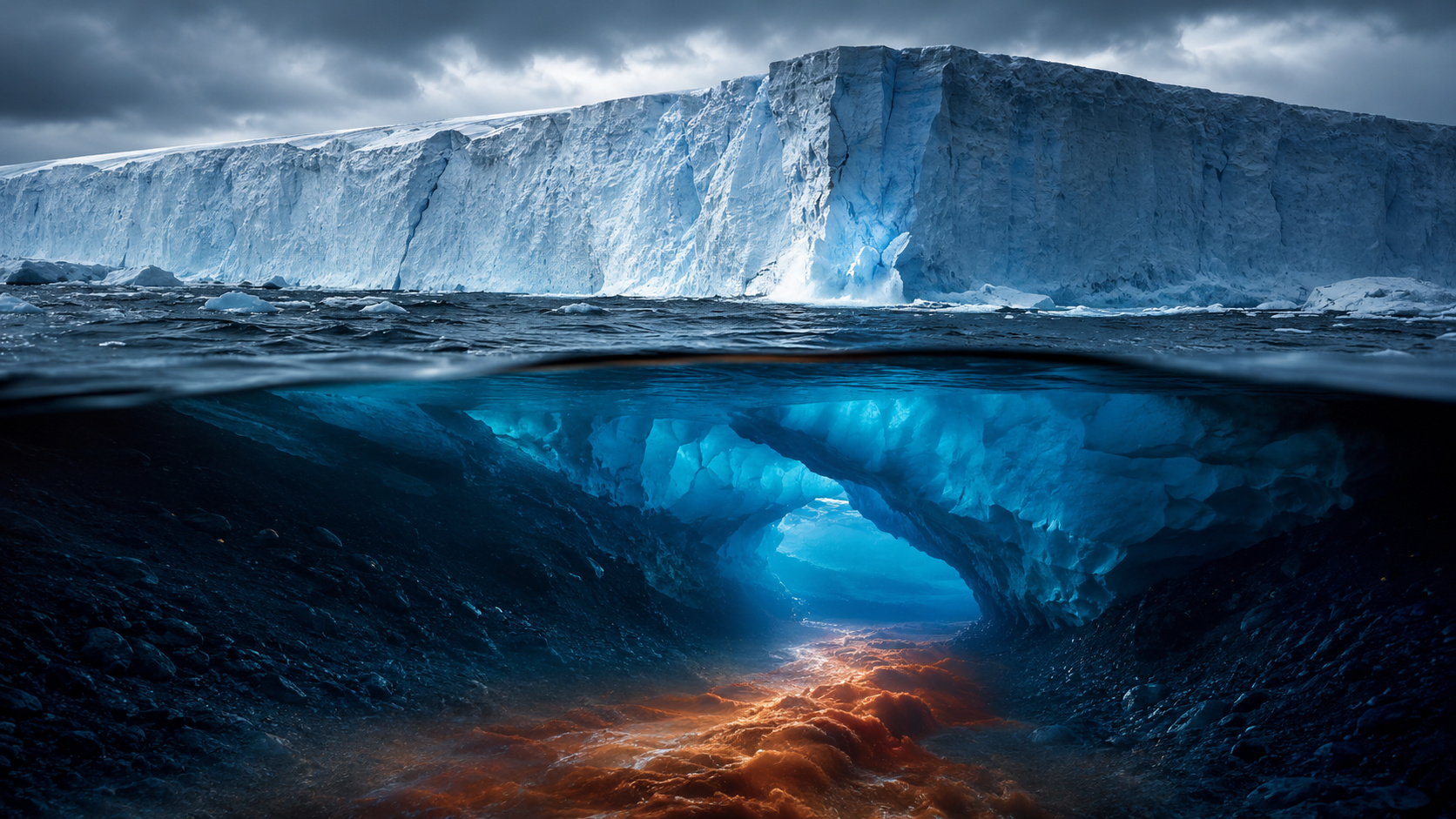


Totten Glacier has a submarine “gateway” that can bring warm water to the ice and drains a basin capable of raising oceans by more than 3.5 m.
Scientists from have identified a kind of submarine “gateway” beneath the Totten Glacier in East Antarctica, which may allow relatively warm ocean water to reach the base of the ice. The discovery helps explain why one of the most important regions of the Antarctic ice sheet shows signs of thinning and mass loss. The “gateway” is a submarine valley about 5 km wide, revealed by aerial surveys with ice-penetrating radar, gravimeter, laser, and geomagnetic sensors. This deep passage may act as a corridor for warm water to reach the cavity beneath the Totten ice shelf.
The size of the risk is noteworthy because the Totten drains the Aurora Subglacial Basin, a region with enough ice to raise global sea levels by more than 3.5 meters if it were to undergo extreme loss over centuries. This number is not an immediate forecast, but the physical potential for elevation if the ice mass were destabilized.
Totten Glacier hides a submarine passage capable of connecting warm water to deep ice
The discovery was published in a study in Nature Geoscience and reported by institutions such as the Australian Antarctic Division and Imperial College London.
-
China Develops Custom 140-Ton Electric Mining Truck with 770 kWh Swappable Battery, Deploys 290 Units in Xinjiang’s Largest Zinc Mine

-
Meta to Launch Arena, a New Prediction App Targeting 3.56 Billion Users, Competing with Polymarket and Kalshi

-
Scientist Challenges Famous Human Evolution Theory, Argues Homo Sapiens Evolved Gradually Over Thousands of Years
-
15-Year-Old American Builds Ocean Generator with PVC Pipe and 3D-Printed Propeller for $12, Wins National Prize, Presents at White House, and Makes Forbes 30 Under 30 List




Researchers mapped the hidden topography beneath the glacier and found a valley on the seabed capable of opening a path for ocean water to reach the base of the ice.


The Australian Antarctic Division states that this passage may explain why Totten is considered the fastest thinning glacier in East Antarctica.
Warm water does not need to melt the ice from the surface: it can attack the glacier from below, precisely in the region where the ice begins to float.
This point is crucial because ice shelves act as natural barriers. When they lose thickness from below, they reduce their capacity to hold back the continental ice that flows towards the ocean.
Totten drains a basin with enough ice to raise the sea by more than 3.5 meters
The scale of Totten is what turns the discovery into a global alert. According to the Australian Antarctic Division, there is enough ice in the system drained by the Totten Glacier to raise the average sea level by at least 3.5 meters, a value comparable to the potential of the West Antarctic ice sheet.

The study also highlights that part of the basin drained by Totten is supported below sea level, with regions reaching 1.7 km below ocean level and covered by up to 4 km of ice. This geometry increases vulnerability to the entry of warm water.
In simple terms: it’s not just a large glacier. It is an exit door of a deep basin, buried under kilometers of ice, with the potential to affect coasts around the planet if it enters prolonged retreat.
Warm water arrives through deep depressions, currents, and channels on the seafloor
A study published in Nature Communications in 2023 detailed better how ocean heat can advance to the Totten ice shelf. Researchers identified a combination of deep continental shelf break, broad depression, cyclonic circulation, and deep channels that help transport warm water to the cavity beneath the ice.

The National Institute of Polar Research, Japan, explained that ocean-origin warm water interacts with the Totten shelf and reaches the cavity through two large deep glacial troughs. This path helps explain how the heat surpasses a region that was previously difficult to observe due to thick sea ice.
The same study reported that the temperature of the warmest water reaching the cavity varies about 0.8 °C on an interannual scale. In a polar environment, this difference is enough to change the basal melting rate.
Helicopters launched 74 probes through ice cracks to measure warm water beneath the platform
The difficulty of studying the Totten is extreme. Ships are often blocked by sea ice and icebergs, so researchers have turned to using helicopters to launch probes through cracks in the coastal ice.
In a six-day campaign, scientists launched 74 AXCTD and AXBT probes into ice cracks ranging from 15 to 540 meters wide. These instruments measured temperature and salinity up to 1,000 meters deep.
The results showed intrusions of relatively warm ocean water, between 0.5 °C and 1 °C, below 550 to 600 meters in a previously under-sampled area of the continental shelf.
The scientists also identified the outflow of meltwater from the platform’s cavity, a direct evidence of melting from below.
Totten Ice Shelf has one of the highest basal melt rates in East Antarctica
The Totten Ice Shelf is not only exposed to the ocean. According to a study by Nature Communications, it has an average basal melt rate of 10.5 ± 0.7 meters per year, the highest among the ice shelves in East Antarctica in the analyzed set.
The same work cites a basal loss of 63.2 ± 4 gigatons per year in the period from 2007 to 2008. This data reinforces that the interaction between ocean and ice is already a relevant component of Totten’s dynamics.
The discovery of the “portal” and the paths of warm water does not mean that a collapse is happening immediately. But it shows that East Antarctica, long considered more stable than the West, also has points vulnerable to ocean warming.
The danger of Totten lies in what satellites cannot see
Satellites can measure thinning, ice velocity, and surface changes. But the most sensitive problem of Totten is hidden below: in the contact between the ocean, the seafloor, and the base of the ice shelf.

It is at this invisible point that submarine valleys, deep depressions, and heat-laden currents can transform the stability of a glacier. Totten does not need to melt from above to concern scientists; it is enough for relatively warm water to continue finding its way to its base.
The final image is unsettling: a colossal glacier in East Antarctica, seated over a deep basin, traversed by underwater passages and connected to enough ice to raise the sea by more than 3.5 meters.
The “portal” is not science fiction, it is geography hidden beneath the ice, and it may be one of the keys to understanding the future of coastal cities.







