Portuguese
  Spanish


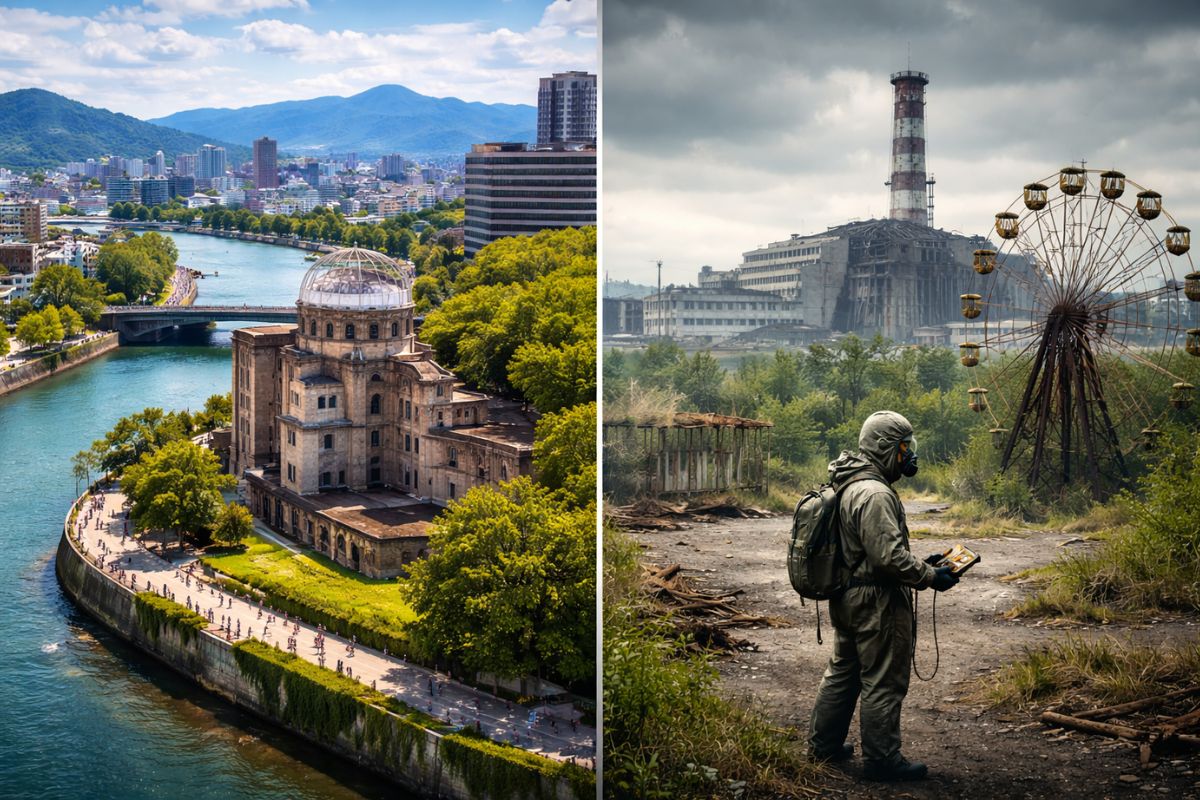


Comparison Between Hiroshima and Chernobyl Becomes a Viral Argument, but Nuclear Energy Shows, with Nuclear Fission, Atomic Bomb and Nuclear Reactor, Why the Impact Was So Different.
In 1945, a nuclear bomb destroyed Hiroshima. In 1986, a reactor exploded in Chernobyl. Today, Hiroshima is a living, rebuilt city, while Pripyat and the Chernobyl region remain largely empty, with exclusion zones. The question “if Hiroshima is alive, why is Chernobyl still deserted?” seems logical, but it is precisely this simplicity that misleads those comparing Hiroshima and Chernobyl without understanding how nuclear energy truly works.
The Comparison Between Hiroshima and Chernobyl That Goes Viral and Confuses
The most repeated argument on social media is straightforward: if an atomic bomb fell on Hiroshima and the city exists to this day, then the bomb couldn’t have been “that nuclear” or the Chernobyl accident must be inexplicably worse.
-
DNA Analysis Reveals How Five Cattle Survived Over 130 Years on a Deserted Brazilian Island

-
Private Spacecraft Intercepts Another for First Time in History During U.S. Space Force Mission Completed 11 Hours Early with Rocket Launched in Record 16 Hours

-
Scientists Predict Earth’s Habitable Lifespan: 1.8 Billion Years Before Oceans Evaporate and Sun Forces Planet Out of Life Zone
-
LG Unveils XBOOM Stage 501 Portable Speaker with 25-Hour Battery, AI Karaoke, and Sound by will.i.am in Brazil


From there, hasty conclusions appear, saying that if Hiroshima were real, it would be uninhabitable to this day, or that if Chernobyl was “just an accident,” it wouldn’t make sense for it to be worse than an atomic bomb.
This line of reasoning seems intuitive but ignores almost everything that nuclear physics has discovered. When someone places Hiroshima and Chernobyl side by side without discussing fission, isotopes, reactor design, and the timescale of radiation, they are trading science for guesswork and leaving the door open for misinformation.
The content that underpins this text does the opposite. Instead of using Hiroshima and Chernobyl to fuel fear or deny history, it uses both cases as a lesson on how nuclear energy can be released in completely different ways.
How Nuclear Fission Really Works
It all starts at the end of the 1930s. By bombarding uranium atoms with neutrons, researchers noticed the emergence of barium, an element much lighter than uranium. This didn’t make sense as a common chemical reaction.
It was Lise Meitner, already in exile, who correctly interpreted the result. The uranium nucleus had split into two pieces.
They had just described nuclear fission. When the nucleus divides, part of the mass disappears and is converted into energy, exactly as indicated by the famous equation E = mc².
For a single atom, this energy is irrelevant. For trillions upon trillions of nuclei fissioning at the same time, the result is enormous.
There, humanity found the most concentrated source of energy ever accessed and, with it, two opposing paths: to use this energy in a controlled or uncontrolled way.
From there, two distinct scenarios arise. In one, this energy is released slowly, in a controlled manner, in reactors to generate electricity. In the other, it is released all at once, in an uncontrolled manner, in nuclear weapons.
Physically, both scenarios use the same basic phenomenon, fission, but the materials, geometries, enrichment levels, and the rate of the reaction are entirely different. Confusing this is the first step to misunderstanding Hiroshima and Chernobyl.
Isotopes, Enrichment and Why a Reactor Doesn’t Become a Bomb
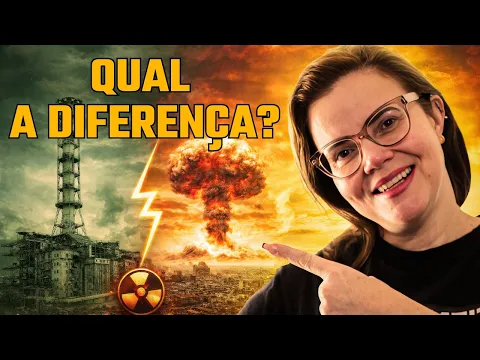

Uranium is always uranium, with 92 protons in the nucleus. What changes is the number of neutrons. When this number varies, the so-called isotopes emerge. The two most important in the history of Hiroshima and Chernobyl are uranium 235 and uranium 238.
Both exist in nature, but only uranium 235 fissions easily. And here comes a detail that almost never appears in the superficial discussions about Hiroshima and Chernobyl: more than 99% of natural uranium is uranium 238, and less than 1% is uranium 235.
Nature does not deliver “bomb fuel” ready; it is necessary to enrich the material for it to become explosive.
For a chain reaction to sustain itself, the neutrons released in fission need to quickly find other uranium 235 nuclei. If they don’t, the reaction dies.
Therefore, a nuclear bomb needs highly enriched fuel, with over 90% uranium 235, while a typical nuclear reactor uses much lower enrichment, around 3% to 5%.
In reactors, most of the material is uranium 238, which does not enter the same explosive chain reaction. Additionally, neutrons are moderated, absorbed by control rods and materials prepared to slow down the reaction.
This combination is the physical reason why a reactor doesn’t “explode like a bomb,” which applies to both Hiroshima and Chernobyl as well as modern nuclear power plants.
Current reactors are designed with intrinsic safety. When the temperature rises, the physics itself makes the reaction decrease in intensity.
In Chernobyl, the design was the opposite. This point is crucial to understand why Hiroshima and Chernobyl had such different outcomes.
Hiroshima: Aerial Explosion, Little Material, and Instant Event

In August 1945, two atomic bombs were dropped over Japan. Hiroshima received a uranium bomb, and Nagasaki, a plutonium bomb. Both were detonated in the air, tens of meters above the ground, with relatively small amounts of nuclear material.
The goal of a bomb is simple and brutal. Concentrate the maximum amount of energy in an extremely short period of time, in microseconds, generating an instant release of heat, shockwave, and intense radiation.
What happens in Hiroshima can be summarized in this way in physical terms. The fuel had high enrichment, the chain reaction grew uncontrollably until it reached the maximum energy point, and everything resolved in a single pulse.
The radiation was intense but extremely brief, and part of the radioactive material was thrown and diluted into the atmosphere.
The human, thermal, and mechanical impact was devastating. The shockwave and extreme heat destroyed much of the city, instantly killed tens of thousands of people, and left deep scars.
However, from an environmental long-term perspective, the contamination did not remain active for decades in the same way it did in Chernobyl.
In Hiroshima, the environment did not turn into an open reactor soaked with nuclear fuel; it was a one-time event with limited material, detonated in the air, and with a relatively quick dispersion of most of the radiation.
Therefore, the city could be rebuilt and today is a living place, even though it carries historical scars and memorials of the tragedy.
Chernobyl: Open Reactor, Hundreds of Tons, and Prolonged Contamination

Chernobyl is another story. There was no bomb. There was an RBMK reactor in operation with about 180 tons of nuclear fuel in its core.
It was a 1950s design with serious safety flaws, lacking a robust containment building, and with dangerous physical behavior under certain conditions.
Unlike modern reactors, the RBMK could enter a cycle in which the hotter it got, the more power it generated, feeding a positive feedback effect.
In Chernobyl, safety systems were turned off, control rods were removed beyond permitted levels, and the test conducted at night pushed the reactor outside the safe zone.
When the accident occurred, there was no nuclear explosion like in Hiroshima. What happened was a sudden power surge, a core rupture, steam explosion, and graphite fire, with radioactive material being continuously released into the atmosphere.
Moreover, fuel and fission products mixed with the soil, reactor structures, and the surrounding environment, creating a source of contamination that was much more persistent.
Instead of a single pulse as in Hiroshima, Chernobyl released radioactive material for days, in direct contact with the soil, air, and water. The result was deep and lasting contamination.
Contaminated soil means contaminated plants, contaminated animals, and contaminated water. This scenario justifies the existence of a wide exclusion zone, something that does not happen in Hiroshima precisely because the type of event was completely different.
Hiroshima and Chernobyl: Energy, Time, and the Illusion of Comparison
A classic question is whether the Hiroshima bomb was “more powerful” than the Chernobyl accident. The answer depends on how we define power. Hiroshima released a large amount of energy in an instant, with extremely high intensity and ultra-short duration.
Chernobyl released less instantaneous energy but spread much more radioactive material into the environment over time.
Those who only look at the immediate destruction see Hiroshima as “worse,” but those who view the prolonged environmental contamination see Chernobyl as a more persistent problem for the territory.
Another common mistake is associating direct physical destruction with long-term radiation. In Hiroshima, much of the destruction came from the shockwave and extreme heat. In Chernobyl, the immediate visual impact was less, but the surrounding area became impregnated with radioactive material.
Thus, placing Hiroshima and Chernobyl side by side as if they were equivalent phenomena ignores the total amount of nuclear material involved, the duration of the release, the fact that one explosion was airborne and the other was on the ground, and the type of facility involved – nuclear weapon in one case and unstable operating reactor in the other.
The difference between Hiroshima and Chernobyl is not whether one was real and the other was not; the difference lies in how the energy was released, how much radioactive material was at stake, and how long that material interacted with the environment.
Fear, Misinformation, and the Symbolic Weight of Hiroshima and Chernobyl
After Chernobyl, something changed more outside the laboratories than inside them. The accident became a symbol. For many people, nuclear came to mean synonymous with inevitable catastrophe, regardless of the type of reactor or level of security adopted.
Chernobyl embodies almost everything the collective imagination fears. Radiation is invisible, the effects on health are real, there was initial silence from authorities, and an entire city was abandoned. This combination creates a very powerful narrative that tends to survive even when data shows a more nuanced picture.
Meanwhile, other energy sources, such as coal, oil, and gas, continue to cause deaths through pollution, climate change, and accidents without receiving the same symbolic weight.
The fear of a rare and spectacular risk, such as an extreme nuclear accident, often leads countries to accept much more frequent and silent risks from other energy matrices.
Chernobyl was not an inevitable outcome of nuclear energy. It was the result of a specific reactor design, wrong human decisions, and a political context that allowed layers of safety to be turned off.
Hiroshima and Chernobyl, together, show both the worst military use of fission and one of the worst scenarios of civil nuclear engineering. Science learns lessons from both, while denialism tries to use both as ammunition against any form of nuclear energy.
When someone uses Hiroshima and Chernobyl to deny the reality of bombs or to demonize any nuclear technology without looking at the data, they are choosing the simpler narrative, not the truer one.
Understanding why Hiroshima lives and Chernobyl remains largely deserted does not erase the human tragedy on both sides, but prevents these stories from being distorted to fuel fear and misinformation.
And you, after understanding better the differences between Hiroshima and Chernobyl, do you think the fear of the word “nuclear” still makes us decide more by emotion than by data when it comes to energy and real risk?