






 Portuguese
  Spanish
  4 min of reading
  0 comments


Unprecedented Archaeological Discovery In Vienna Reveals Mass Grave With Remains Of Possible Roman Soldiers Under A Football Field. Indications Point To An Ancient Military Confrontation Between Romans And Germanic Tribes.
A football field in the Simmering district of the Austrian capital has become the center of one of the most impressive archaeological discoveries in Central Europe. During renovations carried out in October 2024, construction workers came across a mass grave containing the remains of 129 individuals, many of whom were likely Roman soldiers who participated in a military conflict in the 1st century AD.
The preliminary analysis, conducted by archaeologists from the Vienna Museum, suggests that the bodies are part of an unprecedented military event documented thus far in the region.
“There are various battle wounds, excluding execution. It is an authentic battlefield. We found marks of swords, spears, and blunt force trauma,” stated the city’s chief archaeologist, Kristina Adler-Wölfl, during the official presentation of the discovery, held on Wednesday (2).
ARTICLE CONTINUES BELOWSee also
Survivor of 1966 SS Daniel J. Morrell Shipwreck in Lake Huron Recounts 38-Hour Ordeal in Extreme Cold

The Greatest Hoax in World Cup History? The Film That Denied Brazil’s 1958 Victory and Exposed How Fake Evidence Can Seem Convincing on TV
Fake South Korean Online Stores Offer Shopping Thrill Without Spending Money or Receiving Products
The War of Jenkins’ Ear: How a Severed Ear Sparked One of the 18th Century’s Most Unusual Conflicts


Indications Of A Forgotten Battle Emerge Beneath Viennese Soil
According to experts, the way the skeletons were found — intertwined, with displaced bones and signs of violent injuries to the skull, chest, and pelvis — points to a hasty burial of combatants killed in a large-scale military confrontation.
The archaeologists estimate that the total number of dead could exceed 150.
According to the excavation leader, Michaela Binder, the find is extraordinary: “There are huge battlefields in Germany where weapons have been found. But finding the dead, that is unique in the entire Roman history.”
This is due to the fact that Roman soldiers were traditionally cremated until the 3rd century. The existence of this mass grave changes the understanding of funeral rites and military practices of the time.
Material Evidence And Scientific Analyses Confirm Presence Of Roman Soldiers
Carbon-14 dating placed the human remains between the years 80 and 130 AD, coinciding with the reign of Emperor Domitian, who led military campaigns along the Danube River.
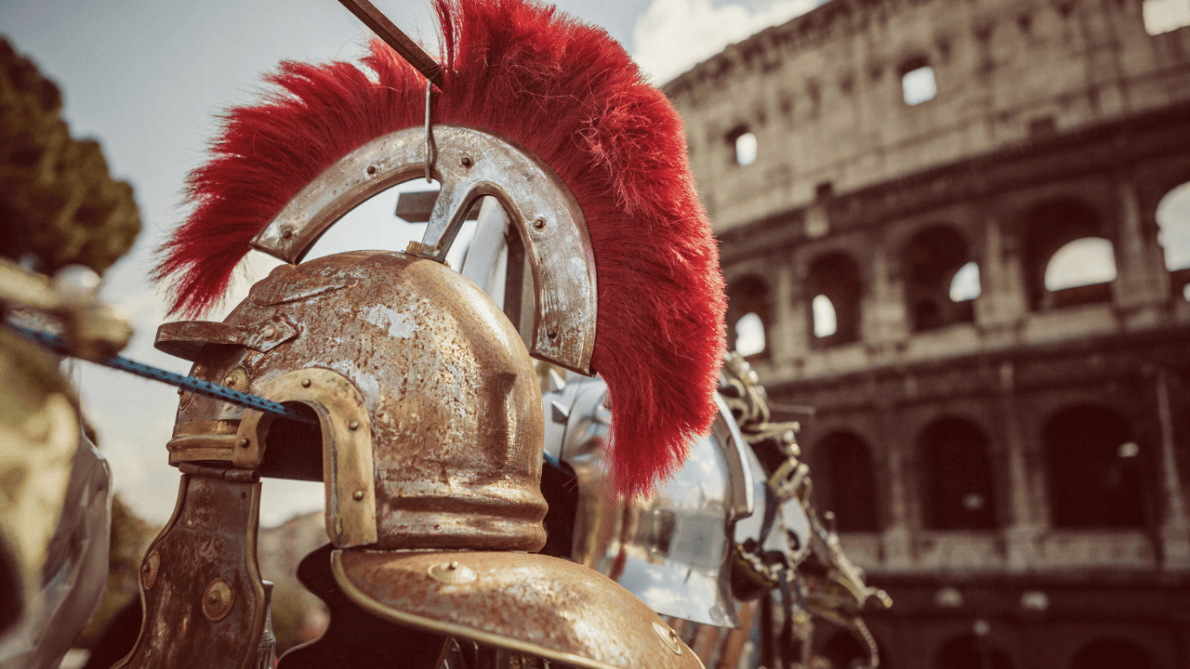
This theory is reinforced by artifacts found alongside the bodies, such as parts of armor, pieces of helmets, and the typical military sandals known as caligae.
The most emblematic object of the discovery was a rusty Roman dagger, whose typology is specific to weapons used between the end of the first century and the beginning of the second.
So far, only one of the 129 skeletons has been clearly identified as a Roman soldier based on his belongings.
Experts believe that new DNA and strontium isotope tests on the teeth and bones could identify the geographical origin and military affiliation of the other victims.
Vindobona And The Echoes Of Roman Military Past
The excavation also revealed foundations that date back to ancient Vindobona, the Roman settlement that preceded modern Vienna.
The discovery of Roman soldiers in this context reinforces the notion that the city had a continuous occupation since antiquity and may have been the scene of decisive clashes between the legions of Rome and Germanic tribes.
For Adler-Wölfl, “the most likely theory at this moment is that this is linked to the Danube campaigns of Emperor Domitian — which are from 86 to 96 AD.”
The hypothesis, supported by material finds and historical chronology, connects the discovery on the football field to the geopolitical landscape of the time, during the height of the Roman Empire and the so-called Pax Romana, a period of stability that still faced various threats at the borders.
A Window Into The Past In The 21st Century
The find, considered unprecedented in terms of scope and preservation, sheds new light on the presence of Roman soldiers in the region and on the confrontations fought at the boundaries of the Empire.
For the archaeologists involved, the mass grave found beneath the Viennese football field is more than a relic — it is a time capsule that shows how wars and civilizations have left deep marks on European soil.
The expectation now is that ongoing analyses may detail not only the identities of the combatants but also the broader context of this forgotten battle, which unexpectedly emerged from beneath a tranquil sports facility.





-

1 person reacted to this.