






 Portuguese
  Spanish
  6 min of reading
  2 comments


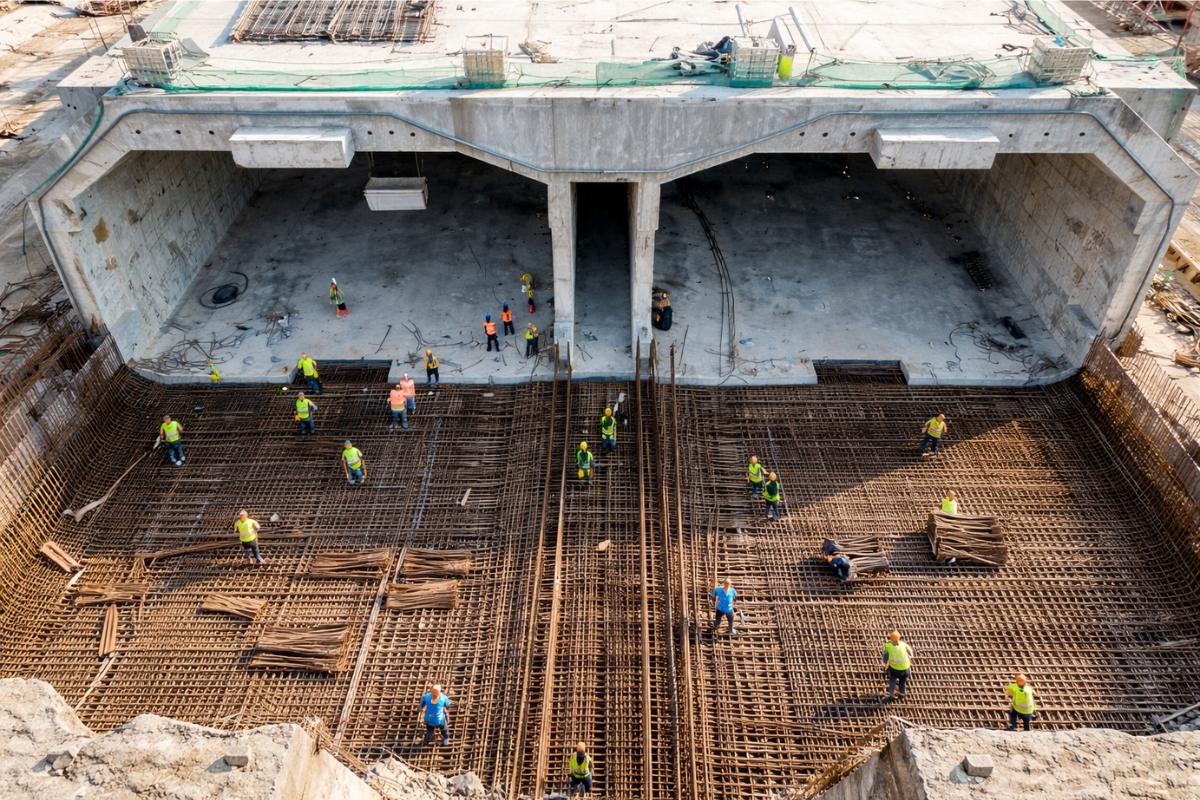


Operation signed in April 2026 unlocks the financial phase of the historical work, which will have 870 meters submerged, multimodal connection, and promise to cut the crossing between Santos and Guarujá from up to 1 hour to 5 minutes
Kept for generations as a project that never left the drawing board, the Santos-Guarujá tunnel has officially entered another phase. The signing of the credit operation with Banco do Brasil in April 2026 secured R$ 2.5 billion for the São Paulo Government’s share in the PPP and pushed a project debated since the 1920s into the decisive stage.
In the complete package, the venture totals around R$ 6.8 billion to R$ 7 billion, already has a signed contract with the responsible concessionaire, and has become one of the largest infrastructure showcases in the country. After crossing a century of promises, the project gained the new fact it needed to become hard news: the money from the operation officially entered the game.
Credit signed in April changes the weight of the news
The auction completed in 2025 had already placed the tunnel at a new level. The contract signed at the beginning of 2026 also showed that the project was moving beyond political discourse and advancing on the real calendar.
-
The urgent need to implement a severe cut in public spending and a massive increase in taxes, in addition to drastically compromising the quality of basic services and the purchasing power of the population, could result in social unrest in the country, with the population leading protests, strikes, and frequent disturbances.

-
FIRJAN’s mega plan of R$ 526.3 billion for Rio de Janeiro aims to revive Brazil’s largest industry, with two-thirds of the investments going to oil and gas.

-
China signals an increase in beef imports, Brazil has already consumed 70% of the 1.106 million ton quota and seeks to renegotiate the tariff that jumps from 12% to 55%, while demand from the US also skyrockets.
-
Food inflation rose 302% in 20 years in Brazil, but the supermarket changed: purchasing power yielded 87% more mortadella and 31% less fruit, and ultra-processed foods took over the cart.



Even so, the signing of the credit operation in April changed the perception of the work. This movement provides financial backing to the state participation and reinforces the view that the submerged crossing has moved from the realm of promise to enter the decisive execution phase.
This is the point that transforms the topic into hard news. For decades, the tunnel was remembered as a great idea never realized. Now, the story changes tone because a concrete financial milestone related to the work has come into existence.

The first submerged tunnel in Latin America
The project carries a scale that stands out on its own. The connection between Santos and Guarujá will have a length of 1.5 km, with 870 meters submerged under the port channel.
The structure was designed to be multimodal. The tunnel will have lanes for vehicles, space for bike paths, pedestrian crossings, and provisions for a light rail transit system in the future. It is not just a road crossing, but a connection with a much broader urban and logistical design.
This set helps explain why the project has become a symbol of engineering and mobility on the São Paulo coast. The project simultaneously addresses daily transportation, regional integration, and the operation of one of the most strategic areas of the country.
End of an era for those who lose hours in the crossing
Today, the connection between Santos and Guarujá depends on ferries, small boats, and a much longer road route. On days with queues, waiting, and heavy traffic, the crossing can take nearly an hour.
With the tunnel, the official promise is to reduce this travel time to about five minutes. This is one of the strongest points of the article because it translates into direct impact what has been treated for years as just a technical project.
In practice, the project sells itself as the end of an era. Gone are the crossings marked by queues, waiting, and unpredictability. In comes a fixed, fast, and integrated connection, with the potential to change the routine of residents, workers, and transporters.

A project thought out since the 1920s
The strength of this story also lies in the time it took to mature. The dry connection between Santos and Guarujá has been debated since the 1920s.
Throughout the century, the proposal reappeared at different times, crossing governments, changes in priorities, discussions between bridge and tunnel, technical obstacles, environmental impasses, and financing difficulties. The project became known precisely for surviving as an idea for over 100 years without being realized.
Now, the sequence of recent milestones has changed this trajectory. After the license, the auction in 2025, the contract signing, and the credit operation in April 2026, the tunnel has finally entered a phase with a defined schedule and financial basis.
Santos Port expands the impact of the project
The weight of the news grows even more because of the place where this connection will be born. The tunnel will pass under the Santos Port channel, the largest port in Brazil and the heart of Brazilian logistics.
This is not a geographical detail. It is the center of the country’s foreign trade operation. What happens in Santos reverberates through productive chains, exports, imports, circulation of goods, and national competitiveness.
Therefore, the tunnel ceases to be just a regional demand. It connects directly to Brazilian logistics infrastructure. The project is born where urban mobility and cargo circulation coexist under permanent pressure.
Urban mobility and logistics in the same project
This is one of the strongest points of the topic. The tunnel was designed to tackle two problems at the same time.
On one hand, it seeks to ease the routine of those who depend on the crossing between Santos and Guarujá to work, study, move around, or provide services. On the other hand, it helps to reorganize flows in a sensitive area for port operations.
This combination expands the scale of the project. It is not just about shortening a path. It is about creating a new infrastructure capable of reorganizing human movements and improving the connection of a region essential to the national economy.
The timeline that puts the project on the country’s radar
The project now enters a phase that draws attention from the market, the port sector, and the population of Baixada Santista. The official expectation points to the coming years as the period for technical development and physical advancement of the project, with operations expected to begin in the early next decade.
This timeline reinforces the new moment of the undertaking. For decades, the tunnel was remembered for its absence. Now, it begins to be followed by its next steps.
The national interest surrounding the topic tends to grow precisely because the project combines large-scale engineering, a billion-dollar value, social impact, and direct interference in one of the most strategic points of Brazilian infrastructure.
After 100 years, the promise became a reality
The great editorial strength of this story lies in this turning point. For more than a century, the Santos-Guarujá tunnel was synonymous with waiting. In 2026, with the credit operation signed in April, the narrative changes.
The project that crossed generations as a regional promise now imposes itself as a national work. The submerged crossing under the largest port in the country has begun to gather money, contracts, scale, and a timeline.
That is why the tunnel has ceased to be just an old plan and has become hard news with the weight of an end of an era. When this connection comes to fruition, it will not just be a new passage between two cities. It will be the project that ends a 100-year wait at the heart of Brazilian logistics.


Are other tunnels in latin America like this with more than 2km and have more than 80 years with high transit , Tunel Subfluvial Uranga Carlos Sylvestr Begnis
https://es.wikipedia.org/wiki/T%C3%BAnel_subfluvial_Ra%C3%BAl_Uranga-Carlos_Sylvestre_Begnis
Great question, Dario! The Túnel Subfluvial Uranga-Sylvestre Begnis connecting Santa Fe and Paraná in Argentina is indeed a remarkable example — over 2.4 km long, built in the 1960s, and still handling heavy traffic after more than 50 years underwater. Latin America has several impressive tunnels, though most are shorter and newer. The fact that some of these structures have lasted 80+ years with high traffic volumes really speaks to the quality of mid-20th century engineering. Thanks for bringing up this comparison!