






 Portuguese
  Spanish


Submarines for Soda? Pepsi Became the Sixth Largest Naval Power in the World, Trading Tons of Soda Concentrate for Submarines and Destroyers
Have you heard about the time when Pepsi became, out of nowhere, the sixth largest naval force on the planet? It may sound like a comedy plot, but this actually happened. In the late 1980s, during the Cold War, the soda brand struck such an outlandish commercial deal that it is still remembered today as one of the most bizarre episodes in modern history: it traded tons of soda concentrate for submarines and destroyers from the Soviet Union. Yes, actual warships.
The Background: An Empire in Crisis and a Brand Thirsty for Expansion
By the 1970s, Pepsi was already well positioned in the Soviet Union. It was one of the few Western companies with products circulating there. But by the end of the 1980s, things took a serious turn: the ruble was worthless outside Soviet territory, making any traditional international transactions unfeasible.
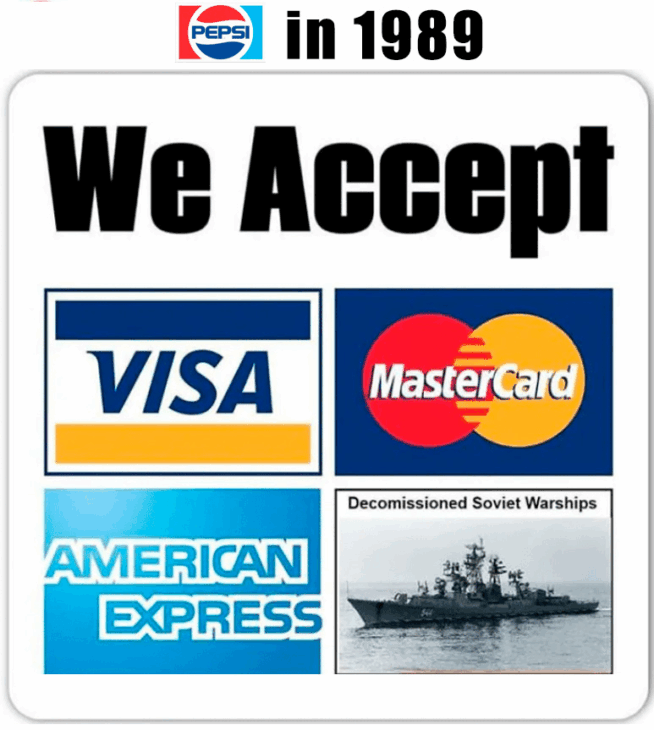
That’s when capitalist creativity came into play. Struggling to pay what it owed to Pepsi in cash, the Soviet government offered something different: a fleet of decommissioned military ships.
-
Strawberry Moon to Be Visible in Brazil on Monday (29th); Here’s When and How to Watch

-
Driver Crosses 100-Year-Old Railway Bridge Over Uruguay River, Encounters Rural Couple Preserving Traditional Farming Methods
-
Rural Producer Returns to Brazilian Farmland, Builds Family Agricultural Business with Children’s Support and Industry Backing
-
Goiás Couple Boosts Artisan Cheese Production from 25 to 70 Kilos Daily with Technical Support, Transforming Family Life in Rural Brazil




According to reports from The New York Times, the deal included 17 submarines, one cruiser, one frigate, and one destroyer, all obsolete, yet still representing an impressive volume of naval material.
A Soda Brand with Submarines? The Madness Made Headlines
For a brief moment, Pepsi was more than just a beverage giant: it had, on paper, a fleet larger than many national navies. And the world, of course, was shocked. The scene was so absurd that the then CEO of the company, Donald Kendall, joked: “We are disarming the Soviet Union faster than you are.”
The statement was a direct jab at the West and the disarmament negotiations of the time. But it also reflected what this deal symbolized: the USSR was economically crumbling, and even the ships were not safe from the collapse.
Pepsi Didn’t Build an Army, but the Impact Was Real
Despite the initial shock, nobody at Pepsi’s headquarters was planning to set up a naval base. The goal was different: to recover the value of the deal profitably. Thus, all the ships were quickly resold to a Swedish company specializing in naval scrap.
The negotiation carried a symbolic weight greater than practical. And though brief, it marked one of the most unexpected moments in Cold War history. In purely numerical terms, Pepsi actually surpassed countries like Sweden, Poland, or Turkey in the number of ships, even if just for a few days.
Creative Capitalism or Cold War Delirium?
This episode was not just a brilliant marketing move, but also a demonstration of how capitalism knows how to adapt to the most improbable situations. In a world divided between the capitalist and socialist blocs, Pepsi managed to convert soda concentrate into military hardware.
According to Smithsonian Magazine, Pepsi’s deal is often remembered as an example of creative negotiation at the end of the Soviet regime, a regime that would cease to exist two years later.
The Legacy of an Unthinkable Deal
Decades have passed and this episode continues to be recalled with a mix of astonishment and curiosity. After all, how many soda brands can claim they once commanded a fleet of warships? Even if only on paper, Pepsi made its mark during one of the tensest phases in world history, not with soldiers, but with ships.
Today, the case is studied in business schools, cited in documentaries, and remembered in lists of historical curiosities as one of the greatest commercial absurdities of the 20th century. A perfect symbol of how the unpredictable can happen when geopolitics and corporate interests intersect.
So, did you already know this story? Leave a comment below or share this article with someone who would never imagine seeing Pepsi involved with Soviet submarines. After all, some things can only be explained by the Cold War.





Incrível, sou fã de histórias impactantes e reais deste planeta que e denominado como Terra o que discordo totalmente, o correto e “PLANETA AGUA” QUE EM BREVE POUCA TERRA RESISTIRA A SOBERANIA DA AGUA GRACAS AO AQUECIMENTO GLOBAL, “A CONFERIR” ADEMA BOA TARDE.
Essa descoberta desse artigo mostra que muitas vezes o capitalismo é o socialismo , fazem coisas que deixam brechas para as empresas se aportarem das fragilidades dos governos que atuam em uma geopolítica sem rumo, mas grandes empresas se apresentam dessa situação para levantar seu capital financeiro.
O Brasil pagou caças ingleses com algodão