






 Portuguese
  Spanish


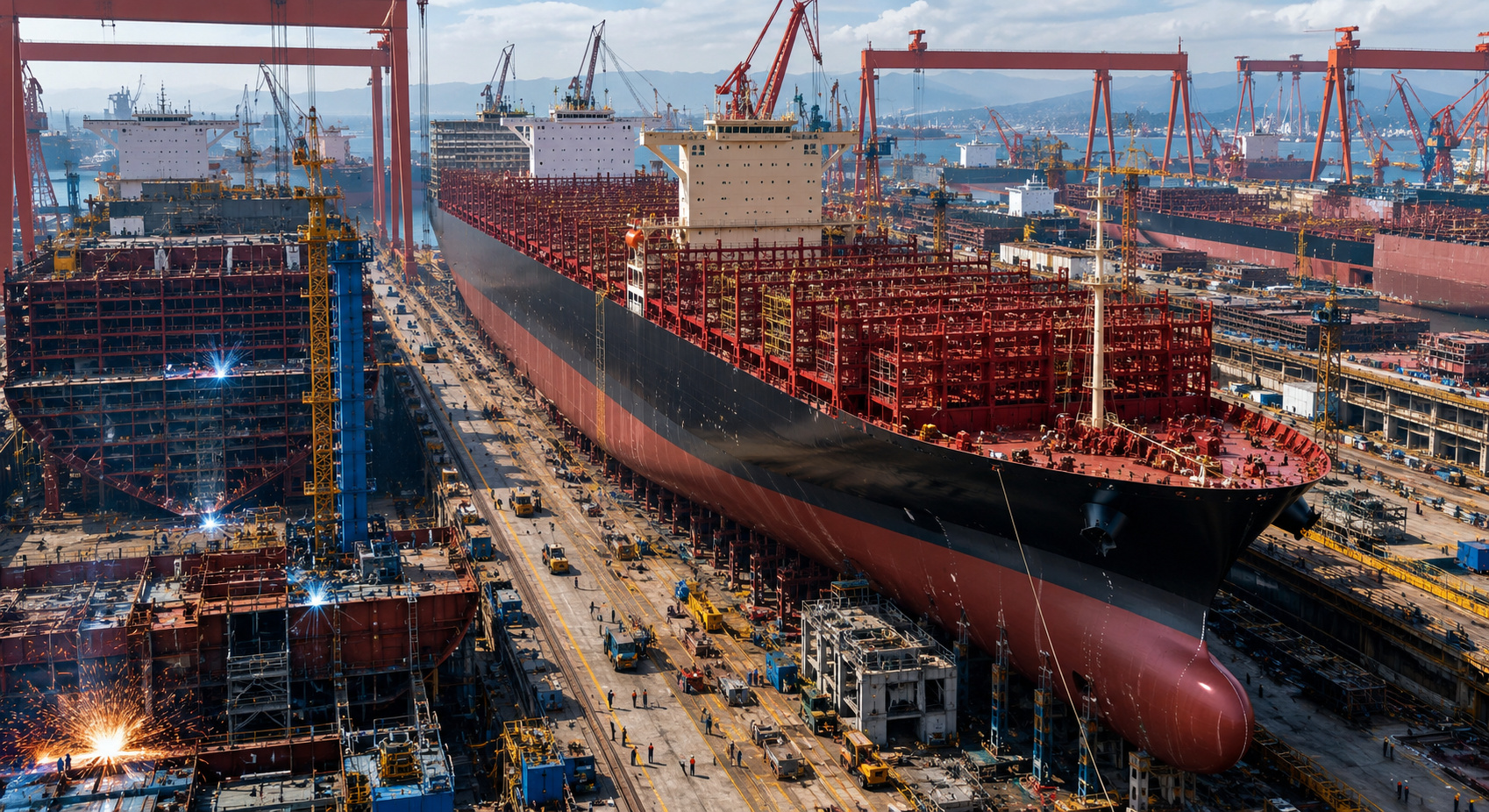


China received more than 60% of global ship orders in 2025, delivered 56% of world production, and expanded dominance over South Korea, Japan, Europe, and the USA.
According to Maritime Executive, of the approximately 2,500 ships ordered worldwide in 2025, more than 1,500 went to China shipyards, a volume exceeding 60% of the global total. In tonnage, the Chinese share was even greater: about 62%, according to Clarksons, and 69%, according to the Ministry of Industry and Information Technology of China. China also delivered 53.7 million DWT in 2025, equivalent to 56% of all global shipbuilding production for the year. South Korea, in second place, signed contracts for 260 ships, just over 10% of the world total. Japan, which led the sector for decades, lost market share for five consecutive years.
The three largest European shipyards, Fincantieri, Meyer, and Chantiers de l’Atlantique, do not even appear among the top 30 in the world by volume. Meanwhile, American shipyards, although maintaining the largest military naval fleet on the planet, have not competitively built large commercial ships for more than four decades.
China dominates global shipbuilding with more than 60% of ship orders in 2025
Chinese shipbuilding has ceased to be just a story of industrial expansion and has come to represent a profound shift in the control of the global maritime chain. In 2025, most of the new ships ordered worldwide were contracted at Chinese shipyards.
-
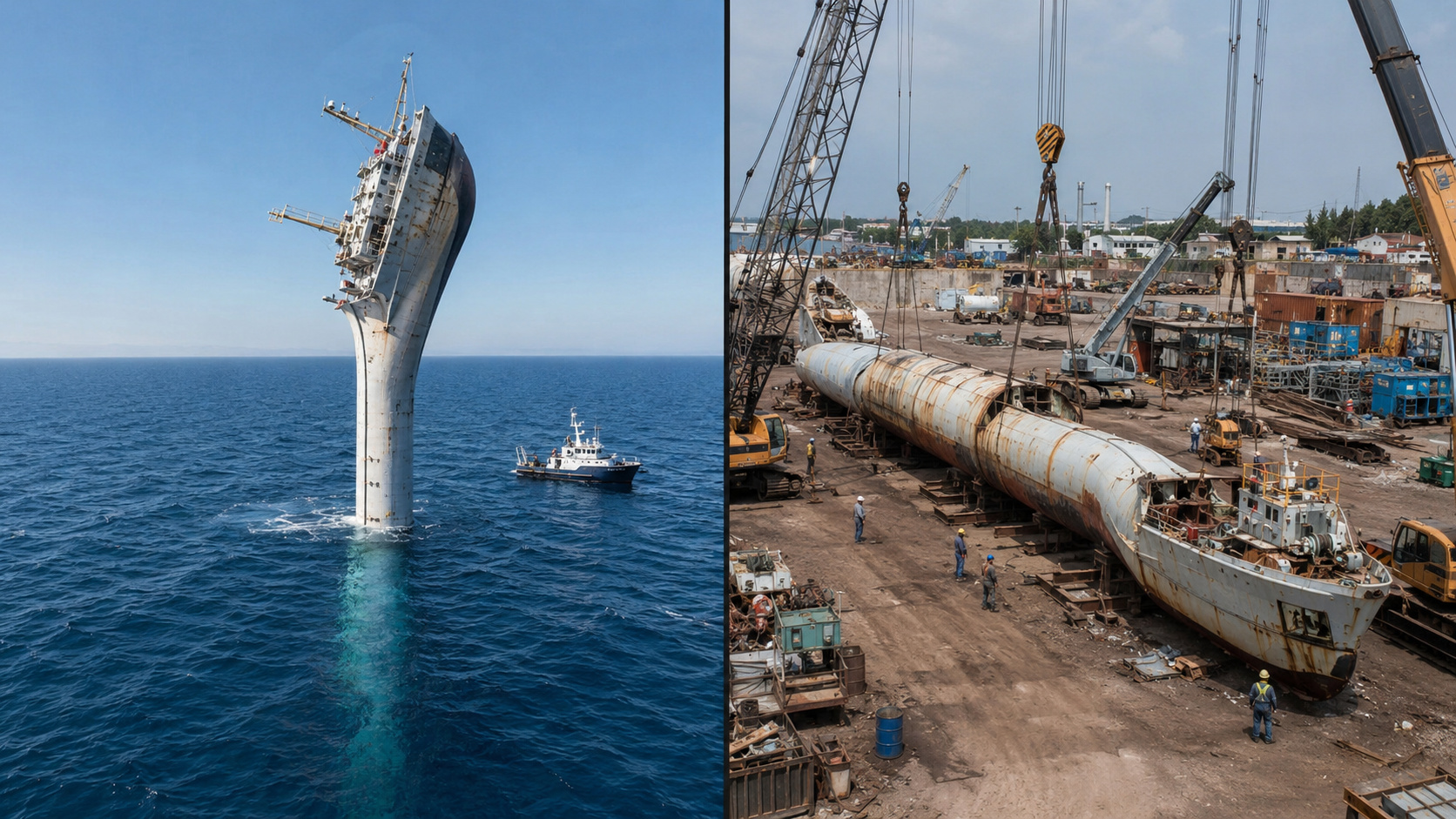
The FLIP: A 108-Meter Ocean Laboratory That Stood Vertically for 60 Years, Dismantled in 2023

-
North Korean Fiasco: Launch of the Largest Warship Ends in Sinking

-
While giant ships still burn heavy fuel and the maritime sector races against climate targets, Maersk and Vale are starting to bet on ethanol as a new route to reduce emissions at sea.

-
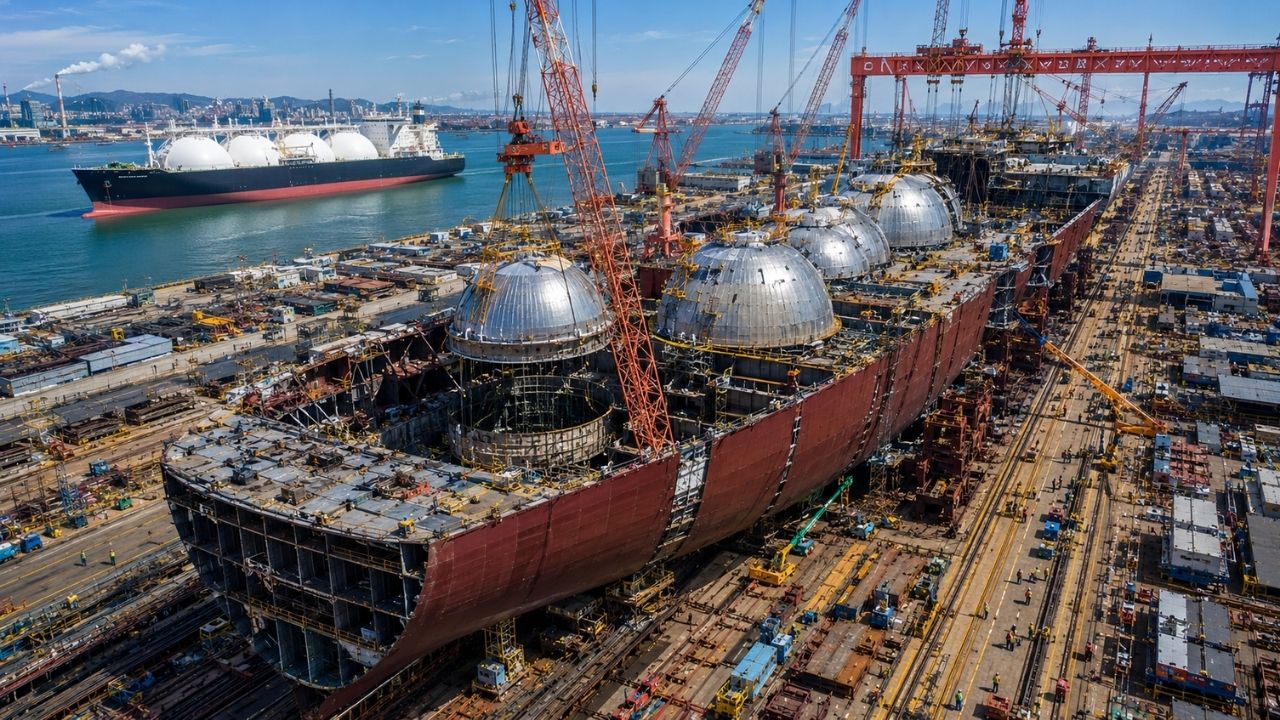
China begins construction of the world’s largest LNG ship, a 344-meter giant capable of supplying 4.7 million homes for a month, carrying 271,000 m³ of gas, and placing QatarEnergy in the largest naval order ever recorded in world history.


This dominance is evident both in the number of vessels and in the tonnage contracted. In practice, this means that China is not only producing many small ships but is also concentrating orders for large vessels, such as bulk carriers, tankers, container ships, and industrial ships.
According to a study cited by the Cheung Kong Graduate School of Business, in 2024 the largest Chinese state-owned shipyard built more commercial ships by tonnage than the entire American shipbuilding industry since the end of World War II. This is not rhetorical exaggeration: it is the real dimension of the industrial gap opened between China and the United States.
Chinese shipbuilding rose from the 16th position in 1982 to control most of the future orders
China’s rise in shipbuilding is one of the fastest industrial stories of the 21st century. In 1982, the country was only the 16th largest ship exporter in the world, a position that did not pose an immediate threat to Japan and South Korea.


At the turn of the millennium, China had already advanced to third place, but still produced only a fraction of the global tonnage. In 2002, then-Prime Minister Zhu Rongji stated that the country would become the world’s largest shipbuilder by 2015, a goal that seemed overly ambitious at the time.
The promise was fulfilled six years ahead of schedule, in 2009. In 2024, Chinese shipyards received orders for new ships valued at US$ 123 billion, while South Korea invested US$ 178 million in efforts to regain competitiveness in the sector.
Chinese shipyards concentrate 69% of future naval production capacity
The most important effect of this sequence of orders is not only seen in current deliveries but in the future of the industry. Chinese shipyards currently hold about 69% of all future naval production capacity in the world.
This means that the ships to be delivered in the coming years are largely already contracted in Chinese docks. Even if no new orders were placed with China in the next 12 months, the country would continue to lead global deliveries for several years.
This accumulation creates a difficult-to-break advantage. China not only controls current ship production but also a significant portion of the global shipbuilding queue that will supply maritime trade in the coming decades.
Cheap steel and industrial scale give structural advantage to China’s shipyards
The Chinese advantage does not come only from labor or the number of shipyards. It arises from an integrated industrial structure, in which steel, financing, suppliers, engineering, and production capacity mutually reinforce each other.

The first pillar is steel. China is the world’s largest producer and accounts for more than half of global production, which ensures local shipyards access to raw materials in conditions that South Korean, Japanese, and European competitors cannot easily match.
In a large ship, steel represents between 15% and 25% of the total construction cost. A 20% to 30% advantage in this input can directly translate into a more competitive final price for global shipowners.
Subsidies and state financing enhance the competitiveness of the Chinese naval industry
The second pillar of Chinese shipbuilding is state financing. Between 2006 and 2013, Chinese shipyards received RMB 624 billion in subsidies, strengthening production capacity, technological modernization, and international competitiveness.
The model also involves preferential interest rates for buyers of Chinese ships. This allows a European or Asian shipping company to obtain cheaper financing when purchasing a vessel produced in China.
In practice, financing works as an additional price advantage. Even when competitors have good engineering and high productivity, it is difficult to compete against an industry supported by scale, cheap steel, and targeted state credit.
American shipbuilding collapsed commercially after decades of protectionism
The trajectory of the United States is the mirror opposite of China’s rise. In the post-war period, American shipyards dominated commercial shipbuilding and produced high-quality vessels for the global market.
With the advancement of Japan and South Korea, supported by lower costs and aggressive industrial policies, American competitiveness was eroded. Instead of modernizing the industry to compete globally, the US protected its domestic market through the Jones Act.
The law requires that cargo transported between American ports use ships built in the United States. The result was a protected bubble: expensive ships for the domestic market and an almost total abandonment of global competition in large commercial vessels.
US shipyards still build military ships, but have lost commercial scale
Today, the American shipbuilding industry survives mainly in military segments and the protected domestic market. Even so, only a few shipyards have significant capacity for warships, such as Huntington Ingalls, General Dynamics, and Austal USA.
Building a military ship in the United States can take between 5 and 10 years and cost three to four times more than equivalent vessels built in other industrial democracies. The American Navy itself turns to South Korean technology to accelerate frigate programs.
The historical contrast is brutal. The same country that built 141 aircraft carriers in four years during World War II now relies on foreign partners to regain speed and efficiency in shipbuilding.
Chinese shipyards deliver container ships in up to 15 months and surpass rivals in speed
The most operational advantage of China is in the delivery time. A large container ship, over 15,000 TEUs, usually takes 18 to 24 months at major South Korean shipyards, such as Hyundai and Samsung.

In Japan, shipyards like Imabari and Japan Marine United work with similar timelines. In Europe, companies like Fincantieri focus on cruise ships and naval vessels, with even longer cycles in complex projects.
In Chinese shipyards, such as Jiangnan, Hudong-Zhonghua, and CSSC, the timeline for an equivalent container ship can be between 12 and 15 months. For shipowners, gaining 6 to 9 months can mean seizing or missing an entire market window.
Chinese naval production accelerated in 2026 and reinforced dominance over global deliveries
Chinese production not only remains high but has accelerated. In the first two months of 2026, the country’s shipyards produced more than 11 million DWT, a 38% increase over the same period in 2025.
This advance shows that the Chinese shipbuilding industry has not yet reached a plateau. On the contrary, the capacity for simultaneous production in multiple docks allows for the delivery of several ships to the same customer, in shorter timeframes and with superior scale.
Speed matters because maritime transport depends on demand cycles. When freight rates rise or new routes become strategic, companies need ships quickly, and Chinese shipyards can respond before most competitors.
China advances in LNG, methanol, and ammonia ships to dominate higher value segments
For decades, South Korea maintained an advantage in more complex and expensive ships, especially LNG carriers, which require advanced cryogenic technology. This leadership still exists but is beginning to be challenged.
China is developing capacity in LNG ships and vessels powered by methanol and ammonia, alternative fuels gaining traction with environmental regulations from the International Maritime Organization. These segments have higher added value and require more technology.
In 2024, Chinese shipyards delivered their first large LNG carriers on a commercial scale, reducing global dependence on Korean shipyards. If they repeat in this segment what they did with bulk carriers and tankers, South Korea’s last major advantage may diminish before 2035.
Chinese dominance in shipbuilding changes the geopolitics of global maritime trade
Shipbuilding is not just a heavy industry. It supports international trade, as about 90% of global goods are moved by ships, including containers, oil, gas, ore, grains, and industrial products.
If China concentrates the construction of most of these vessels, the world will increasingly depend on a single country to renew and expand the fleet that keeps the global economy moving. This has commercial, military, and geopolitical implications.
Chinese dominance began in lower-value segments, advanced to bulk carriers, tankers, and container ships, and is now moving to LNG, methanol, and ammonia. If this trajectory continues, the industry that transports world trade will be built mostly in Chinese shipyards.









21st century is the Chinese century.