






 Portuguese
  Spanish
  4 min of reading
  1 comment


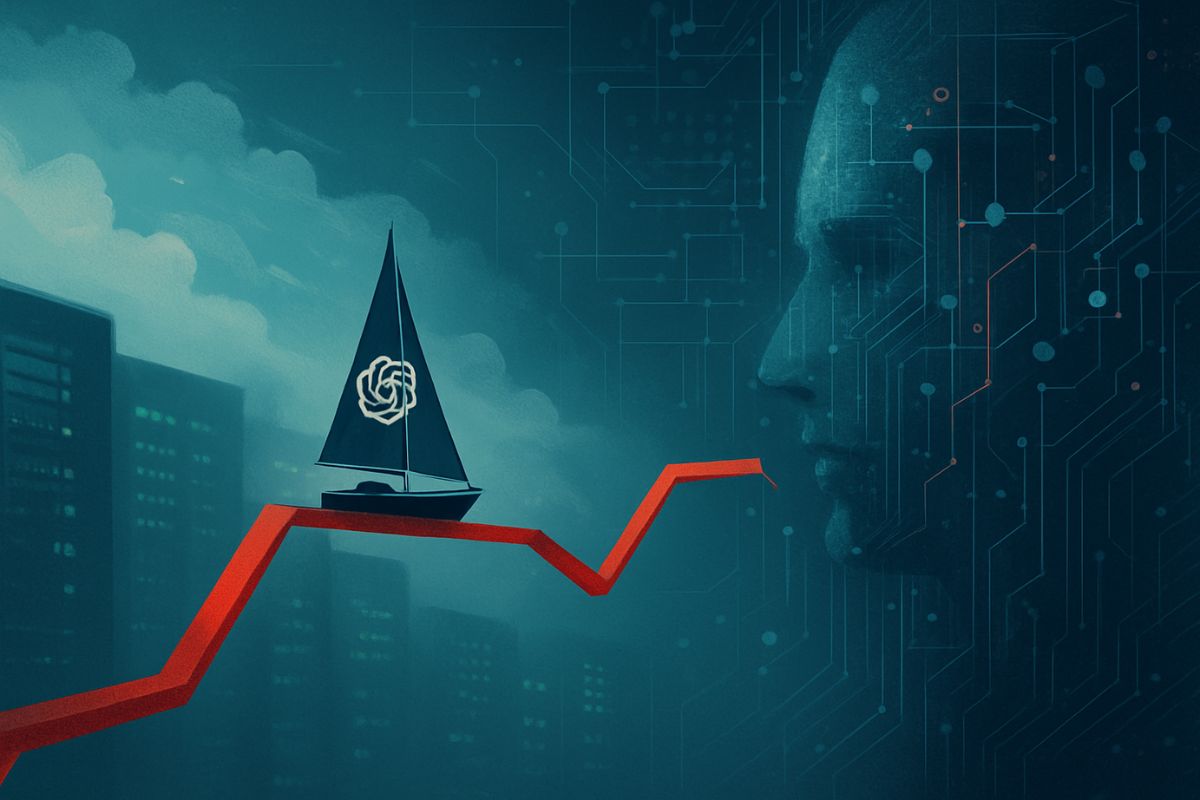


OpenAI Conquered The World With ChatGPT, But It’s Still Far From Turning A Profit. Find Out What Prevents This Tech Giant From Getting Out of The Red
ChatGPT seems to be everywhere: on phones, computers, in work meetings, and even in everyday conversations. Since its launch in November 2022, the chatbot developed by OpenAI has become a global craze, with millions of users excited about its impressive capabilities. However, despite its overwhelming popularity and the billion-dollar revenue it generates, there’s a surprising fact behind this seemingly unbeatable success: ChatGPT is not yet profitable. Furthermore, according to the company’s own calculations, it won’t be profitable anytime soon.
A Popular Giant, But Financially Complicated
OpenAI is living a paradox that many famous startups have faced: having millions of users and substantial revenues does not necessarily mean generating profit. The company founded by Sam Altman is a clear example of this. Even with rapid growth and impressive annual revenue, OpenAI continues to spend more money than it can raise, remaining in the red year after year.
To understand this scenario, just look at the recent figures. According to estimates revealed by the specialized portal The Information, OpenAI has accumulated losses approaching 5 billion dollars just in 2024. And the situation in 2025 does not seem much better. The reason? The astronomical costs needed to train increasingly powerful models, maintain robust servers in continuous operation, and recruit highly specialized professionals in the field of artificial intelligence.
-
Survivor of 1966 SS Daniel J. Morrell Shipwreck in Lake Huron Recounts 38-Hour Ordeal in Extreme Cold

-
The Greatest Hoax in World Cup History? The Film That Denied Brazil’s 1958 Victory and Exposed How Fake Evidence Can Seem Convincing on TV
-
Fake South Korean Online Stores Offer Shopping Thrill Without Spending Money or Receiving Products
-
Brazilian Joins Homeownership Consortium, Faces Decade of Dual Payments Totaling $141,000, Surpassing Traditional Mortgage


The Example Of Other Giants: Spotify And Telegram

The situation at OpenAI is not unique. Similar stories can be found in other big names in the tech industry. Spotify, for example, was founded in 2006, but it had to wait no less than twelve years to record profits for the first time, which only happened in 2018. And even then, it only managed to close a whole year in the positive recently, in 2024.
Another emblematic case is Telegram, which emerged in 2013 and accumulated users by the millions without ever generating profit. It took eleven years and a massive base of 900 million active users for the platform to finally become profitable in 2024. These examples clearly show that achieving profitability is a complex marathon, even for the most popular startups.
Billion-Dollar Revenue, But Insufficient
A key point to highlight in the case of OpenAI is the rapid growth of its revenues. Data revealed by the Financial Times shows that from 2023 to 2024, the company’s annual revenue nearly doubled, jumping from 5.5 billion to around 10 billion dollars. Half of that impressive sum comes specifically from paid subscriptions to ChatGPT.
However, even with this accelerated expansion, the company estimates that it still needs to multiply its revenue by more than ten times to reach the annual figure of 125 billion dollars, a point at which, according to its own executives, it could finally become profitable. The internal expectation is that this will only happen in 2029, emphasizing that even with substantial revenues, costs are proportionally enormous.
The Path To Profitability Passes Through The API And Advanced AI
To achieve this ambitious financial goal, OpenAI is betting heavily on two main fronts: the API (Application Programming Interface) and so-called advanced artificial intelligence agents. The API allows companies across various sectors, such as health, finance, and technology, to integrate sophisticated OpenAI models, like GPT-4.1, into their own products and services.
The advanced agents are technologies that go beyond merely answering questions; they can execute complex tasks autonomously. OpenAI’s expectation is that these agents will be the basis for highly profitable premium products in the near future.

Financial Privacy And Hybrid Model
Another important point about OpenAI is the peculiarity of its corporate model. Unlike giants like Microsoft, Google, or Tesla, which are publicly traded and required to report publicly every quarter, OpenAI adopts a hybrid model, consisting of a nonprofit entity (OpenAI, Inc.) and a limited for-profit subsidiary, which is currently undergoing a process to become a public benefit corporation.
As it does not have publicly traded shares, OpenAI does not need to disclose its detailed financial results to the public, making it difficult to evaluate its revenues, costs, and losses with total accuracy. The available information mostly comes from leaks, estimates by specialized sites, and selectively shared reports with private investors.
Conclusion: Success Does Not Guarantee Immediate Profit
The trajectory of OpenAI with ChatGPT proves that it is perfectly possible to conquer the world with revolutionary technology without, however, ensuring immediate profits. Sam Altman’s company continues to struggle to balance its financial books while rapidly expanding its revenues.
The path to profitability is still long, but the horizon is promising. It remains to be seen whether OpenAI will be able to meet its optimistic forecasts by 2029, turning a global phenomenon into an economically sustainable business.





Uma coisa é certa se não gera lucro no mercado ninguém investe ou mantém …
Se NGM tem acesso aos números mais passível de ser uma grande mentira , não acredito que a empresa da open aí não tem lucro com Ia..