





 Portuguese
  English
  Spanish
  4 min of reading
  0 comments


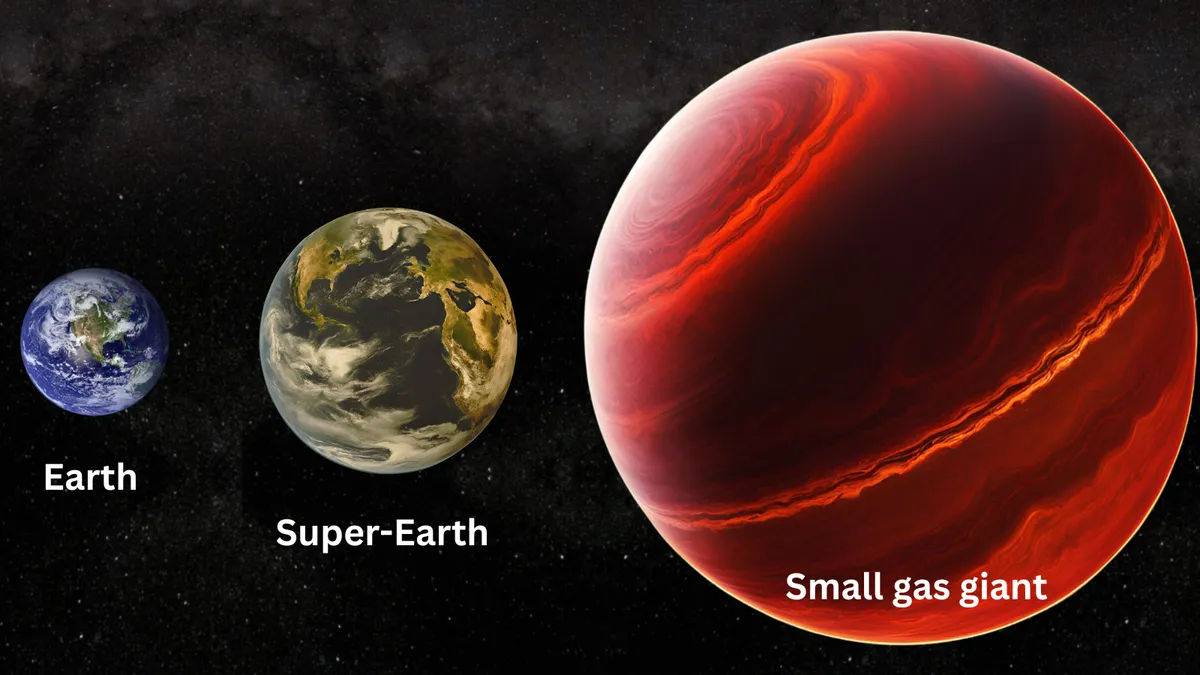
Kepler-725c Was Identified Through Gravitational Variations and Only Remains in the Habitable Zone During Part of Its Elliptical Orbit.
A new discovery has stirred the scientific community: a super-Earth exoplanet has been identified orbiting a star 2,472 light-years from Earth.
The super-Earth, named Kepler-725c, has an unusual characteristic that makes it even more intriguing. It only remains in a potentially habitable region during part of its orbit.
Additionally, its detection was made indirectly, without scientists ever seeing it transit in front of the star.
-
Error on the FIFA website releases free tickets for the 2026 World Cup for $0, surprising around 60 fans and now puts buyers against the clock to pay before cancellation.

-
Rains of up to 200 mm already have a date to advance over Brazil: atmospheric phenomenon, cyclone, and moisture river may cause intense storms in 6 states and put millions of people on alert in the coming days.
-
The most advanced maritime radar of the US Navy secures a $515 million contract, targets hypersonic missiles, hostile ships, and aircraft, and is expected to equip more than 50 vessels in the next decade.

-
While a common construction still relies on months of masonry work, debris, and a blown budget, ready-made houses that arrive by truck, 3D-printed walls, and robots that lay blocks are beginning to transform construction into an assembly line.



Detected Without Being Seen
The discovery of Kepler-725c was not made through images or direct observation. Scientists used a method known as TTV, an acronym for “Transit Timing Variations.”
Normally, planets are detected when they pass in front of their star, causing a slight dip in observed brightness. This is the traditional transit method, used by the space telescope Kepler from NASA, responsible for over 3,300 confirmed exoplanet discoveries.
However, this technique has limitations. It favors planets with short orbits and requires perfect alignment with Earth’s field of view. Small inclinations can prevent detection.
The TTV technique overcomes this obstacle. When a visible planet transits its star with delays or advances, these variations can indicate the presence of another invisible planet affecting its orbit with gravitational force.
Gravitational Influence
This is what happened with the planet Kepler-725b, a gas giant with an orbital period of 39.64 days. Researchers analyzed irregularities in the transit of this planet and discovered that it was being influenced by another body.
Thus, it was possible to infer the existence of Kepler-725c, even without seeing it. The data also allowed them to determine its mass and orbit.
The study was led by Sun Leilei from the Yunnan Observatories in the Chinese Academy of Sciences. In a statement, he noted that the team successfully identified the orbital parameters of the hidden planet based on the variations observed in Kepler-725b.
Ten Times the Mass of Earth
Kepler-725c has an estimated mass of about 10 times that of Earth. This places it among the largest examples of super-Earths — large rocky planets, for which there is still no known equivalent in our solar system.
The properties of these super-Earths continue to generate debates within the scientific community. It is still uncertain what their atmospheres would be like, whether they would have tectonic plates, or how their gravity would affect the possibility of life.
What is known so far is that Kepler-725c has a highly elliptical orbit with an eccentricity of 0.44. For comparison, Earth has a much lower, almost circular, eccentricity of 0.0167. This means that, over the course of its orbit, Kepler-725c comes quite close to its star at times and moves far away at others.
Short Passages Through the Habitable Zone
Due to its elongated orbit, the planet enters and exits the so-called habitable zone — the region around the star where temperature would allow for the existence of liquid water on the surface.
Despite receiving on average 1.4 times more heat than Earth, this average hides significant variations. At certain times during its orbital year, the planet receives much less radiation.
If Kepler-725c has an atmosphere, these drastic changes in heating could severely affect its climate. The habitable zone does not track the planet along its elliptical trajectory.
It is potentially habitable for only a fraction of its 207.5-day “year.” This raises the question: could life exist in such a constantly changing environment?
These uncertainties have been theoretically discussed for years. But the confirmation of Kepler-725c turns these assumptions into real questions.
Despite the discovery, scientists will not be able to analyze its atmosphere with the James Webb Space Telescope, as the planet does not transit directly in front of its star. This type of analysis relies on light from the star passing through the planet’s atmosphere, something impossible in this case.
Future of Discoveries via TTV
The good news is that the TTV technique promises to reveal other similar worlds. When the PLATO probe from the European Space Agency is launched in 2026, it is expected that many other exoplanets may be detected through this technology.
The advantage of the TTV method is precisely in allowing the identification of more distant planets with wide orbits that cannot be observed through traditional transit methods.
Sun Leilei emphasized that the discovery of Kepler-725c reinforces the potential of the method to find low-mass planets in habitable zones around sun-like stars. This broadens the possibilities in the search for worlds that might harbor life.
The confirmation of the existence of Kepler-725c was published in the scientific journal Nature Astronomy on Tuesday, June 3. The discovery not only expands the catalog of known exoplanets but also reinforces the importance of alternative observation techniques.
Science gains a new tool to explore the mysteries of the universe — and the search for life beyond Earth gains another candidate for observation.
Even without being visible, Kepler-725c already holds an important place in current astronomy. A giant planet, in an unstable orbit, that passes through a habitable zone only for a brief time — and that was discovered solely by its effects on another planet.


-

3 people reacted to this.