Portuguese
  Spanish


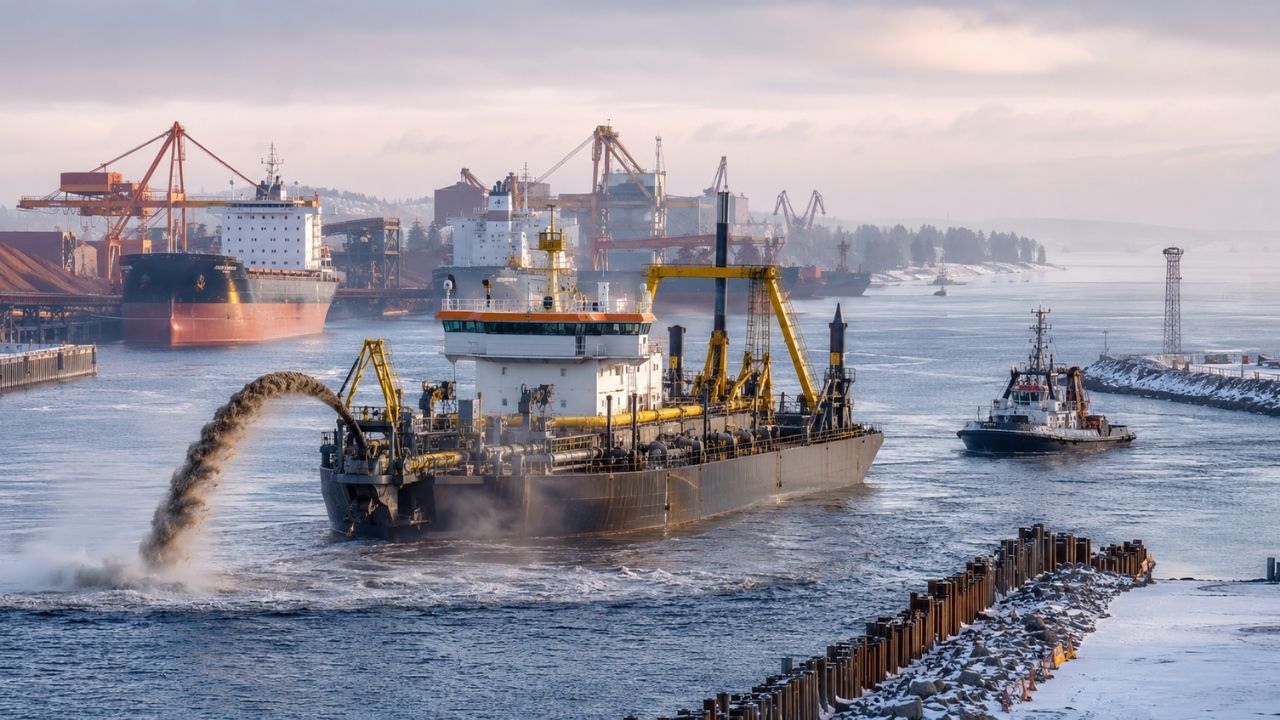


The new dredging in Luleå repositions Sweden on the logistics map of Northern Europe, expands ship entry into the Baltic Sea, and aims to resolve a historical bottleneck for iron ore outflow and industrial supply.
According to the Sjöfartsverket website, the official body of the Swedish Maritime Administration responsible for navigation, maritime safety, and port infrastructure, what makes the news significant is not just the colossal volume of material to be removed. The plan foresees approximately 22 million cubic meters of dredging, modernizes access channels, enhances maritime safety, and aims to free up a route considered crucial for iron ore coming from northern Sweden and Finland. In other words, it’s not just about deepening a port, but about redesigning a strategic artery of the Baltic Sea.
Luleå became the center of a project aiming to change the port’s scale

The Malmporten project was designed to increase the operational capacity of the Port of Luleå and allow the entry of the largest vessels capable of accessing the Baltic Sea when the area is ice-free. This change is considered decisive because the ore transport line to Narvik is already operating under strong pressure, and the alternative of receiving larger ships in Luleå now carries direct economic weight.
-
He has never read a line of code, but he already knows how to work: the French company UMA presented in Paris the Northstar, its first AI-powered humanoid robot designed for factories and warehouses, capable of copying tasks just by observing an employee in action.

-
A young Kenyan engineer collects plastic waste from the streets and transforms it into robots that translate physics lessons into sign language in real-time, a machine made with old bottles that teaches what was missing to deaf children left out of science.

-
What is the dark substance found in the sand of Ipanema Beach? Civil Police conduct an examination, collect samples of the material, and initiate an investigation to identify the composition, clarify the origin, and verify if there was an environmental crime.
-
The beer that was hidden for 3,000 years has returned to the world: scientists find yeast preserved in Ancient Egyptian vessels and recreate a pharaoh’s drink to discover the lost taste of an ancient civilization.




The logic is simple yet powerful. As iron ore is a relatively low-value commodity, transport needs to gain scale to keep costs under control. Larger ships help reduce the cost per ton transported, decrease fuel consumption, and also alleviate emissions per cargo moved. The same reasoning also applies to the reception of coal destined for steelmaking.
The 22 million m³ help measure the true scale of the intervention

The most striking number of the Malmporten project is the preliminary dredging volume: approximately 22 million m³ in situ. Of this total, about 1 million m³ corresponds to rock, approximately 20 million m³ to sand and moraine, and about 0.6 million m³ to contaminated material, which will require treatment and controlled disposal.
The planned depth varies between 16.85 meters and 12.85 meters, within the Swedish national system RH2000. In areas connected to dock foundations, the trench depth can reach around 19 to 20 meters. It is this combination of volume, depth, and differentiated material treatment that helps explain why the project is treated as a landmark for Swedish maritime infrastructure.
The most curious part is that the port depends not only on excavation, but also on ice, winter, and a hybrid tugboat
The Luleå case draws attention due to an unusual detail in large port projects: the engineering must respond not only to the seabed but also to the extreme winter of the Gulf of Bothnia. As there is ice in the region for five to six months a year, the transport route near the Swedish coast is also being improved to reduce travel time and the need for icebreaker assistance.
This scenario makes the project’s visual scene even grander. Amidst the dredging, the Vilja stands out, described as the world’s most modern tugboat, with hybrid propulsion and icebreaking capability, acquired by the Port of Luleå to assist significantly larger vessels that will now dock there. The work, therefore, involves not only dredgers and channels: it also requires an operation adapted to a harsh, seasonal, and highly technical maritime environment.
The project impacts cost, emissions, and safety on a strategic ore route
The expansion of the port’s capacity has a direct impact on the competitiveness of the northern European mineral chain. If Luleå can receive much larger vessels, iron ore outflow can gain efficiency and reduce some of the pressure currently concentrated on other routes. This means less waiting, fewer bottlenecks, and better logistical utilization in a region that depends on robust infrastructure to remain competitive.
There is also a relevant environmental and operational effect. Larger vessels reduce fuel consumption per ton of goods transported and, consequently, decrease relative emissions. The project also includes the modernization of waterways in accordance with recommendations from the Swedish Transport Agency and international guidelines for signaling and safety margins, which expands the importance of the work beyond just cargo capacity.
The Baltic Sea enters the story as a physical limit and strategic opportunity


The Malmporten project doesn’t just affect Luleå. A small intervention is also planned in Norra Kvarken, a point where the current depth limits the size of vessels that can access ports in northern Sweden and Finland, within the Gulf of Bothnia. This detail expands the scope of the work and shows that the dredging responds not only to a local problem but to a regional restriction.
When observing the logistical map of northern Europe, it becomes clearer why the project attracts attention. By allowing the entry of the largest vessels that can reach the Baltic Sea, Luleå begins to compete at a new level of relevance for mineral cargo and industrial supply. The port ceases to operate at its current limit and seeks to transform into an infrastructure prepared for much larger flows.
What can still happen until the end of the project’s planned window
The informed schedule for Malmporten indicates an implementation period between April 2024 and December 2026, with environmental license and funding already secured. Activities occur in partnership with the Port of Luleå, while works by Luleå Hamn AB proceed in parallel with normal port operations, which adds complexity to the execution.
This makes the project something that deserves attention until its completion. If the goal is achieved, Luleå could go from a port limited to 50,000-ton ships to a structure capable of receiving 160,000-ton vessels, redesigning ore logistics in the Baltic Sea. In a region where ice, depth, safety, and scale define competitiveness, dredging ceases to be merely a hydraulic work and becomes a strategic international gamble.