Portuguese
  Spanish


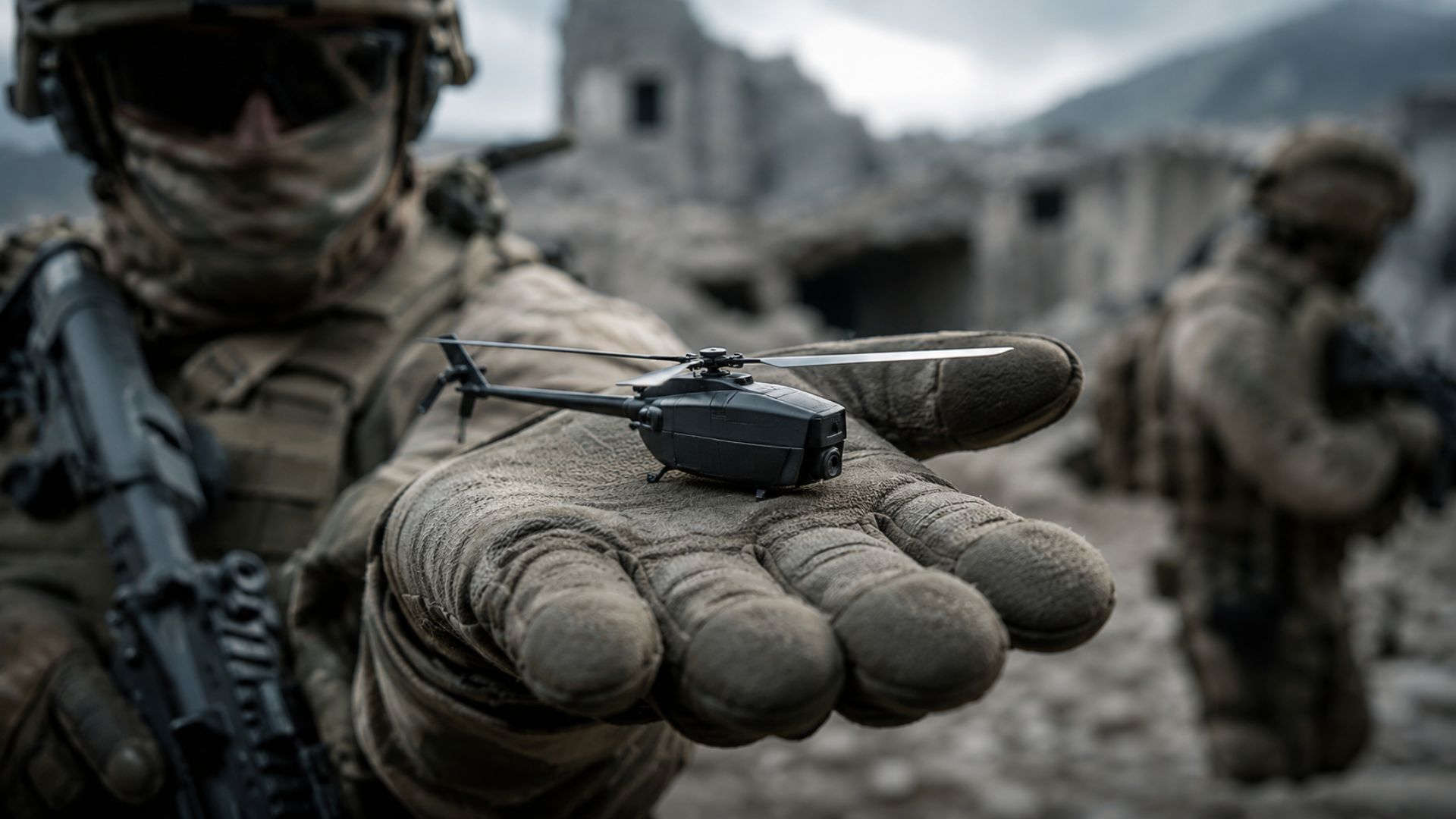

The Black Hornet is a military nanodrone manufactured by Teledyne FLIR Defense that fits in a soldier’s pocket and allows reconnaissance of dangerous areas without direct troop exposure. The latest nanodrone, the Black Hornet 4, weighs 70 grams, flies for more than 30 minutes, covers more than three kilometers, and operates under winds of 25 knots and rain. FLIR Defense has already delivered more than 33,000 units of the nanodrone to military and security forces in over 45 countries, and contracts with the United States Army already total more than 300 million dollars.
The nanodrone that is changing military reconnaissance worldwide weighs 70 grams and is the size of a finger. The Black Hornet, originally developed by Norwegian Prox Dynamics and now manufactured by Teledyne FLIR Defense, was designed to give soldiers in the field a discreet way to observe threats, access remote locations, and enhance situational awareness without needing to expose themselves. The nanodrone is ready to fly in less than a minute, generates an almost imperceptible noise, and transmits live video and images to a portable device used by the operator, who can control it by joystick or program a route with integrated GPS.
The complete system of the nanodrone includes two drones and a base station, designed to fit alongside an individual soldier’s equipment. FLIR Defense has already delivered more than 33,000 units of the Black Hornet to forces in over 45 countries, and orders placed by the United States Army through the Soldier Borne Sensor program and other contracts already total more than 300 million dollars. In May, the company inaugurated a 13,000 square foot facility in Somerset, Kentucky, as a center for maintenance, testing, and training for systems used by the U.S. Armed Forces.
What the Black Hornet nanodrone can do

The Black Hornet 4, the latest version of the nanodrone, weighs 70 grams, flies for more than 30 minutes, and covers more than three kilometers. The equipment features a 12-megapixel daytime camera, high-resolution thermal camera, and advanced obstacle avoidance capabilities, allowing operation in congested urban environments, tunnels, and buildings without relying on GPS.
-
She spent 73 years breathing inside an iron lung, survived the aftereffects of polio, and became the last woman in the United States dependent on the equipment before dying at 78 years old.

-
Brazilian students created a $1 filter using pine bark, cotton, and 3D-printed parts to clean cassava wastewater, reduce the toxicity of a hazardous waste, and transform contaminated water into biofertilizer.

-
Astronaut from Artemis II steps down after mission to the Moon and decision surprises after a record of 406,771 km, a historic 10-day journey, and an unprecedented achievement for Canada.

-
A fossil kept for years in a small museum in Montreal concealed 450-million-year-old soft tissue, a discovery that has only happened once before in history.


According to information released by the Época Negócios portal, the nanodrone reaches speeds of up to 10 meters per second and operates under winds of 25 knots and rain, conditions that would down similarly sized civilian drones. The digital data link allows operating the Black Hornet in a straight line up to a thousand meters away. For the soldier in the field, the nanodrone functions as an extra pair of eyes that can enter a building, check what’s on the other side of a wall, or fly over an intersection before the team advances.
The evolution of the nanodrone in four generations


The development of the nanodrone began in April 2008 by Prox Dynamics. The first model, the PD-100, measured 100 millimeters in length, weighed only 16 grams including the camera, and entered serial production in early 2012. The United Kingdom’s Ministry of Defense signed a 31 million dollar contract for 160 units of the nanodrone, which was deployed in Afghanistan for surveillance of British troops.
In 2016, FLIR Systems acquired Prox Dynamics for 134 million dollars. The Black Hornet 3, launched in 2018, weighed 32 grams and gained the ability to fly without GPS. The version 4 of the nanodrone nearly doubled the weight to 70 grams, but in exchange extended the autonomy to more than 30 minutes, the range to more than three kilometers, and added a thermal camera and obstacle avoidance.
Why 45 countries adopted the nanodrone
The nanodrone solves a problem that has accompanied infantry since war exists: knowing what’s ahead without risking lives to find out. In urban operations, jungles, or mountainous terrains, the Black Hornet allows a patrol of a few soldiers to have the same reconnaissance capability that previously required helicopters, larger drones, or sending scouts on high-risk missions.
The cost, although high for such a small object, is justified by the reduction in casualties. The United States Army has been acquiring the nanodrone since 2018 and has already invested over 300 million dollars in the program, demonstrating that the value of protecting soldiers surpasses the price of the equipment. In more than 45 countries, defense and security forces use variants of the Black Hornet in operations ranging from urban combat to border surveillance.
The nanodrone and the future of military reconnaissance
The inauguration of the maintenance center in Kentucky signals that FLIR Defense treats the nanodrone as a long-term product, not as a passing technological novelty. The investment in support infrastructure indicates that the American Army plans to operate the Black Hornet for decades, integrating the equipment into the combat doctrine of small units as a standard tool.
For the future, the trend is for the nanodrone to become even lighter, more autonomous, and capable of operating in coordinated swarms, multiplying the surveillance capacity of a single patrol. The Black Hornet has already proven that a 70-gram piece of equipment can change the equation of a confrontation, and each new generation expands the possibilities for soldiers who, before the nanodrone, had as their only option to stick their own heads out of cover.
Did you know there is a 70-gram military nanodrone that fits in your pocket and has already been sold to more than 45 countries? What impresses you the most: the size, the thermal camera, or the 300 million dollars in contracts? Tell us in the comments.