Portuguese
  Spanish


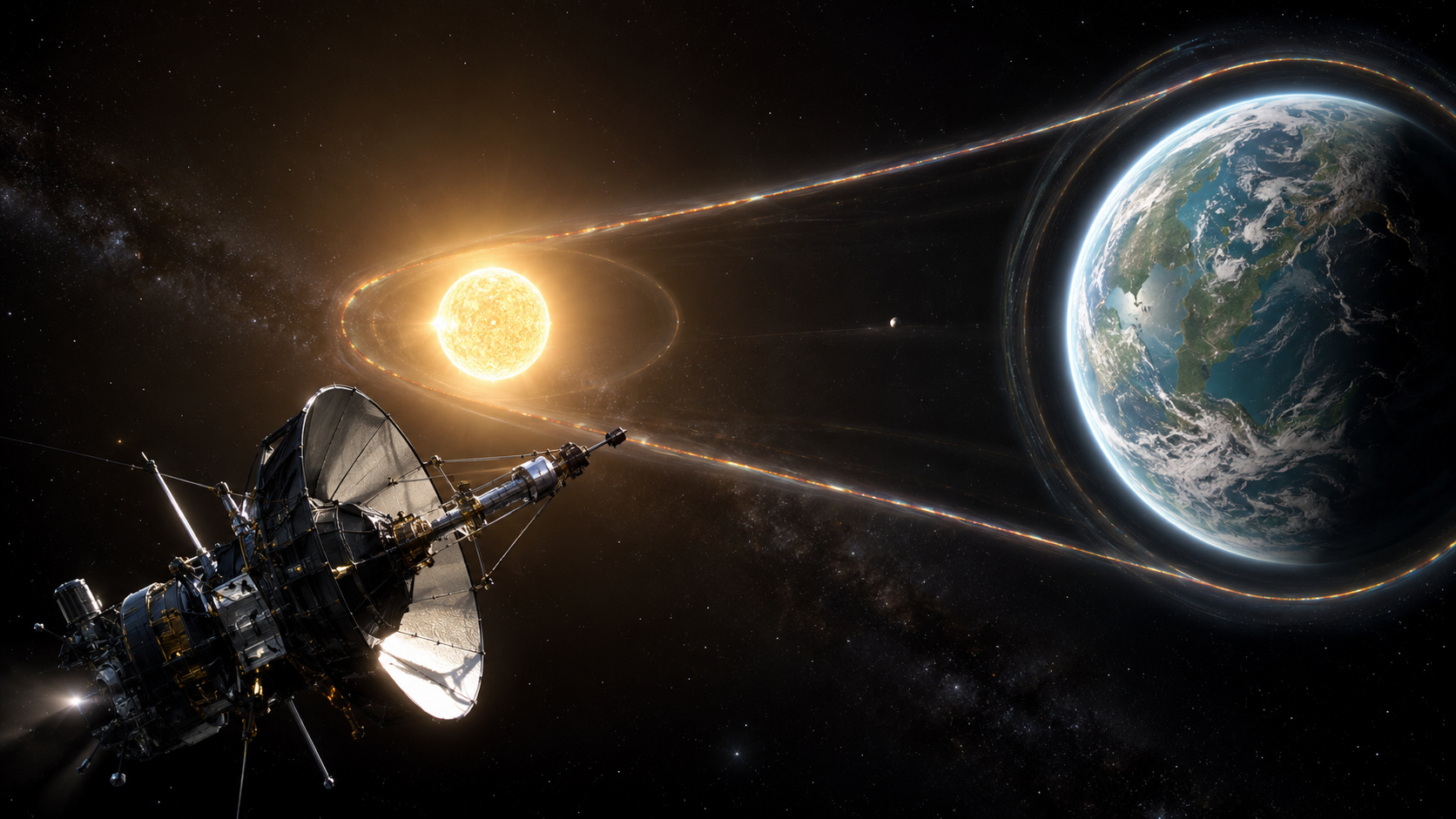

NASA project studies using the solar gravitational lens to generate direct images of exoplanets with resolution far beyond current telescopes.
One of the most ambitious concepts ever studied by NASA for the search for life beyond Earth does not involve building an even larger telescope, but turning the Sun itself into an astronomical instrument. The proposal, called Solar Gravitational Lens, or solar gravitational lens, attempts to exploit the curvature of light predicted by relativity to magnify the image of very distant exoplanets.
The idea is to position a spacecraft beyond 547.6 astronomical units, in the region where solar gravity acts as a natural lens. According to studies cited by NASA, this configuration can offer brightness amplification of the order of 10¹¹ and angular resolution of about 10⁻¹⁰ arcseconds, a level unattainable for conventional telescopes.
How the solar gravitational lens would transform the Sun into a natural telescope
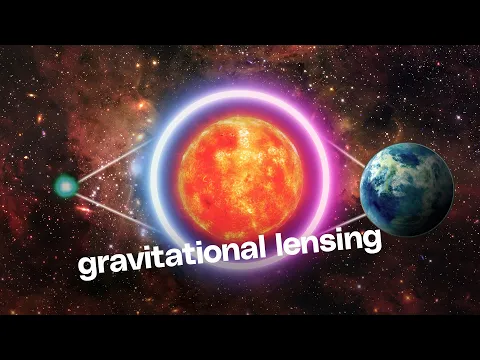
The concept is based on a central principle of general relativity. When light passes by a very massive body, like the Sun, its trajectory is deflected, and this deflection allows the star to function as a cosmic lens capable of concentrating light coming from much more distant objects.
-
Spanish Startup Develops Europe’s Densest Solid-State Battery at 402 Wh/kg

-
Australian Researcher Turns Discarded Coffee Grounds into Eco-Friendly Bricks with 80% Less Pollution and Double the Strength Required by Law

-
Scientific Tool Developed in Brazil Aims to Prevent Femicide by Identifying Risk Factors and Strengthening Women’s Protection

-
Brazil Sets New LED Bulb Efficiency Standards to Save Energy for 14 Million Homes by 2028




In practice, the spacecraft would be aligned with the Sun and the target exoplanet. The light from this distant world would be compressed into an Einstein ring around the solar disk, and the mission’s telescope would collect this signal to reconstruct the planet’s image with computational processing.

This focal region begins at great distances from the Sun and extends for hundreds of astronomical units.
The mission architecture study works with scientific operations between 548 and 900 AU, a range where the solar gravitational lens could be used for multipixel images of exoplanets located up to 100 light-years away.
Solar gravitational lens can generate images of exoplanets with oceans and continents
The main attraction of the proposal lies in what it promises to see. In the study presented by NASA, a metric-class telescope with a coronagraph, operating in the focal region of the solar gravitational lens, could reconstruct in about six months an image of an Earth-like planet at 30 parsecs with a resolution of approximately 25 kilometers on the surface.
This level of detail would already be sufficient to distinguish broad planetary structures and relevant signs of habitability. NASA’s own description of the concept talks about observing surface features and possible indications of habitability, a huge leap compared to current methods, which generally detect exoplanets as points of light or infer properties through indirect signals.
A subsequent study, from 2022, refined the analysis of solar corona noise and integration times. The authors concluded that, under realistic conditions, a high-quality image with 1000 x 1000 pixels of an Earth-like planet in Proxima Centauri could be obtained with approximately 14 months of integration, which significantly reduced more pessimistic duration estimates.
Mission to the solar gravitational lens would require decades-long journey beyond 550 AU
The scientific promise is extraordinary, but the distance is brutal. The architecture study states that the mission would have to operate from 548 AU, far beyond Neptune’s orbit and much farther than any astronomical observatory ever sent by humanity.
Therefore, researchers do not treat the proposal as a simple extension of current missions. The work talks about decades of travel up to 900 AU and discusses an architecture with solar sailing, or navigation with solar sails, as well as in-flight aggregation of modular units and the use of small spacecraft to reduce risk and cost.
The requirement for precision is also extreme. The technical study indicates that repositioning the observatory in the image region requires precision on the order of 1 meter between sampled pixels, because the final image is not captured at once but reconstructed point by point along the spacecraft’s movement in the focal plane.
NASA’s challenges with the solar gravitational lens go beyond distance
Traveling so far is only part of the problem. The image of the exoplanet would arrive mixed with the brightness of the solar corona, which the 2022 study points out as the main source of stochastic noise for observations of this type.
Furthermore, the signal produced by the solar gravitational lens does not arrive as a ready-made photograph. It needs to be collected, calibrated, and deconvolved with advanced algorithms, because the observed image suffers from the effects of the lens’s own optics, background noise, and the dynamics of the observed system.

The researchers also highlight long-term obstacles, such as communication over extreme distances, reliable power supply, operational autonomy, and ultra-fine navigation. Nevertheless, the architectural study concludes that the mission is challenging but feasible with existing or actively developing technologies.
NASA’s project for exoplanets is still a concept, but has already left the realm of fantasy
The Solar Gravitational Lens is not yet an approved mission for launch. What exists today is a matured technical concept in studies supported by NASA and conducted with strong participation from the Jet Propulsion Laboratory, already with scientific goals, preliminary architecture, and quantitative performance estimates.
In the material published by NASA, the team states that the study in NIAC Phase II confirmed the feasibility of a mission to the strong interference region of the solar lens, using a metric-class telescope, coronagraph, and an architecture based on multiple small satellites. The proposal also includes ideas to reduce cost and accelerate system development.
If it ever comes to fruition, the concept could radically change exoplanet astronomy. Instead of just detecting atmospheres or measuring brightness oscillations, humanity would attempt to reconstruct real maps of distant worlds, using an entire star as a lens to view planetary surfaces outside the Solar System.