






 Portuguese
  Spanish


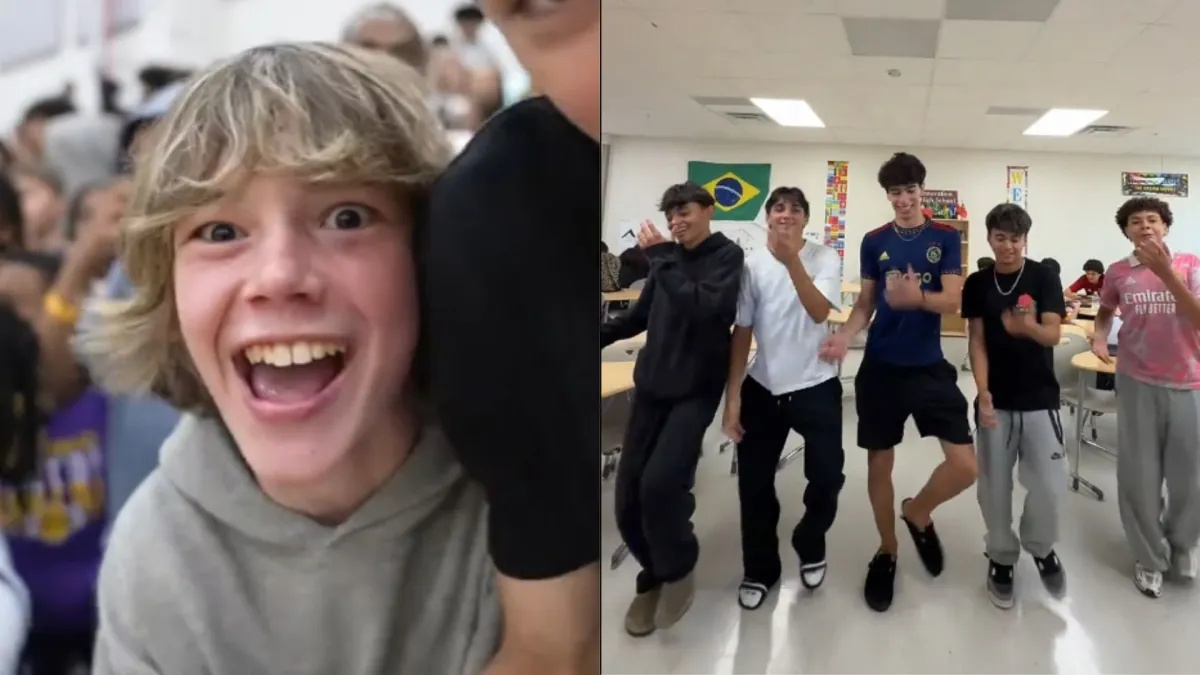

A nonsensical fixed number left social media, entered schools, and became one of the most repeated catchphrases among children and teenagers, driven by music, short videos, sports, and the effect of group identification.
An expression without a defined meaning began to occupy classrooms, short videos, and conversations among children and teenagers, especially in the United States.
Pronounced in English as “six-seven”, “6 7” spread on social media and became a catchphrase repeated in everyday situations, often without apparent context.
In 2025, the term was chosen as word of the year by Dictionary.com.
-
Billionaire says the most valuable skill will help overcome job elimination caused by AI, following Bill Gates’ fears

-
A Dutchman created a ‘box’ that makes trees grow in the desert almost without water and without irrigation: the invention has already brought seedlings to dozens of countries and achieves up to 90% survival where common planting did not exceed 10%.

-
Abandoned warehouse hid a giant collection of rare computers, with over 2,000 artifacts from the 1930s to the 1980s.
-
Scientists warn that melting ice is triggering an alarming chemical transformation in preserved areas, and the first signs are already concerning researchers worldwide.




Without a single definition, the expression gained strength more through collective use than through its literal meaning.
Instead of functioning as a traditional slang, with a stable meaning, “6 7” began to circulate as a recognition code among youth.
According to CNN, teacher Gail Fairhurst states that this type of language can function as a game shared by those who are part of a certain group.
Origin of “6 7” and how the catchphrase went viral
The most cited origin for the catchphrase is the song “Doot Doot (6 7)” by rapper Skrilla from Philadelphia.
The track began circulating at the end of 2024 and helped bring the number into the realm of short videos, sports clips, and memes.
With the repetition in the chorus, the expression became easily recognizable and began to be reproduced in different contexts.
Still, the exact meaning is not consensus.
Some interpretations associate the number with a reference present in the song.
Another part treats the expression merely as a sound element that detached from its origin and gained a life of its own on social media.
According to analyses published about the phenomenon, this displacement is common when a viral term begins to circulate outside its original context.
The diffusion increased when the expression began to appear in videos of athletes and influencers.
One of the most cited episodes involves player Taylen Kinney, who used “6 7” while reviewing a drink in a video published by Overtime.
“`htmlThe phrase was accompanied by a hand gesture, which was later repeated in other recordings and helped to consolidate the meme visually as well.
The number also frequently appeared in posts related to the player LaMelo Ball of the Charlotte Hornets.
In this case, the association was boosted by the fact that the player measures 6 feet and 7 inches, equivalent to 2.01 meters.
The coincidence contributed to the spread of the expression in sports content.
Why “6 7” Spread in Schools
The school environment accelerated the popularization of the catchphrase.
Any mention of the numbers 6 or 7 became a trigger for collective reactions among students.
According to CNN, teacher Gabe Dannenbring reports that just mentioning any variation of these numbers causes several students to repeat the expression aloud.
This type of behavior is not new in the school universe.
Slang, nicknames, and catchphrases often serve as signs of belonging and complicity among children and teenagers.
In the case of “6 7,” the logic is similar but adapted to the dynamics of social media, where short, easy-to-repeat content that can generate reactions tends to circulate more quickly.
The absence of a clear meaning also helps explain the adherence.
Since there is no stable definition, the expression can be used in different situations without a commitment to coherence.
For those participating in the joke, this reinforces the group effect.
For those outside, the lack of explanation can amplify the feeling of strangeness.
According to experts interviewed in reports on the subject, part of the strength of the meme lies precisely in this combination of repetition, collective identification, and adult reaction.
When teachers or parents show discomfort, the expression can gain new momentum among students, who start to repeat it as a way to provoke a response.
The Role of Group Language Among Children and Teenagers
Although treated as nonsense, “6 7” serves a social function.
“`Expressions of this type do not always need to convey objective information to become relevant in a group.
They can also serve to mark presence, reinforce bonds, and distinguish those who share the same cultural repertoire.
Fairhurst states that language helps to form communities and can unite those who understand the code while excluding those who do not recognize it.
This mechanism helps explain why an apparently empty catchphrase can remain in circulation longer than other fleeting internet trends.
Furthermore, the trajectory of “6 7” shows how a meme can cross different environments.
The expression was not restricted to TikTok or online comments.
It began to appear in face-to-face interactions, school hallways, and games among peers, which expanded its presence in daily life.
In some schools, teachers began to try to neutralize the repetition by using the catchphrase themselves in class.
Dannenbring states that, at certain moments, he repeats the expression on purpose or uses it inappropriately to reduce the novelty effect.
The strategy, according to him, usually drains the humor in a few seconds.


What the phenomenon reveals about memes, language, and generation
The circulation of “6 7” has also reignited discussions about language among children and teenagers.
For specialists, however, the creation of their own codes by younger people does not represent, by itself, an unprecedented rupture.
Each generation produces its own slang, expressions, and internal references, often incomprehensible to those outside that group.
What changes in the current scenario is the speed of propagation.
An expression can emerge in a song, gain traction in short videos, be adopted by athletes or influencers, and then reach schools in a short span of time.
This path helps explain how an apparently random catchphrase can become recognizable in different spaces.
According to published analyses on the subject, “6 7” also exemplifies a type of language whose strength lies less in meaning and more in circulation.
In this case, the value of the expression does not depend on explaining something precisely, but on the ability to be repeated, recognized, and shared.
At the same time, excessive exposure tends to accelerate wear and tear.
When parents, teachers, dictionaries, and media outlets start to treat a slang term as an object of analysis, part of the symbolic power linked to the group may weaken.
According to CNN, some students are already starting to show fatigue regarding the catchphrase, while other numerical combinations, such as “41”, appear as possible substitutes.
Still, the case of “6 7” helps to show how a seemingly meaningless expression can gain lasting space by bringing together repetition, digital circulation, and collective identification.
More than trying to define the number rigidly, the phenomenon has been observed as an example of how children and adolescents construct their own language repertoires in environments increasingly influenced by social media.





