Portuguese
  Spanish



Unexpected episode in historical mission reveals extreme preparation of the crew and highlights real challenges of modern space exploration
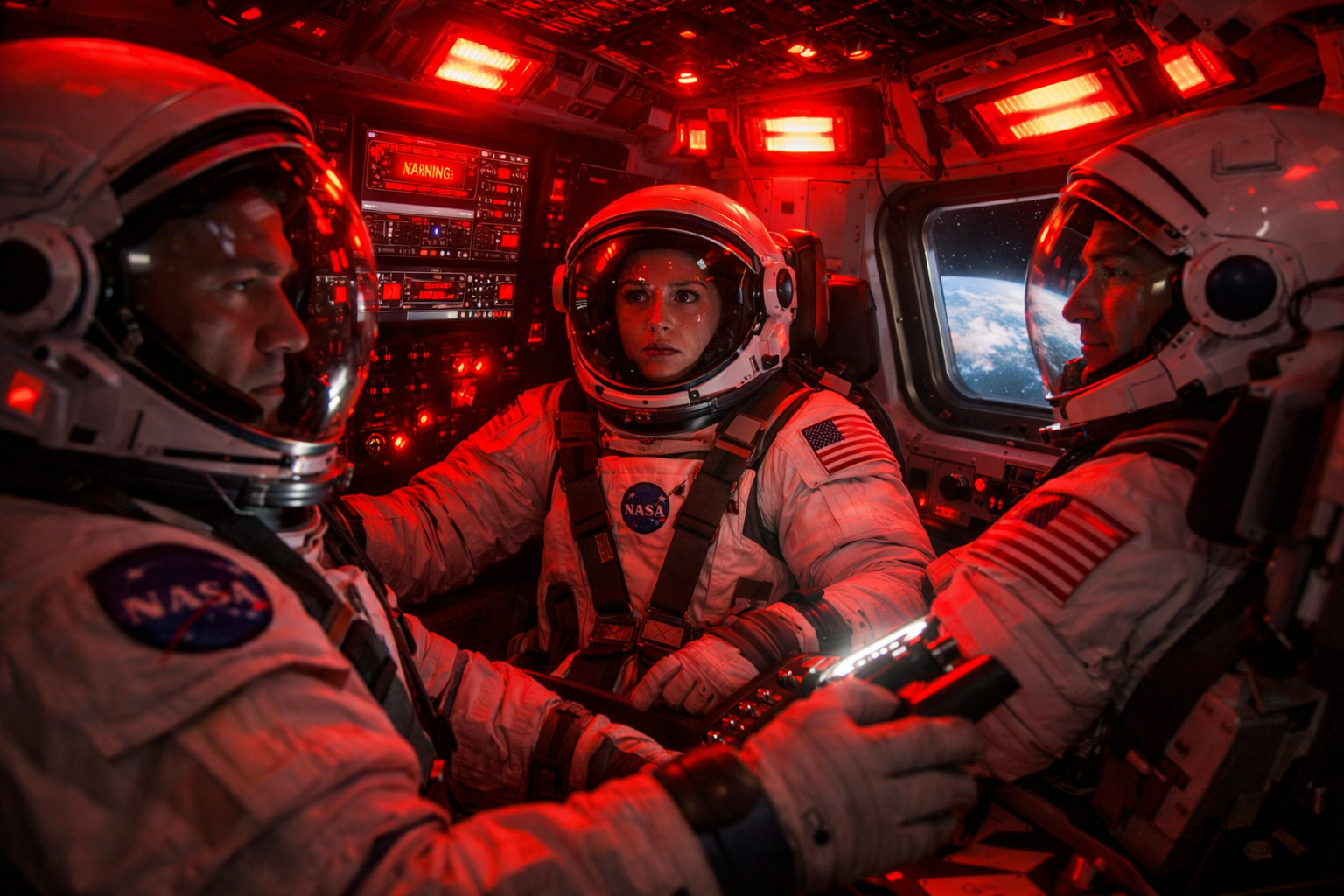
The Artemis II mission, considered one of the most important milestones in modern space exploration, experienced tense moments when a fire alarm was triggered inside the Orion capsule just one day before returning to Earth. The episode, although quickly controlled, practically exposed the risks faced by astronauts even in highly planned operations.
The information was disclosed by “BBC News,” based on statements made during a press conference on Thursday (16), in which Commander Reid Wiseman detailed the situation faced by the team still in space.
NASA training was crucial to contain critical situation in a few minutes
According to Wiseman, the fire alarm went off on the penultimate day of the mission while the crew was still in orbit. Despite the initial scare, he emphasized that the moment was “tense, but not frightening.” Still, the following minutes required absolute focus and strict adherence to NASA protocols.
-
At 9, Hailey Builds Mini Shelters for the Homeless Using Recycled Materials in Her Backyard

-
Seven-Year-Old Nicknamed Hulk Wins Gold in Brazilian Jiu-Jitsu After Defeating South American Competitors

-
Once Burdened by $90,000 in Debt and a Divorce, Now Leads a Beauty Group Targeting $150 Million by 2026
-
Ice Cream Shop Grows from 39 Square Meters to $19 Million Revenue with Popsicles Sold at 20 Cents in Brazil




“It was tense. It wasn’t frightening, but it was tense for a few minutes until we reconfigured everything,” the commander stated.
Although the exact reason for the alarm was not detailed, Wiseman highlighted that the team faithfully followed the training received. In this regard, one of the main rules taught to astronauts was decisive: avoid any impulsive reaction in critical situations.
“We will assess the machine, see what it is telling us, see what Houston is telling us, and then make an integrated decision,” he explained, reinforcing the importance of communication with mission control.
Furthermore, the crew’s quick response allowed the problem to be resolved in a few minutes, without compromising the rest of the mission.
Reentry into the atmosphere reaches extreme temperatures and tests the resilience of the Orion capsule
Despite the incident, the mission proceeded as planned, and the Orion capsule showed positive performance in all stages, including reentry into the atmosphere — one of the most critical moments of any space journey.
During this phase, the spacecraft faced temperatures equivalent to half the surface of the Sun, highlighting the extreme level of engineering involved in the design. Nevertheless, Wiseman reported that, from the crew’s perspective, the descent was surprisingly smooth.
Pilot Victor Glover also emphasized that, overall, the spacecraft responded well to the challenges, demonstrating the reliability of the system even in the face of unexpected situations.
10-day mission leaves physical and psychological impacts on astronauts
Throughout the 10 days of the mission, the four crew members — Reid Wiseman, Victor Glover, Christina Koch, and Jeremy Hansen — experienced events that continue to impact their daily lives even after returning to Earth.
For example, astronaut Christina Koch revealed that she still wakes up feeling like she is floating. In one of the more curious accounts, she mentioned being startled when holding a t-shirt and seeing it fall to the ground, something that contrasts with the absence of gravity experienced in space.
On the other hand, Jeremy Hansen, the only member on his first space flight, described an almost contemplative experience while observing the universe. According to him, the view of the galaxy with the naked eye brought a three-dimensional perception of the stars, something impossible to capture in photos or videos.
Artemis II marks historic return to lunar orbit after more than 50 years
The Artemis II made history by becoming the first crewed mission to reach the vicinity of the Moon since Apollo 17, which took place in 1972. This achievement represents a significant advancement in NASA’s plans to resume lunar exploration.
During the mission, the Orion capsule conducted a lunar flyby, providing unprecedented images, such as the Earth in a crescent shape seen from deep space.
Furthermore, the astronauts also discussed the next steps of the Artemis program. Christina Koch expressed her belief that building a permanent base on the Moon is feasible. Wiseman was even more direct in stating that, had there been a landing module available, the team would have attempted to descend to the lunar surface.
“It’s not the leap I thought it was,” declared the commander, indicating that technological advancements already allow for even greater ambitions.
Next steps include return to the Moon and crewed mission to Mars
The Artemis program’s main goal is to take humans back to the surface of the Moon within this decade, with plans for the Artemis IV mission. However, the plans go beyond that.
In the long term, NASA aims to use the experience gained from these missions to enable crewed trips to Mars, consolidating a new era of space exploration.
Thus, even episodes like the fire alarm serve as crucial learning experiences to improve systems, protocols, and astronaut preparation.