





 Portuguese
  English
  Spanish
  8 min of reading
  0 comments


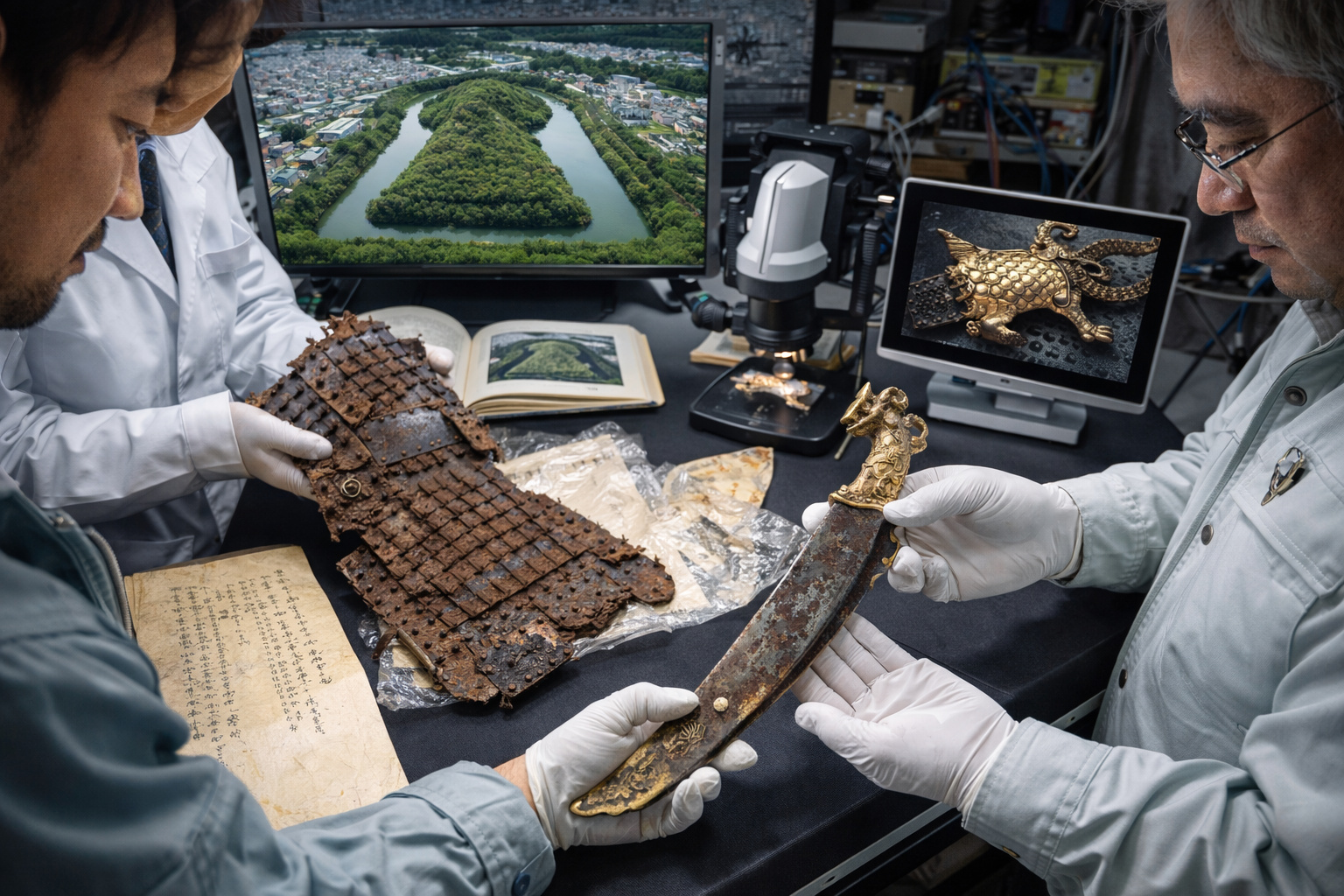
Unprecedented analysis of imperial artifacts reveals sophisticated techniques from the 5th century, reignites debates about scientific access to Japanese tombs, and broadens the understanding of the formation of power and culture in ancient times.
In June 2025, the Kokugakuin University Museum in Tokyo made an announcement that shook Japanese archaeology: two objects acquired from an art dealer in 2024 were confirmed as the first authenticated funerary artifacts from Emperor Nintoku’s tomb — the largest burial mound in Japan, a keyhole-shaped monument 486 meters long surrounded by three moats, which has not been entered since 1872.
According to Archaeology Magazine, Heritage Daily, Ancient Origins, and Japan Times, the objects — a gold-plated iron knife with a Japanese cypress sheath and fragments of golden armor — were wrapped in the original paper from September 1872, with handwritten notes and the seal of Kaichiro Kashiwagi, the man who last saw the inside of the tomb.
And the scientific analysis revealed something that Kashiwagi’s drawings did not show: sophisticated metallurgical techniques that rewrite what we knew about the Japanese imperial court of the 5th century.
-
The James Webb telescope detected the climate of a planet 280 light-years from Earth, with days hot enough to forge iron and nights covered by dense clouds, where winds reach 8,000 km/h.

-
China is equipping a scientific base in the heart of Antarctica with solar, wind, hydrogen, and battery power to operate even during the polar night in the Ross Sea.
-
A British company installed Japan’s first megawatt-scale tidal turbine under the Naru Strait, generating clean electricity from the predictable force of the tides, without relying on wind or sun.
-
End of bricklayers laying brick by brick: compact robots use AI, carry bricks and mortar, pass through doors, work in teams, and are already building real facades in Europe.


The largest tomb in Japan that no one can visit
The Daisen Kofun is located in Sakai, Osaka Prefecture. With a length of 486 meters, a width of 300 meters at its widest point, and a height of 34 meters, surrounded by three concentric moats, it is the largest keyhole-shaped burial structure in Japan — and one of the largest in the world. Viewed from above, the shape is unmistakable: a trapezoid in the front connected to a circle in the back, like an ancient door lock enlarged thousands of times.

The tomb is attributed to Emperor Nintoku, the 16th emperor of Japan, who is believed to have reigned from 313 to 399 AD. It is part of the Mozu-Furuichi group, inscribed as a UNESCO World Heritage Site in 2019. It is controlled by the Imperial Household Agency, which manages the tombs associated with the Japanese imperial family. Access is prohibited. No one climbs the mound. No one enters the chamber. People can only walk around the moats — which, ironically, are popular fishing spots.
1872: the landslide that opened and closed the tomb
The only time someone saw the inside of the tomb was in 1872, when a landslide exposed part of the stone chamber at the front section of the mound. Kaichiro Kashiwagi — a local builder with an interest in cultural preservation — conducted an improvised inspection and made detailed drawings of what he found: helmets, armor, swords, and glass objects. The artifacts were officially buried back.
But not everything went back into the ground. The objects that Kokugakuin acquired 152 years later were still wrapped in the original paper dated September 1872, with handwritten descriptions stating that they came “from the tomb of Emperor Nintoku” and Kashiwagi’s personal seal. The artifacts passed into the private collection of Masuda Takashi, a Japanese industrialist and art collector who had personal ties to Kashiwagi. From there, they went to an art dealer. And in 2024, Kokugakuin purchased them.
The knife that does not exist in any other tomb
The first object is a ceremonial knife called tōsu. The blade is made of iron, broken into two pieces that total about 15 centimeters of original length. It is housed in the original Japanese cypress sheath — a sacred wood in Japanese culture, used in Shinto temples. The sheath is covered by a gold-plated copper plate that is only 0.5 millimeters thick, secured by five silver rivets.

The combination of materials — iron, cypress, gold-plated copper, silver rivets — is unique. No other gold-plated knife from 5th-century kofun tombs is known. Archaeologist Taro Fukazawa from Kokugakuin stated that the knife was not a functional weapon. “These were not everyday objects. They were specifically created as funerary offerings for the ruling elite, demonstrating the extraordinary political and economic power of the Nintoku court.”
The armor that disproved 150-year-old drawings
The second set of objects consists of three fragments of armor measuring between 3 and 4 centimeters. When Kashiwagi drew the artifacts in 1872, he represented the armor as gold-plated copper — a known and expected technique for the period. But when scientists from Kokugakuin and Nippon Steel Technology analyzed the fragments using modern techniques, they discovered something different: the material is iron directly coated with gold. Not copper with gold on top — iron with gold.
The difference is significant. Coating iron with gold is technically more difficult than coating copper, because iron oxidizes and adheres poorly to other metals without prior treatment. The fact that 5th-century artisans were able to apply gold directly onto iron indicates a level of metallurgical sophistication that Kashiwagi’s drawings — the only available reference for 150 years — did not capture. 21st-century science corrected what 19th-century eyes could not distinguish.
The 20,000 tombs that shaped ancient Japan
To understand the meaning of the tomb of Nintoku, one must understand the Kofun period — the era between the 3rd and 6th centuries AD when Japan built around 20,000 monumental tombs throughout the archipelago. The word kofun literally means “ancient tomb.” The largest were reserved for the ruling elite — emperors, empresses, and court members — and were built in the shape of a keyhole, which became the visual signature of the period.
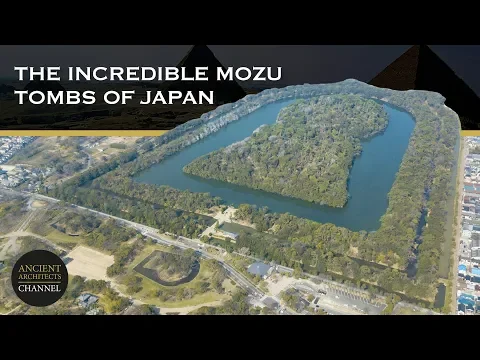

The Kofun period marks the formation of Japan’s first centralized political structures. The tombs were not just graves — they were statements of power. The larger the kofun, the greater the authority of the occupant. And the Daisen Kofun, at 486 meters, is the largest of all — a message carved into the landscape that told the 5th-century world: here lies the most powerful.
The first academic visit since the Second World War
In March 2025 — just a few months before the announcement of the artifacts — representatives from 17 historical and archaeological organizations were allowed to visit the Daisen Kofun for the first time since the end of World War II. Escorted by officials from the Imperial Household Agency, the scholars were able to walk around the mound, but did not enter the burial chamber or remove any objects.
The visit was symbolic: it signaled a gradual opening of access to sites that Japan protects as sacred. But it also coincided — perhaps not by chance — with the announcement that would come in June. Kokugakuin had already had the artifacts since 2024 and was in the process of authentication. The combination of academic access to the mound and confirmation of artifacts from outside it created an unprecedented moment in Japanese archaeology.
The seal that proved everything
The authentication of the artifacts depended on something surprisingly simple: paper. The objects were wrapped in papers dated September 1872, with handwritten descriptions identifying the tomb as that of Emperor Nintoku. Kashiwagi’s personal seal authenticated the provenance. And some of the armor fragments matched exactly the designs that Kashiwagi had made 152 years earlier — confirming that the objects came from the same lot documented in 1872.
The knife, on the other hand, does not appear in Kashiwagi’s drawings. This raises the possibility that he may have kept certain objects secret — documenting some and keeping others for himself. It is an archaeological irony: the man who made the only records of the interior of the tomb may also have been the man who hid part of what he found.
The debate about who is really buried there
Despite the colossal size and the official attribution to Emperor Nintoku, the identity of the occupant of the tomb is not unanimous among scholars. The Imperial Household Agency designated the mound as the mausoleum of Nintoku, but the academic debate about who is really buried there continues. Without access to the burial chamber and without direct analysis of the remains — something the agency does not allow — the question may never be definitively resolved.

The recovered artifacts do not settle the debate but add concrete data. The exceptional quality of the objects — gold over iron, silver, cypress — is consistent with an occupant of the highest rank in the imperial hierarchy. If it was not Nintoku, it was someone of equivalent power.
The museum that can now show what nobody saw
The knife and the fragments of armor have been loaned to the Sakai City Museum for public display until September 2025. For the first time in history, visitors have been able to see authenticated objects from inside the largest tomb in Japan — a place where no modern archaeologist has ever entered.
Professor Takashi Uchikawa from Kokugakuin summarized: “It is significant that objects directly linked to the tomb have appeared.” The statement is measured — in the Japanese academic style — but hides the magnitude of the moment: 153 years after a landslide revealed and sealed the tomb, pieces of what was inside reappeared in an old paper wrapping bought from an antique dealer.
The Boston artifacts that lost the race
Before the confirmation of the Kokugakuin objects, the Museum of Fine Arts in Boston possessed artifacts that were attributed to the Daisen Kofun. But recent studies suggested that the dating of these objects may be incorrect — casting doubt on their origin.
The knife and fragments acquired by Kokugakuin are therefore the first to be “irrevocably confirmed” as belonging to the tomb of Nintoku, in the words of Archaeology Magazine. The distinction matters: in a discipline where provenance is everything, having a wrapping paper from 1872 with the seal of the man who entered the tomb is equivalent to a signed receipt of origin by the sole executor.
Japan that protects its dead like no other country
Japan’s relationship with its imperial tombs has no parallel in the world. While Egypt excavates pyramids, Greece opens Mycenaean tombs, and China unearths terracotta warriors, Japan keeps its largest kofun sealed — not due to a lack of scientific curiosity, but out of religious and political respect for the imperial lineage, considered unbroken since the founding mythology of the country.
The Imperial Household Agency manages hundreds of sites that archaeologists would like to investigate but cannot. The opening in March 2025 — the first academic visit since World War II — was a step, but the interior of the chamber remains out of reach. The paradox is clear: Japan has some of the largest funerary monuments of the ancient world and almost no scientific data about what lies within them.
The tomb that keeps its secrets beneath three moats
The Daisen Kofun remains closed. The moats continue to be filled with water. Fishermen continue to cast lines around the mound that houses one of the most important emperors in Japanese history. And inside the stone chamber that the landslide of 1872 exposed and that Kashiwagi saw for a few moments before everything was sealed again, there may be much more — helmets, swords, glass, objects that he sketched but never reappeared.
The iron knife with a cypress and gold sheath of half a millimeter, and the fragments of armor with iron directly coated in gold, are the only physical evidence the world has of what exists inside the largest kofun in Japan.
They left the tomb in a paper from 1872, passed through a collector, an antiquities dealer, and a metallurgical analysis laboratory before reaching a museum display case. And what they revealed — techniques that the drawings from 150 years ago did not capture — is a reminder that what we think we know about the past is always limited by the tools we use to look.




-

1 person reacted to this.