






 Portuguese
  Spanish
  5 min of reading
  0 comments


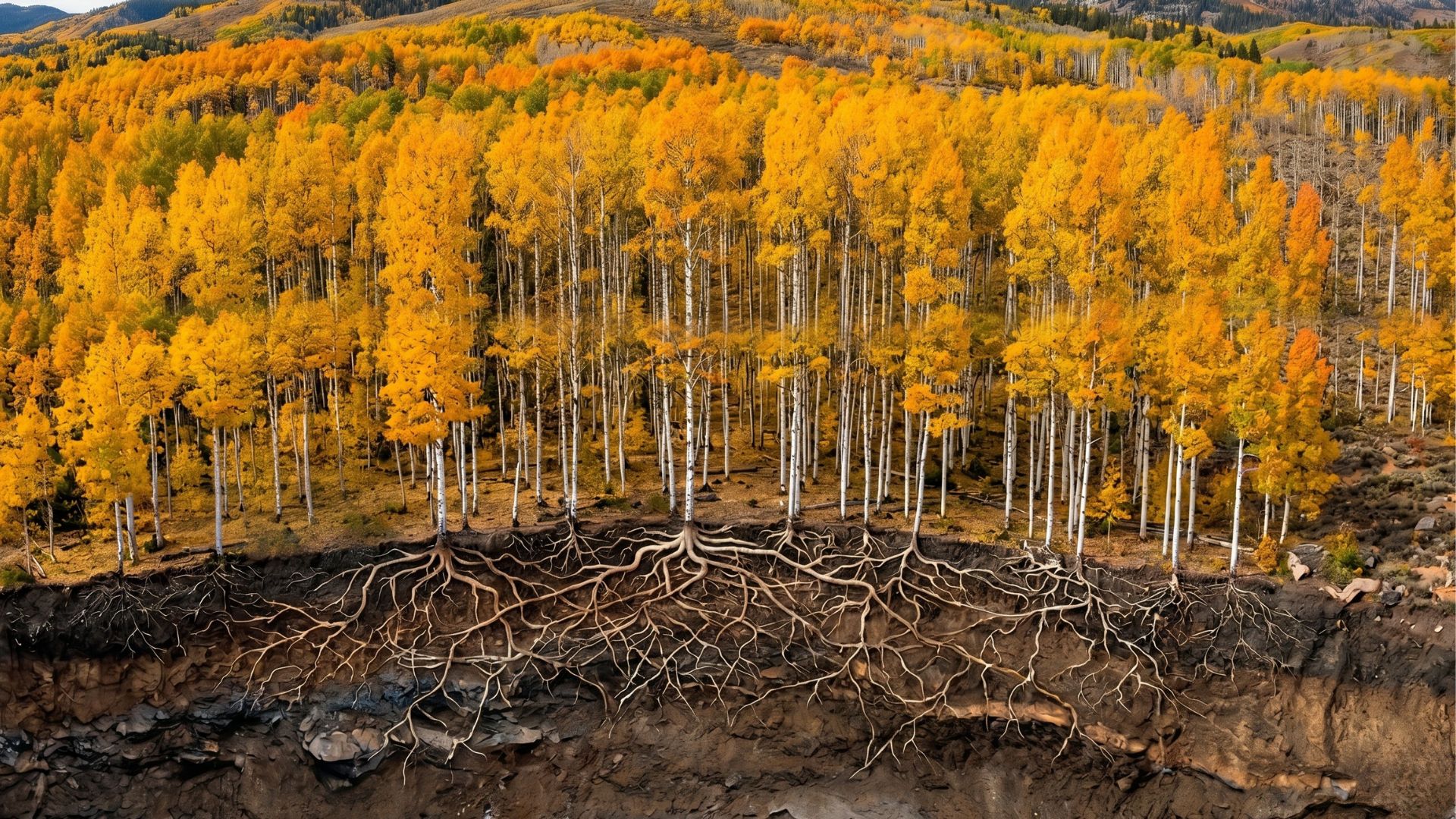
Pando looks like a common forest in the USA, but it is a single organism with more than 40,000 trunks connected by the same underground root.
In the center of the state of Utah, in the United States, there is a place that seems just like a common forest of quaking aspens swaying in the wind. At first glance, nothing indicates that this scene hides one of the most extraordinary organisms ever found on Earth. But scientists have discovered that all those trees are part of a single colossal living being called Pando, a biological structure so gigantic that it challenges the way humans usually understand the concept of a tree.
Located in the region of the Fishlake National Forest, Pando is a clonal colony of the species Populus tremuloides, known as quaking aspen. Although it appears to be a forest composed of thousands of independent trees, genetic studies have proven that all the trunks belong to the same organism and share a single underground root network.
The most accepted estimates suggest that the system occupies about 43 hectares, equivalent to approximately 106 acres, has more than 40,000 genetically identical trunks, and weighs close to 13 million pounds, something around 6,000 metric tons. This makes Pando one of the heaviest organisms ever identified on the planet.
-
Survivor of 1966 SS Daniel J. Morrell Shipwreck in Lake Huron Recounts 38-Hour Ordeal in Extreme Cold

-
The Greatest Hoax in World Cup History? The Film That Denied Brazil’s 1958 Victory and Exposed How Fake Evidence Can Seem Convincing on TV
-
Fake South Korean Online Stores Offer Shopping Thrill Without Spending Money or Receiving Products
-
The War of Jenkins’ Ear: How a Severed Ear Sparked One of the 18th Century’s Most Unusual Conflicts


Scientists discovered that thousands of trees were actually a single connected organism
For a long time, researchers believed that the area was just a large grove of common aspens. The change occurred when genetic analyses showed that practically all the trunks shared the same DNA. This meant that the trees were not separate individuals, but extensions of a single underground biological system.
The secret lies in the roots. Instead of relying exclusively on seeds for reproduction, Pando’s aspens use a process called clonal reproduction.
The enormous underground root sends shoots to the surface, creating new trunks genetically identical to the original organism. This mechanism makes the entire “forest” function as a single living entity.


Each individual trunk can die after about a century, but the organism remains alive because new shoots constantly emerge from the same root. This is precisely what makes Pando so extraordinary: although the visible trees are relatively young, the underground system may have existed for thousands of years.
The giant organism may have started growing at the end of the last glacial era
Determining the exact age of Pando is extremely difficult because the trunks are constantly being replaced. Unlike isolated trees, there is no single ancestral trunk preserved since the beginning of the organism.
Even so, ecological models and genetic studies suggest that the system began to emerge after the end of the last glacial era. Some scientific estimates suggest that Pando may be up to about 14,000 years old, although much larger numbers have circulated in the past without robust confirmation.
The United States Forest Service itself states that the colony likely began to grow at the end of the last glaciation, making it one of the oldest known life forms in terrestrial environments.
Pando’s size is so absurd that it can be seen as a “superorganism”
The word “Pando” comes from Latin and means “I spread”, an appropriate name for an organism that continuously expands through underground roots.
Researchers describe the structure as a “superorganism” because thousands of seemingly independent parts biologically work as a single life.
Each visible trunk on the surface functions almost like a temporary module connected to the same central underground system.

According to NASA, the organism covers an area equivalent to about 80 American football fields and weighs approximately the same as 15 jumbo jets.
The visual impact is also impressive. During autumn, thousands of golden leaves transform the Utah hillside into a huge continuous block of vibrant color, giving the sensation that the entire forest responds together to the seasonal changes.
The largest organism on Earth faces silent threats
Despite its colossal size, Pando is not invulnerable. Researchers have been warning for years that the organism shows signs of deterioration in some areas.
Studies cited by Utah State University and researchers specializing in aspen ecology show that part of the young shoots is being destroyed before maturing, mainly by herbivorous animals such as deer and cattle. This hinders the natural renewal of the colony.
Without enough new young trunks to replace the old ones, some regions of the organism slowly begin to lose density. Scientists are also investigating the impacts of climate change, prolonged droughts, and environmental changes on the health of the underground system.
Recent research indicates that protective enclosures in certain areas have helped parts of Pando show signs of recovery, indicating that regeneration is still possible when the shoots can grow without intense herbivory pressure.
Pando has changed the way scientists understand the concept of an individual in nature
Pando’s case intrigues researchers because it challenges an intuitive idea: that each tree would necessarily be a separate individual.

In practice, the organism functions more like a vast underground network capable of generating thousands of temporary external structures. This brings Pando closer to other giant clonal organisms found in nature, such as underground fungi and gigantic seagrass meadows.
Although some marine organisms may surpass Pando in territorial extent, the Utah forest continues to be considered one of the heaviest and most impressive organisms ever recorded in terrestrial environments.
The Utah forest shows that some of the largest living beings on Earth remain hidden in plain sight
The most impressive thing about Pando may be precisely the fact that it seems ordinary. Thousands of visitors pass through the region seeing only individual trees, without realizing they are walking over a single living structure connected by gigantic roots.
While whales, dinosaurs, and giant sequoias dominate the popular imagination when it comes to size, Pando reveals that nature has created something even stranger: an entire forest functioning as a single living organism.
And perhaps it is exactly this that makes Pando one of the most fascinating life forms ever discovered on the planet.





Be the first to react!