Portuguese
  Spanish


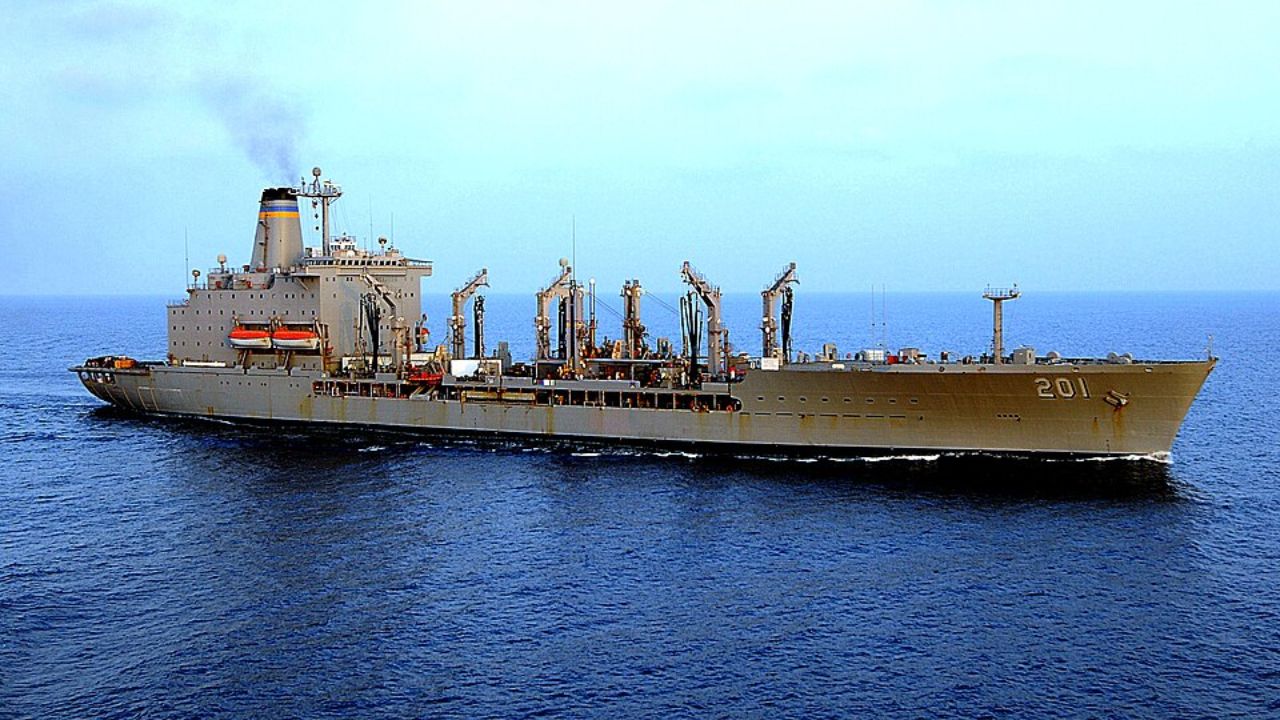

USNS Patuxent is a U.S. Navy tanker capable of refueling vessels at sea and transporting millions of liters of fuel.
The USNS Patuxent has gained prominence for its strategic role in the United States Navy by supplying military vessels in the open ocean. Part of the Henry J. Kaiser class, the ship was developed to transport fuel, dry cargo, and essential supplies, allowing naval operations to continue without the need for immediate return to ports. Built in the 1990s, the tanker operates under the Military Sealift Command and remains active in the American Atlantic Fleet.
With over 206 meters in length and a capacity for millions of liters of fuel, the USNS Patuxent was designed to provide logistical support to military ships in remote areas. The model officially entered service on June 21, 1995, and became part of a generation of double-hulled vessels, a measure adopted to enhance environmental safety following changes in United States legislation.
USNS Patuxent was built to enhance maritime transport safety
The vessel’s keel was laid on October 16, 1991, at Avondale Shipyard in New Orleans, Louisiana. The launch took place on July 23, 1994.
-
Man Transforms Childhood Building in Detroit into Community Bookstore, Draws 400 to Opening

-
Two Brothers Leave City Life to Build Mud House in the Himalayas with Help from Over 100 Volunteers from 18 Countries, Including Brazil

-
At 9, Hailey Builds Mini Shelters for the Homeless Using Recycled Materials in Her Backyard
-
Seven-Year-Old Nicknamed Hulk Wins Gold in Brazilian Jiu-Jitsu After Defeating South American Competitors




Among the 18 ships of the Henry J. Kaiser class, the USNS Patuxent was one of the first three built with a double hull. The change met the requirements of the Oil Pollution Act of 1990, created to reduce environmental risks in maritime accidents.
The structure has a separation of approximately 1.8 meters on the sides and almost 2 meters at the bottom of the hull. Although it reduces the total cargo capacity compared to older single-hull models, the new system increased protection against leaks.

USNS Patuxent’s structure draws attention with its numbers
The size of the oil tanker is among the main differentiators of the military project. The USNS Patuxent was created to transport enormous volumes of fuel and supplies.
Check out some of the main features of the vessel:
- Total length of 206.5 meters
- Beam of 29.7 meters
- Maximum draft of 11 meters
- Displacement of more than 41 thousand tons
- Capacity for about 180 thousand barrels of fuel
- Dry cargo space of 690 square meters
- Refrigerated storage for 128 pallets of food
Additionally, the ship has five refueling stations that allow it to service up to two vessels simultaneously.
How the ship’s refueling system works
The main objective of the USNS Patuxent is to perform at-sea refueling. This operation prevents military ships from having to interrupt missions to seek fuel on land.
The vessel can pump approximately:
- 900 thousand US gallons of diesel per hour
- 540 thousand US gallons of aviation fuel per hour
This operational capacity is considered essential for the logistical support of the United States Navy.
Meanwhile, the propulsion system uses two Colt-Pielstick diesel engines connected to two shafts with controllable pitch propellers. The set generates power exceeding 34 thousand hp and allows a maximum speed of 20 knots, equivalent to about 37 km/h.


USNS Patuxent operates with predominantly civilian crew
Although it is linked to the United States Navy, the ship does not operate with a fully military team. The model operates under the command of the Military Sealift Command, the agency responsible for American military maritime transport.
The crew composition includes civilians and military personnel. The ship operates with:
- 18 civilian officers
- 64 merchant mariners
- 1 U.S. Navy officer
- 20 enlisted military personnel
- Additional reserve teams
In total, more than 100 people can participate in the operations of the USNS Patuxent.
Defensive capability and air operations
Although it was not originally built with heavy armaments, the ship can be equipped with point defense systems. This type of equipment serves for protection against nearby threats during military operations.
Another highlight is the presence of a helicopter platform. However, the design does not include complete facilities for the maintenance of these aircraft.
Nevertheless, the feature enhances the logistical capability of the tanker in long-distance maritime operations.

Henry J. Kaiser class replaced old models
The Henry J. Kaiser class ships were created to replace the old Cimarron class tankers, considered smaller and less efficient for the modern demands of the U.S. Navy.
The USNS Patuxent became part of this new operational standard focused on:
- Greater fuel capacity
- Simultaneous refueling
- Transport of food and dry cargo
- Better logistical efficiency
- More environmental safety
The vessel has been operating in the American Atlantic Fleet since its entry into service in 1995.
USNS Patuxent represents a new phase of naval logistics
The construction of the USNS Patuxent marked an important stage for U.S. military maritime transport. The ship combined large refueling capacity, logistical support, and new environmental safety measures in a single platform.
With millions of liters of fuel, capacity for supplies, and at-sea refueling systems, the USNS Patuxent remains one of the main support vessels of the U.S. Navy.