Portuguese
  Spanish


Two architects traded New Delhi for a hillside near Rishikesh to build a house of mud, stone, and straw, in a project made with trails, mules, and volunteers.
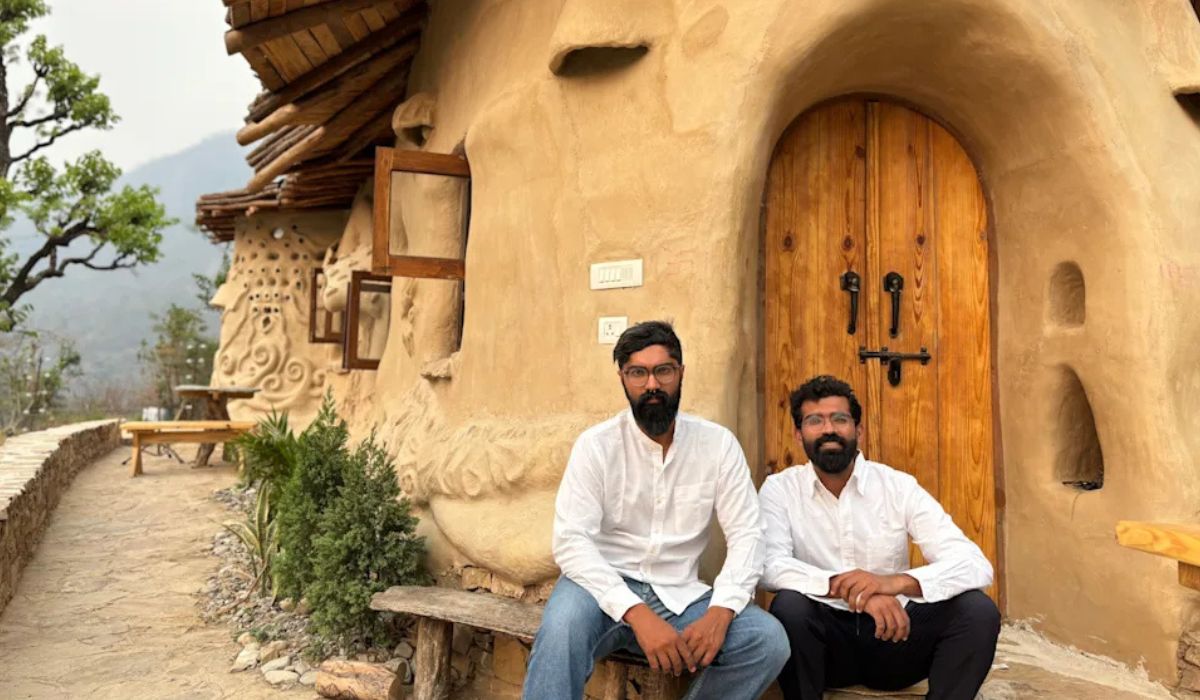
Two architect brothers from New Delhi traded urban routine for a hillside near Rishikesh, in northern India, to hand-build a house of mud, stone, and straw amidst the vegetation.
The project, called Tiny Farm Fort, was completed in 2024, became a rental accommodation on seasonal rental platforms, and started being mentioned in reports about natural construction, mountain living, and off-the-beaten-path tourism.
The story of Ansh Kumar and Raghav Kumar resurfaced in 2026, when Business Insider reported that the house was functioning as an Airbnb accommodation, with about 60% occupancy, according to the brothers themselves.
-
At 9, Hailey Builds Mini Shelters for the Homeless Using Recycled Materials in Her Backyard

-
Seven-Year-Old Nicknamed Hulk Wins Gold in Brazilian Jiu-Jitsu After Defeating South American Competitors

-
Once Burdened by $90,000 in Debt and a Divorce, Now Leads a Beauty Group Targeting $150 Million by 2026
-
Ice Cream Shop Grows from 39 Square Meters to $19 Million Revenue with Popsicles Sold at 20 Cents in Brazil



The accommodation was also publicly listed as an earth house in Rishikesh, with access only via a trail of approximately 1.5 kilometers, without direct car access.
The curiosity of the case lies in the path to the construction.
Instead of buying ready-made materials and hiring a conventional construction, the brothers marked the house’s design on the land with sticks and stones, carried thousands of rocks to the site, transported sand on mules, and invited foreign volunteers to participate in the construction.
Over about three years, more than 100 volunteers from 18 countries helped in the construction, according to an estimate by the brothers cited by Business Insider.
Local workers also participated in the process.
In another publication, Geeli Mitti, an organization linked to natural constructions, describes the project as a work carried out over 18 months of work spread over more than three years, with 100 volunteers from 18 countries.
Mud house in the Himalayas
The construction is located in a mountainous area near Rishikesh, a city known for temples, yoga retreats, trails, and the presence of the Ganges River.
To reach the accommodation, the visitor needs to leave the car in a lower area and walk through the forest with a backpack.
The shape of the house is one of the elements that helped the project gain attention.
The curved walls, straw roof, spiral designs, and earthy tones led visitors to compare the construction to fantasy houses.
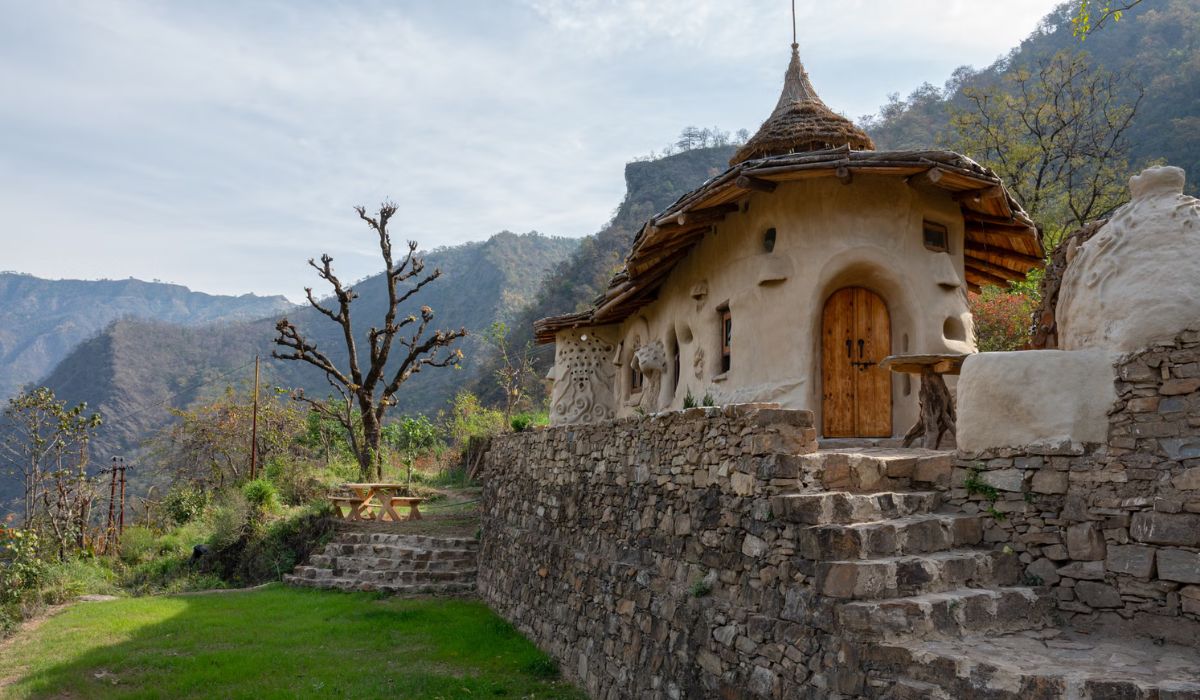
“Some people see it as a Harry Potter house, others as a hobbit house, others as a fairy tale house,” Raghav told Business Insider.
For the brothers, the work has a direct connection with the collective construction process.
“For us, it’s a labor of love, and every curve tells the story of all the beautiful people who came and put effort there,” Raghav stated in the same interview.
The house has two bedrooms, one bathroom, and about 600 square feet, equivalent to just under 56 square meters, according to an Architectural Digest report.
The publication described the property as a hand-sculpted construction, made with local materials and natural building techniques.
Why the brothers left New Delhi
Raghav worked in architecture offices after graduating and even worked at a German company based in India.
According to him, the corporate environment offered important learnings, but it also came with long hours and pressure for productivity.
To Business Insider, Raghav stated that there were days when he worked for up to 48 consecutive hours to meet deadlines.
He also said he began to notice a gap between the architect who designs in air-conditioned offices and the worker who executes the work on site.
Ansh, the younger brother, also had experience with architecture and sustainable projects in rural and mountainous areas of India.
During the pandemic, the two began testing building materials at home, in New Delhi, including mushroom mycelium and a technique made with earth, water, and straw.
It was during this period that the idea of living and building in the mountains took shape, according to the brothers.
“Covid showed that life is short,” said Raghav. “We agreed that we needed to take a leap of faith.”
In March 2021, the two moved to a small village near Rishikesh, on land leased from a family friend.
The agreement included the promise to build a sustainable structure there.
Stones, mules, and mud instead of concrete
The construction was mainly done with mud, stones, straw, and wood.
Instead of starting with detailed digital plans, the brothers used the land itself to design the project, marking the space with elements found around.
Then came the most labor-intensive physical stage, according to reports published about the work.
The stones had to be transported one by one to the site.
The sand arrived with the help of mules, as the land had no car access.
Other materials were obtained in the region whenever possible.
The main technique used in the house is internationally known as cob, a mixture of earth, straw, water, and other natural components.
In Portuguese, it can be understood as a form of construction with mud reinforced by plant fibers, manually shaped into thick walls.
According to Architectural Digest, the house was made with mud taken a few meters from the construction site.
The publication also reported that thousands of large and small stones were carried to strengthen the walls and the base of the construction.
The choice of natural materials did not eliminate financial costs.
According to Business Insider, the brothers spent about US$ 30,000 on the project, using their own savings and support from their parents.
Meanwhile, Geeli Mitti records the cost at 20 lakhs, equivalent to about 2 million Indian rupees, with possible variations depending on exchange rates and calculation criteria.
Volunteers from 18 countries in construction
To attract volunteers, Ansh and Raghav promoted the project on Workaway, a platform that connects travelers with hosts offering accommodation and meals in exchange for collaboration.
The call brought people from different countries to the village to participate in the construction.
The brothers estimated that more than 100 volunteers from 18 countries participated in the work, alongside about 20 hired local workers.
Other publications mention more than 90 international participants, a difference that seems to reflect different ways of counting volunteers, visitors, and workers involved over the years.
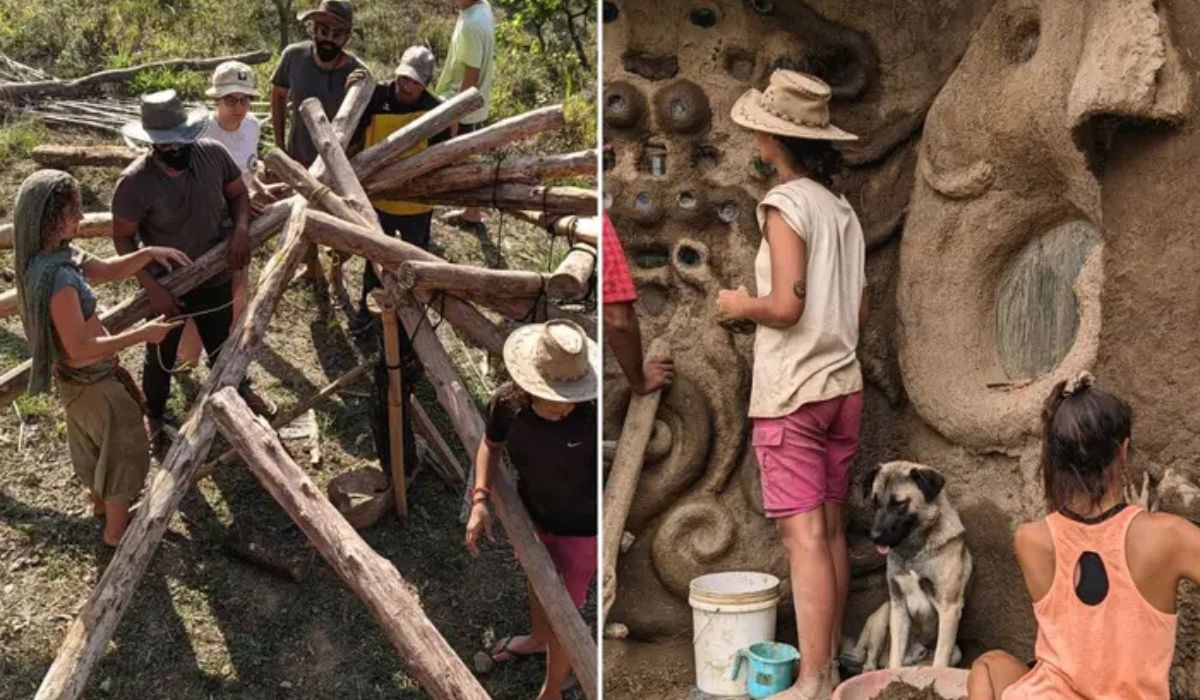
The work progressed visibly on the ground, according to Ansh.
“You can see the progress every day; the house got taller daily, by about 15 to 30 centimeters,” he told Business Insider.
For Ansh, this physical progress contrasted with the experience of spending hours in front of a computer.
He made the comparison when describing the difference between his previous routine and the manual work on the site.
The result was a house with organic shapes, thick walls, cave-style sleeping areas, a loft bed, a compact kitchen, and a bathroom with a skylight.
The accommodation is presented as an experience of isolation, hiking, and direct contact with the forest, rather than a standardized urban accommodation.
Accommodation in Rishikesh requires a hike
The house was listed on Airbnb in April 2024, according to Business Insider, for about US$ 140 per night at the time of the report.
As prices on accommodation platforms vary according to date, demand, fees, and host policies, this price should be understood as a reference for that period, not as a fixed rate.
The listing itself warns that the experience requires physical readiness.
The property is not accessible by car, and guests need to walk about 1.5 kilometers along a forest trail, carrying light backpacks.
Another highlighted point is the absence of wireless internet in the forest.
The accommodation text states that there is no connection on site, but presents this as part of the proposal for digital disconnection and contact with the natural environment.
The region also requires caution with local wildlife.
The listing mentions the presence of wild animals, including elephants, and informs that there is a solar fence for protection during the night.
The hosts ask that visitors arrive before nightfall.


Tiny Farm Lab and natural architecture
After completing the Tiny Farm Fort, Ansh and Raghav established the Tiny Farm Lab, a rural studio for design, research, and natural construction in Rishikesh.
The studio’s website states that the team works with earth houses, bio-based art, sustainable architecture, consulting, courses, and experiments with materials such as mycelium, algae, and plant fibers.
In an interview with Platform, the founders stated that the Tiny Farm Fort continued to influence later projects.
The publication mentions works in Agra, Rishikesh, and Hampi, including adobe house renovation, colonial building restoration, and training of local residents in construction techniques.
This information indicates that the house in the mountains also became a public reference for the studio’s work.
The project ceased to be just an isolated lodging and became part of the brothers’ presentation on building with local materials, manual work, and community collaboration.
Even so, the experience is not described by the brothers themselves as a simple or universal solution.
Building in a remote area requires time, physical effort, adaptation to the lack of infrastructure, relationship with local residents, care for fauna, and reliance on a network of people willing to collaborate.
The case brings together architecture, tourism, rural life, and experimentation with natural materials.
What began as a change in professional direction ended in a mud lodging in the Himalayas, made with hand-carried stones, sand transported by mules, and volunteers from various countries.