






 Portuguese
  Spanish
  5 min of reading
  0 comments


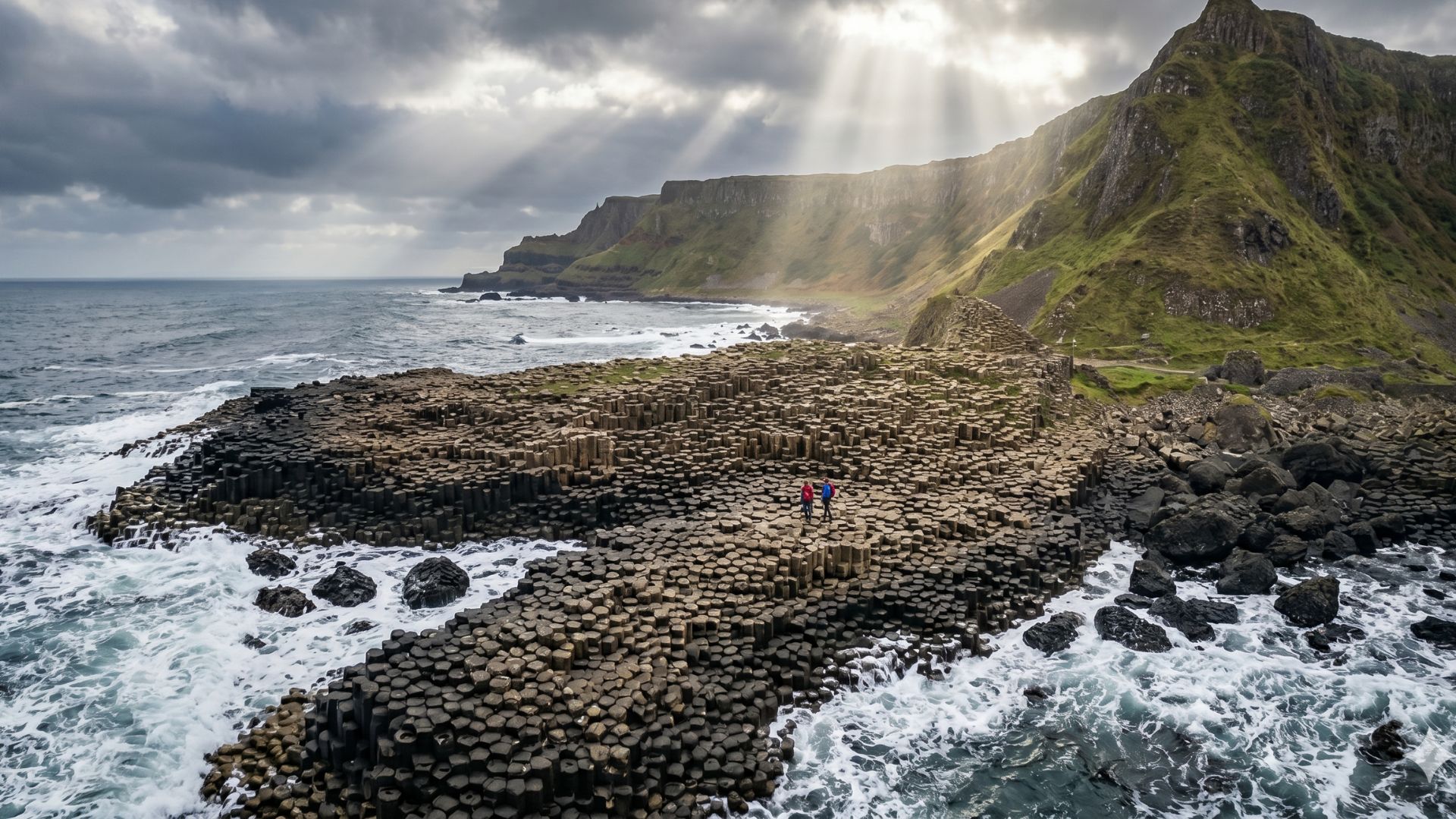
Formation with more than 40,000 basalt columns in Northern Ireland emerged about 60 million years ago and intrigues scientists to this day.
The coast of County Antrim, in Northern Ireland, hosts a geological formation so perfect that for centuries many people believed it had been artificially constructed. Known as the Giant’s Causeway, the structure comprises more than 40,000 prismatic basalt columns fitted side by side, forming a kind of stone road that extends towards the Atlantic Ocean. The landscape is considered one of the most impressive volcanic formations on the planet and was recognized by UNESCO in 1986 as a World Heritage Site.
Seen up close, the formation seems impossible. The columns mainly have extremely regular hexagonal shapes, although some have five, seven, eight, or even nine sides. Many of them appear as gigantic steps by the sea, while others reach several meters in height on the coastal cliffs. In certain places, the structures resemble paved streets, giant church organs, or perfectly aligned artificial pillars.
How volcanic eruptions created one of the most perfect rock formations ever seen in nature
The origin of the Giant’s Causeway dates back to the Paleocene period, approximately 50 to 60 million years ago, when intense volcanic activities affected the region now occupied by Northern Ireland. Large volumes of extremely hot basaltic lava spread over the surface and filled entire areas with thick layers of magma.
-
Survivor of 1966 SS Daniel J. Morrell Shipwreck in Lake Huron Recounts 38-Hour Ordeal in Extreme Cold

-
The Greatest Hoax in World Cup History? The Film That Denied Brazil’s 1958 Victory and Exposed How Fake Evidence Can Seem Convincing on TV
-
Fake South Korean Online Stores Offer Shopping Thrill Without Spending Money or Receiving Products
-
The War of Jenkins’ Ear: How a Severed Ear Sparked One of the 18th Century’s Most Unusual Conflicts


When this mass began to cool slowly, a geological process known as columnar disjunction or columnar jointing occurred.

The lava began to contract during cooling, creating internal stresses that generated extremely regular geometric cracks. These fissures advanced vertically through the rock until forming the famous prismatic pillars observed today.
According to geological explanations cited by researchers and scientific institutions, the hexagonal shape did not arise by chance.
The six-sided geometry is one of the most efficient ways to dissipate contraction stresses in materials that cool slowly. The same principle can be observed in dry mud cracks, but on a colossal scale at the Giant’s Causeway.
The columns seem artificial because nature created almost mathematical patterns in the basalt
The most impressive aspect of the Giant’s Causeway is the level of regularity of the columns. Many of them have almost perfect sides, flat surfaces, and extremely precise fits. This has created for centuries the impression that the structure might have been manually carved.


Some columns reach about 12 meters in height, while others form horizontal platforms near the sea. In many sections, the pillars resemble giant honeycombs petrified by the action of time. The visual result is so unusual that the formation has become the subject of geological studies, local legends, works of art, and film productions.
Scientists explain that the thickness of the lava flow and the speed of cooling directly influenced the size of the columns. The more uniform and slower the cooling, the more regular the basaltic structures became.
The legend of the giant Finn McCool turned the formation into one of Ireland’s greatest myths
Long before the scientific explanation, the inhabitants of the region created a legendary narrative to explain the existence of the causeway. According to Irish folklore, the giant Finn McCool built the stone road to cross the sea and face a Scottish rival named Benandonner.
The story claims that Finn created the passage using huge stone blocks to connect Ireland to Scotland. However, upon realizing that the rival was much larger than him, he was hidden by his wife, who disguised him as a baby.
When Benandonner saw the “baby”, he imagined that the child’s father would be gigantic and fled terrified back to Scotland, destroying the road behind him.

Curiously, on the Scottish island of Staffa, there is a basaltic formation similar to the Giant’s Causeway. This coincidence helped to further strengthen the ancient legend about a connection between the two territories.
The formation inspired architects, musicians, and researchers in different parts of the world
The basalt columns of the Giant’s Causeway have become a reference for geological studies on magma cooling and volcanic rock formation. Similar structures appear in places like Iceland, Scotland, California, and even in images of Mars recorded by space missions.
In Iceland, for example, the waterfall Svartifoss became famous for its black columns similar to those in Northern Ireland. Meanwhile, in the Azores, the formation known as Rocha dos Bordões presents enormous volcanic prismatic pillars comparable to those of the Giant’s Causeway.
The geometric appearance of the columns also influenced modern architectural projects. According to records about Svartifoss, similar basalt structures inspired famous constructions in Iceland, including the Hallgrímskirkja church in Reykjavik.
Even after centuries of research, the Giant’s Causeway still generates new scientific discoveries
Despite being studied for hundreds of years, the Giant’s Causeway still sparks scientific debates. In 2021, a study by geologist Michael J. Simms proposed a new hypothesis for the site’s formation, suggesting that lava may have quickly occupied an area that sank shortly before the volcanic eruption.

According to the research cited by CNN Brasil in June 2025, this subsidence would have occurred so quickly that sediments and erosion did not have enough time to modify the region before being filled by basaltic lava. This would have allowed the formation of an extremely thick layer of basalt, favoring the creation of the giant columns observed today.
The case shows how an apparently known landscape can still reveal new geological interpretations even after centuries of scientific observation.
The Giant’s Causeway continues to seem like an impossible construction even after the scientific explanation
Science has managed to explain how volcanic lava can transform into almost perfect geometric pillars, but this has not reduced the visual impact of the Giant’s Causeway.
The site continues to appear artificial to many visitors, especially when viewed from the top of the Irish coast cliffs.
Amid myths of giants, ancient volcanic eruptions, and natural patterns reminiscent of human engineering, the formation remains one of the most extraordinary geological landscapes on the planet.
And perhaps that is precisely why it continues to intrigue tourists, researchers, and the curious in the 21st century.





Be the first to react!