






 Portuguese
  Spanish
  3 min of reading
  0 comments


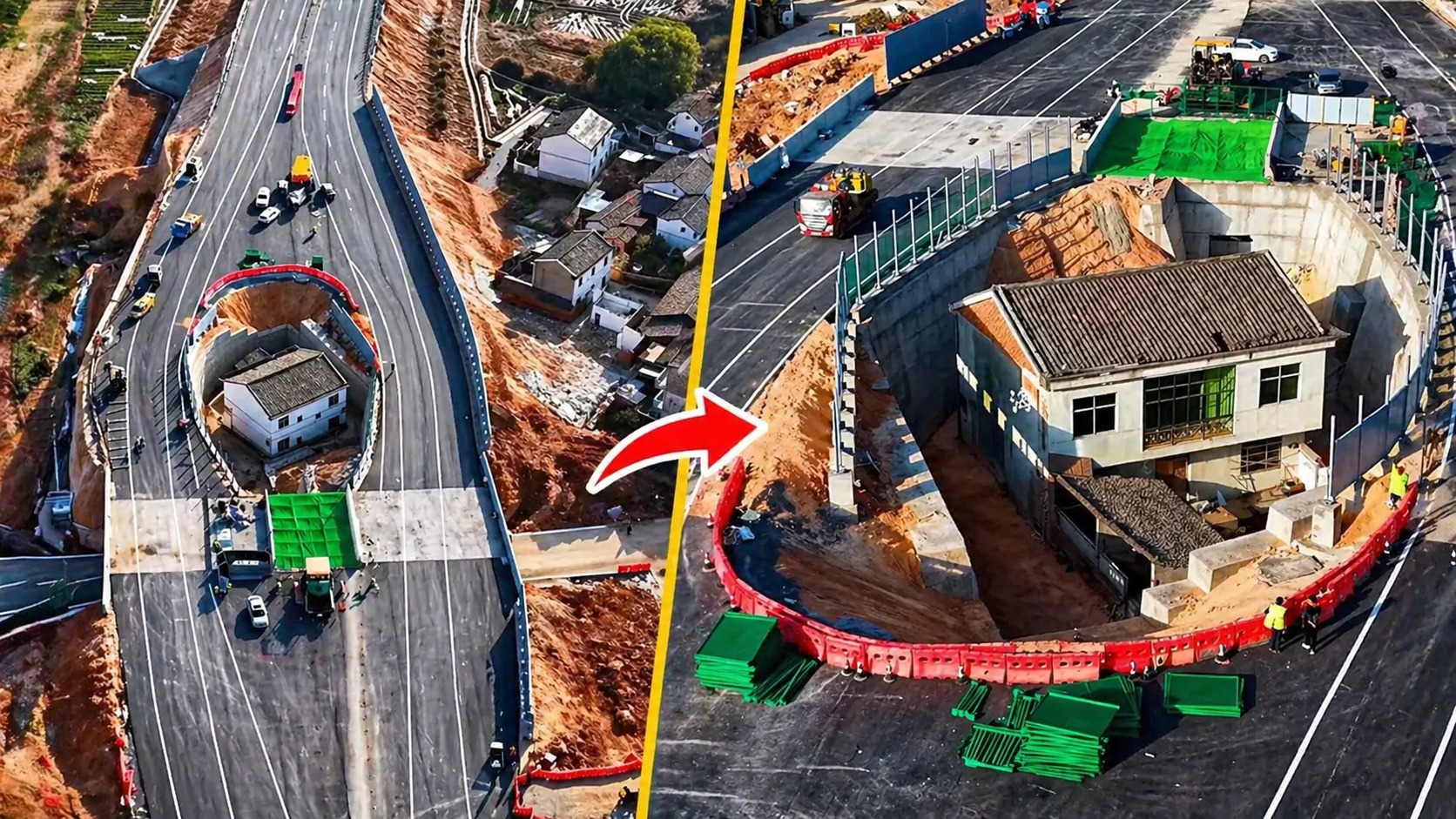
Case of the house in the middle of the highway in China reveals impact of decision on compensation, shows extreme isolation in daily life and raises debate on property rights and urban planning that can change lives forever
A house in the middle of a highway in China became one of the most impressive cases in the world by showing what happens when a homeowner refuses to leave the property. The decision led to the construction continuing as usual, leaving the residence surrounded by busy lanes.
The result is an unusual scene, with a family living isolated in the center of the asphalt. The episode involves refused compensation, a multi-million project, and a declared regret by the owner, who now faces the consequences of the choice.
House in the middle of the highway in China became known as the “Eye of Jinxi”
The construction of the G206 highway, in Jinxi County, Jiangxi Province, proceeded even without an agreement with the owner. The house remained in place and ended up surrounded by the road.
-
Survivor of 1966 SS Daniel J. Morrell Shipwreck in Lake Huron Recounts 38-Hour Ordeal in Extreme Cold

-
The Greatest Hoax in World Cup History? The Film That Denied Brazil’s 1958 Victory and Exposed How Fake Evidence Can Seem Convincing on TV
-
Fake South Korean Online Stores Offer Shopping Thrill Without Spending Money or Receiving Products
-
The War of Jenkins’ Ear: How a Severed Ear Sparked One of the 18th Century’s Most Unusual Conflicts


Seen from above, the image draws attention for resembling a pupil between strips of concrete, which earned it the nickname “Eye of Jinxi”. The scenario went viral and became one of the most extreme examples of resistance in expropriations.
The report was published by South China Morning Post, an international news outlet with coverage in Asia.
What is a nail house and why does this case attract so much attention
In China, properties that resist demolition are called nail houses, a term used to describe owners who refuse to leave during urban projects.
This type of situation usually arises when there is disagreement over compensation values or conditions. In the case of Jinxi, the negotiation did not progress and the construction continued without the removal of the property.
The episode became a symbol of conflict between urban growth and individual decisions, attracting attention both inside and outside the country.
Owner refused 1.6 million yuan, asked for more and now admits regret
The owner Ye Yushou rejected an initial offer of 1.6 million yuan and two houses, presented in 2022. The expectation was to secure a larger settlement.

The demand reached 2 million yuan and three residential plots, which ended up stalling the negotiation. Without consensus, the construction was carried out around the house.
South China Morning Post, an international news outlet with coverage in Asia, highlighted that the owner himself stated that the decision was like “losing a bet”, showing regret after the highway’s completion.
14 km highway was built around and access became a daily challenge
The road is 14 km long and cost 460 million yuan, being constructed even with the house at the center of the structure.
To avoid total isolation, an exclusive access route was created, allowing the family to enter and exit the property.
Despite this, the location presents constant difficulties due to the heavy traffic around the residence, which directly impacts the residents’ routine.
Case became a warning about financial decisions and long-term consequences
The episode generated comments and discussions about choices made during negotiations. Local residents pointed out that neighbors accepted the offers and received compensation.
The isolated house ended up becoming an example of missed opportunity and risky decision, with a direct impact on the family’s quality of life.
The case also raises reflections on the limits of property rights and strategies of major public works.
What happened to the house in the middle of the highway shows the real impact of a decision
The residence remains on site with no plans for relocation. The highway structure has solidified the situation as permanent.
The story shows how a choice can generate lasting effects, especially when it involves high values and large-scale projects.
And you, would you have refused the millionaire offer or would you have accepted the agreement before the highway construction? Leave your opinion in the comments and share this curious story with others.





Be the first to react!