Portuguese
  Spanish


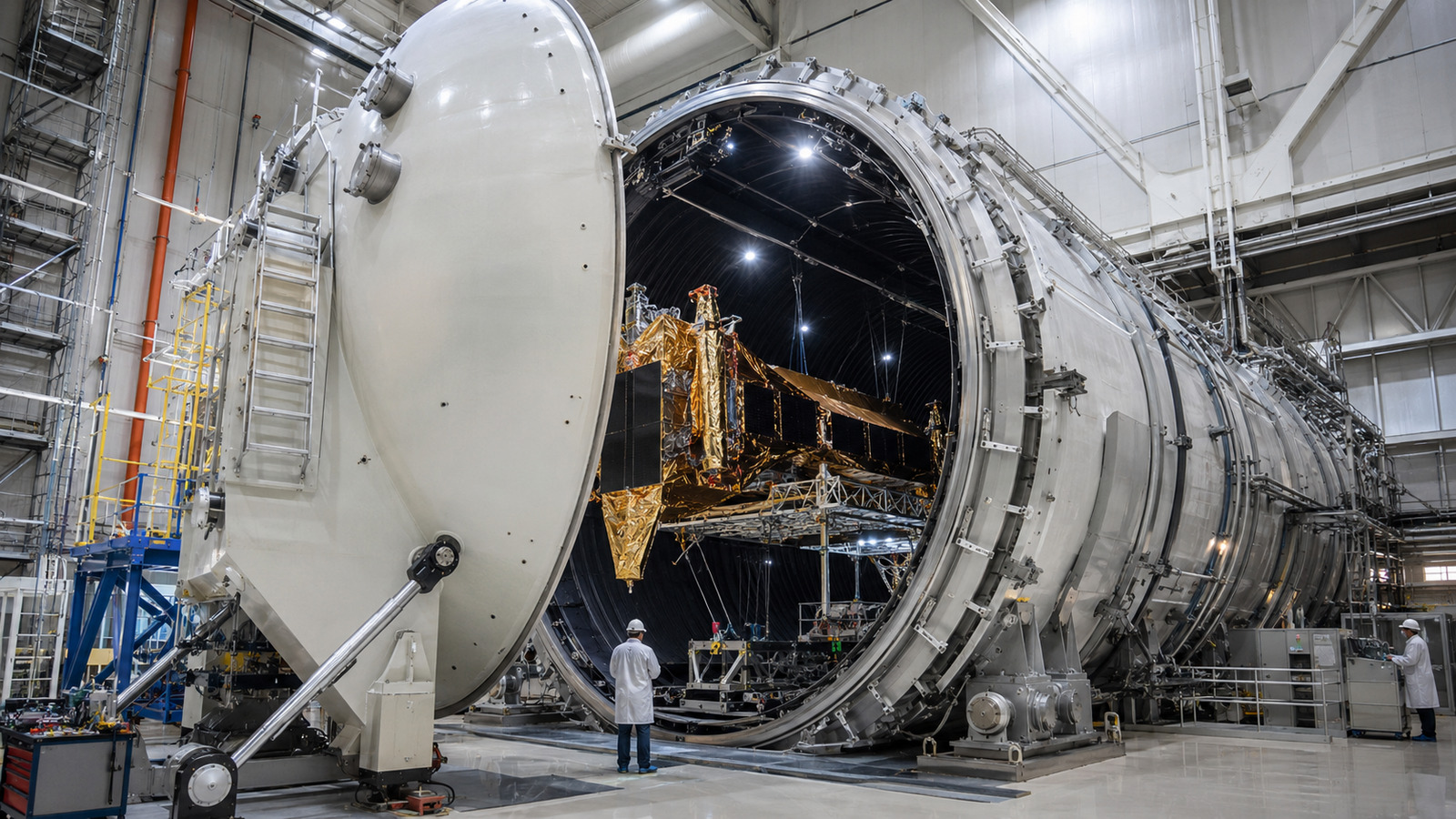

The largest vacuum chamber in the world is located in Ohio, measuring 37.2 meters in height and allows testing rockets, modules, solar panels, and space equipment in conditions similar to those found outside Earth
The largest vacuum chamber for space simulation in the world is located at the Space Environments Complex of NASA, in Sandusky, Ohio, measuring 30.5 meters in diameter and 37.2 meters in height, and tests equipment before they go to space.


Giant structure is located at the Neil Armstrong Test Facility
The facility is located at the Neil Armstrong Test Facility and is operated by the Glenn Research Center. Within the complex, the main highlight is the Space Simulation Vacuum Chamber, also called the Space Power Facility, or SPF.
NASA describes this structure as the largest vacuum chamber for space simulation in the world. The internal space has 22,653 cubic meters, a volume equivalent to 800,000 cubic feet.
-
Brazilian Man Builds Homemade Welding Machine Using Parts from Old Microwaves, Achieving Over 100 Amperes

-
Canada Sinks Six Giant Balloons in Lake Ontario to Test Underwater Battery That Stores Compressed Air 60 Meters Deep

-
Astronauts Returning from Space Develop Early Cataracts Due to Eye Lens Radiation, Highlighting Risks for Future Mars Missions

-
Brastemp Unveils New Dishwasher with Smart Sensor, 14 Place Settings, Acquaspray Jet, 70°C Rinse, Water Efficiency, and Intelligent Drying


The scale allows it to accommodate entire space equipment, rocket parts, and large systems. Before being sent outside Earth, these components undergo tests in conditions close to those found in the space environment.
The chamber was originally built in 1969. The project was born for nuclear and non-nuclear tests on large space systems aimed at advanced missions beyond low Earth orbit.
Despite this initial capability, NASA states that only non-nuclear tests have been conducted at the site throughout its history.
The structure was created with areas, doors, power systems, and support prepared for future demands.
How the chamber simulates the space environment
The function of the largest vacuum chamber is to reproduce critical conditions before a real mission. It maintains high vacuum, creates extreme cold with cryogenic structure, simulates solar and thermal radiation, and reduces interference from external vibrations.
The equipment was designed to test nuclear and non-nuclear space hardware in an environment similar to low Earth orbit. This includes spacecraft, modules, equipment, components, and large systems.
The internal pressure can drop to less than 4×10⁻⁶ Torr in less than eight hours. Pumping occurs in stages, starting at atmospheric pressure and reaching 20 Torr in about two hours.
Then, the system reduces the pressure from 20 Torr to 1×10⁻² Torr in approximately three hours. In the final stage, it goes from 1×10⁻² Torr to 4×10⁻⁶ Torr in another two hours.
To reach this level, the facility uses mechanical pre-vacuum pumps, cryopumps, turbopumps, and plates cooled with liquid nitrogen. The setup sustains the necessary conditions for complex space tests.

Engineering includes a 272.16-ton floor
The test area measures 30.48 meters in diameter by 37.19 meters in height. The floor is designed to support a load of 272.16 tons, allowing it to accommodate heavy parts and complete systems.
The chamber has two large cargo entrances, each measuring 15.24 meters by 15.24 meters, positioned on opposite sides. There is also a door for people measuring 2.44 meters by 2.44 meters.
At the top, there is a vacuum-compatible polar crane, capable of moving up to 18.14 tons. The chamber is made of aluminum and surrounded by thick concrete.
The external walls are between 1.83 meters and 2.44 meters. During operations, this concrete enclosure, with a volume equivalent to that of the chamber, is also usually depressurized, reaching 15 Torr.
The aluminum chamber has attachment points for suspending test equipment. These points also react to loads during opening, separation, or deployment tests of space structures, such as panels and foldable mechanisms.
World’s largest vacuum chamber: Extreme cold, sensors, and historical tests
Another important component is the cryoshroud, used to create extreme thermal conditions. It operates from –160°C to +80°C and has ten individual control zones, allowing for greater thermal uniformity in tests.
In the cylindrical configuration, the cryoshroud measures 12.19 meters in diameter by 12.19 meters in height. There is also an alternative configuration of 12.80 meters in width, 24.38 meters in length, and 6.71 meters in height.
For thermal operations in a vacuum, the facility has local storage of 56,000 gallons of liquid nitrogen. It can also receive additional storage of up to 48,000 gallons, as needed.
The system provides 7 megawatts of power for auxiliary heating. This energy powers lamps, heating panels, and infrared heaters during tests, helping to reproduce controlled thermal situations.
The structure houses more than 1,500 temperature sensors, including thermocouples and RTDs. It also features low and high-speed data acquisition systems to monitor the performance of the evaluated equipment.
The vacuum chamber has already hosted tests for full-scale rocket fairing separations, Martian lander systems, deployable solar sails, solar panels, International Space Station radiators, and high-energy experiments.
Among the records cited by NASA are tests related to the Mars Pathfinder, the development of ISS radiators, the Orion system, the Dream Chaser, and rocket fairing structures.
The complex includes support areas such as the Assembly High Bay on the east side, used for receiving, assembling, and preparing equipment. It measures about 22.86 meters wide by 45.72 meters long.
This area has a clear height of 22.86 meters under a 22.68-ton crane. On the west side is the Vibroacoustic High Bay, with vibration and acoustic testing facilities.
The Space Environments Complex also serves government, universities, and the private sector on a full cost-reimbursement basis. Thus, different institutions can test space equipment under vacuum, cold, thermal radiation, vibration, and other critical conditions.
With information from NASA.