






 Portuguese
  Spanish


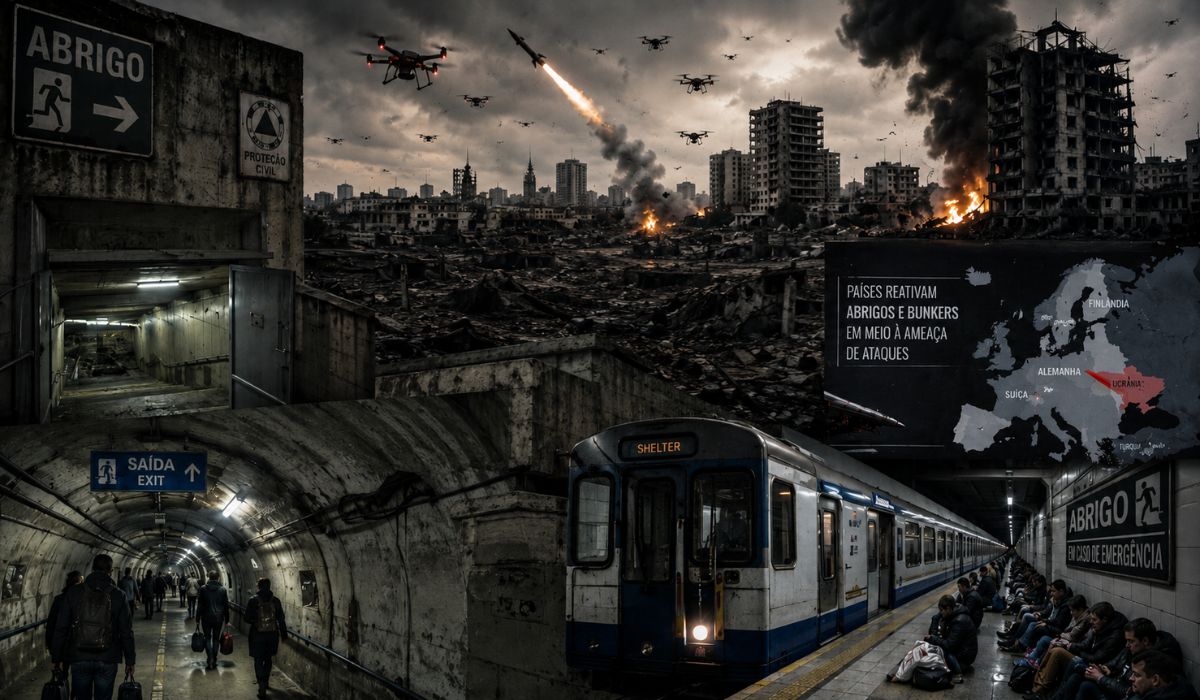

The war in Ukraine has reignited the debate on civil shelters in Europe, leading countries to transform common underground spaces into protection structures against attacks, infrastructure failures, and urban emergencies.
The war in Ukraine has once again placed civil shelters among the security priorities of European countries.
Underground structures that lost their military function after the Cold War are being reevaluated by governments and civil defense agencies as part of the response to drones, conventional missiles, localized bombings, and attacks on essential services.
The change does not just represent the revival of bunkers built in the 20th century.
-
China returned almost 20 Brazilian ships with soybeans and is now back to buying from the USA, but stocks above 9 million tons raise suspicions of a political move, not a commercial necessity.

-
Japan will have a bullet train that levitates at 500 km/h and will cross 90% of the route through tunnels; the project promises trips in just 67 minutes but faces billion-dollar challenges and unprecedented environmental obstacles.
-
Few people know, but the smallest city in Rio holds a tunnel that was once the largest in the world, covering only 95.35 km², housing a railway work of 2,233 meters, and is also known for the historic title of the 4th best climate in the world.
-
A ‘hanging’ road in SP with viaducts over 80 meters, 11 tunnels, 20 suspension bridges, and pillars fixed at a depth of 40 meters has been challenging the Serra do Mar for almost 50 years and still impresses engineers.


In different countries, the strategy has come to include subway stations, underground garages, tunnels, basements, swimming pools, gyms, and sports centers as places that can be adapted for emergencies.
The proposal is to use existing structures in cities, rather than relying exclusively on large buried military complexes.
Since the large-scale Russian invasion of Ukraine in February 2022, the topic has gained space in the European public debate.
The conflict showed that cities on the continent can still face frequent air alarms, power outages, attacks on civil infrastructure, and the displacement of residents to underground areas.
In response, countries that had reduced civil protection began to review plans considered obsolete by sector authorities.
Underground cities return to emergency plans
In recent decades, many European shelters have ceased to have military use.
Some of these structures have been converted into warehouses, parking lots, museums, concert halls, or tourist spaces.
Others have remained closed, abandoned, or without sufficient maintenance for immediate use in a crisis situation.
The current discussion goes beyond the recovery of old facilities.
The central point, according to civil defense authorities, is to adapt dense cities dependent on complex infrastructure for situations where the population needs to quickly protect themselves from air attacks or prolonged failures in basic services.
This debate brings together civil protection, urban engineering, and emergency planning.
A functional shelter needs to bring together elements such as reinforced concrete, ventilation, exit routes, minimum supply, communication, alternative energy, and the capacity to accommodate people in a short time.
As these requirements are not simple to install during a crisis, governments have started mapping spaces that can already be converted.
Switzerland maintains a wide network of civil shelters
Switzerland is one of the most well-known cases of underground preparation in Europe.
The country maintains about 9 million spaces in approximately 370,000 private and public shelters, according to the Federal Office for Civil Protection.
The coverage exceeds the number of inhabitants, although the authorities themselves acknowledge that there may be local differences between cantons and municipalities.
These structures were designed to protect the population in scenarios of war and other serious risks, including nuclear, biological, and chemical threats.
Over time, Swiss legislation has undergone adjustments, but the obligation related to the construction and maintenance of shelters has remained as part of the national civil protection policy.
In other European countries, the Swiss model was treated for years as an exception linked to the Cold War and the local tradition of emergency preparedness.
With the war in Ukraine, the existence of a wide network of shelters has come to be observed by governments and experts as an example of infrastructure built before a crisis, and not just as a historical legacy.


Finland adapts everyday spaces for protection
Finland also maintained a continuous civil defense policy after the end of the Cold War.
In Helsinki, there are about 5,500 civil defense shelters, with approximately 900,000 spaces, enough to protect permanent residents and people passing through the capital, according to city data.
The differential of the Finnish model lies in the everyday use of part of these areas.
Shelters can function, in normal times, as parking lots, sports facilities, leisure spaces, swimming pools, or recreation areas.
In an emergency, these locations can be prepared to accommodate the population within 72 hours, according to information from Helsinki authorities.
This dual-function system has begun to attract international attention.
A Reuters report showed that the Merihaka shelter in Helsinki received foreign delegations interested in the Finnish model.
The location is about 25 meters below ground, can accommodate 6,000 people, and is usually used with courts, a gym, and a children’s area.
In case of emergency, it can be equipped with bunk beds, water tanks, and portable toilets.

Germany seeks shelters in subways, tunnels, and garages
Germany presents a different situation.
The country once had a larger network of public shelters during the Cold War, but today it has 579 shelters for about 480,000 people, according to government data cited by Reuters.
For a population of over 80 million, the coverage is limited.
The German response does not foresee, at least in the current plan, fully rebuilding the logic of classic bunkers.
The government approved a civil defense plan that foresees the use of underground garages, tunnels, and subway stations as protection locations.
The initiative also includes investments in alert systems, special vehicles, protective clothing, and centralized coordination for emergencies.
The strategy recognizes an operational limitation: there is not enough coverage to shelter the entire population in traditional structures.
Germany’s Defense Minister, Boris Pistorius, told Reuters that the country cannot count on shelter available for all its more than 80 million inhabitants.
Therefore, the German plan combines the use of nearby spaces, digital alerts, and quick guidance to residents.
War in Ukraine changes civil defense planning
The Ukrainian experience has come to be used as a reference by civil and military planners in Europe.
In several cities, subway stations, underground schools, and basements have been incorporated into the routine of protecting the population during attacks.
The war also highlighted the importance of alert systems, accessible shelters, and routes known by residents.
Before the large-scale Russian invasion, part of European planning for future conflicts focused on high-tech scenarios and more restricted attacks.
The continuation of bombings against Ukrainian cities has led authorities and experts to reconsider the need for physical protection structures in urban areas.
The new plans, therefore, treat the shelter as part of a broader response chain.
The operation depends on early warning, safe relocation, temporary stay, care for vulnerable people, and a minimum capacity to maintain essential urban services during a crisis.
Access to shelters is a challenge for governments
The revival of civil shelters raises a practical question for local governments.
The existence of an underground structure does not guarantee that everyone can reach it in a timely manner.
Elderly people, people with disabilities, hospital patients, small children, and residents of areas without adequate coverage face additional obstacles in an emergency.
This point differentiates the current debate from the symbolism of the Cold War.
In the 20th century, bunkers also functioned as a demonstration of state capacity in the face of a nuclear threat.
Now, the discussion is more focused on damage reduction in specific scenarios, such as drone attacks, conventional missiles, sabotage, and infrastructure interruptions.
For this reason, planning is not limited to the number of shelters available.
It also involves location, signage, maintenance, training, communication with the population, and integration with alert apps.
Without these elements, the physical structure may exist but not fulfill its function when needed.
Urban engineering transforms common spaces into protection
The renewed interest in underground structures also reveals how urban engineering can transform common spaces into safety equipment.
A garage, a subway station, or an underground pool can only be used as a shelter if it meets technical requirements related to resistance, ventilation, access, communication, and temporary stay.
Many of these solutions are not visible in daily use.
Reinforced doors, air filters, sealing compartments, alternative exits, and emergency supply systems are outside the routine of those who frequent these spaces.
However, these components define whether the location can function as a civil shelter during a crisis.
European interest in bunkers and underground structures, therefore, is not limited to the memory of the Cold War.
It accompanies the adaptation of cities to contemporary risks, including drones, missiles, hybrid attacks, and prolonged failures in energy, transport, and communication networks.
With war once again present on the continent, governments have begun to treat the underground as part of urban planning and civil protection.
Tunnels, basements, garages, and metro stations have ceased to be merely passage or service spaces and have been reintegrated into emergency maps.


