






 Portuguese
  Spanish


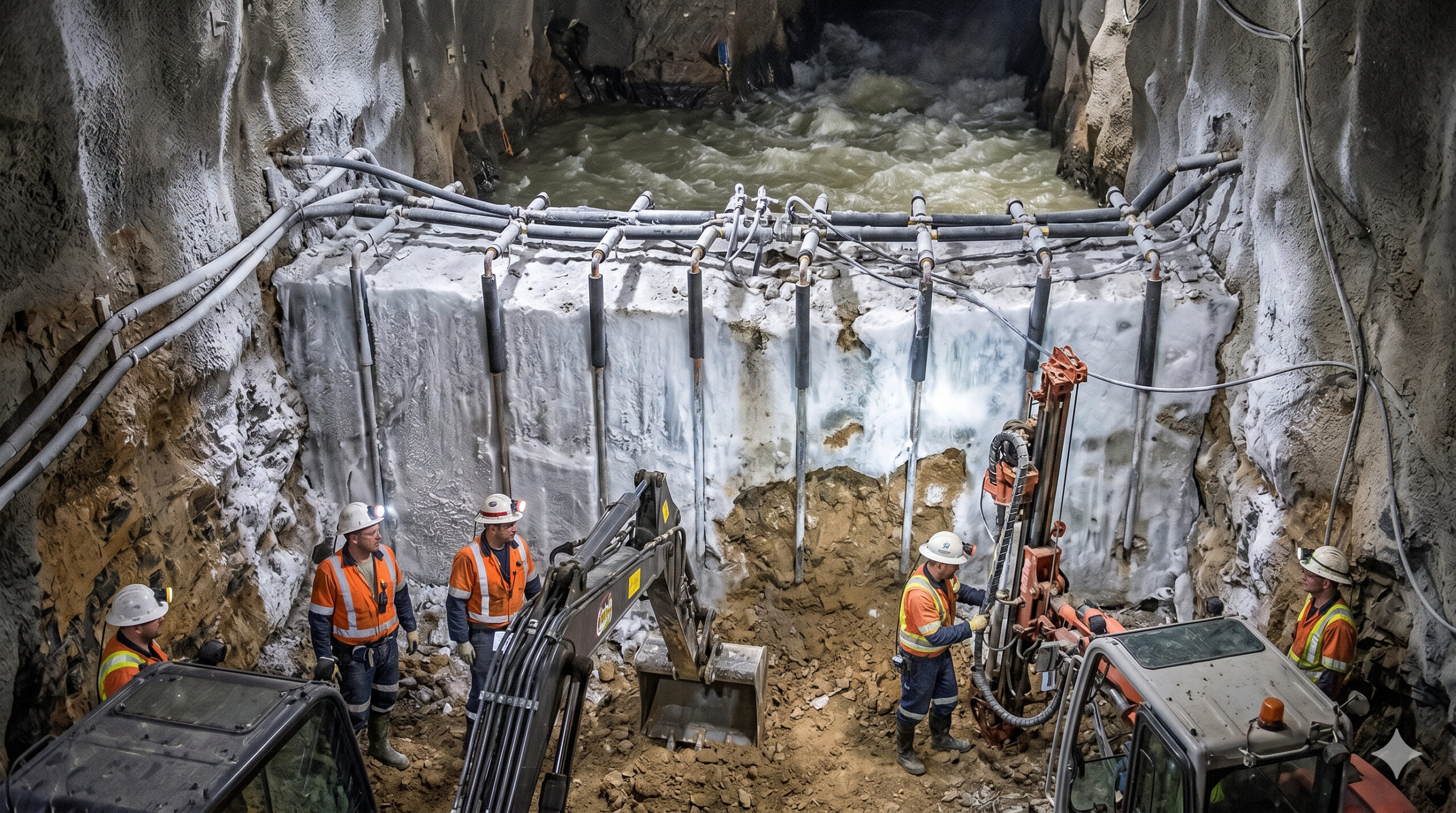

Ground freezing technique creates underground ice barriers to stabilize mines and block water before excavation.
In deep mining and tunnel construction projects, one of the biggest challenges is not only the excavated rock but also the control of pressurized groundwater, ground instability, and geological layers that can lose strength as soon as they are exposed. In deep excavations, these conditions increase the risk of sudden inflows, loss of stability, and local collapses, which is why prior control of the underground is treated as a critical step in underground works. To address this problem, engineers turn to artificial ground freezing, internationally known as artificial ground freezing (AGF).
The method cools the ground around the excavation until the water present in the subsurface turns into ice, creating a temporary barrier that is more rigid, stable, and less permeable, capable of containing water ingress and supporting the ground during the work. According to WSP, this technique has been applied for over 150 years in mining and tunneling specifically to stabilize the ground and limit the flow of groundwater.
Technique transforms the subsoil into a frozen and impermeable structure
The principle behind ground freezing is relatively simple, but its execution involves highly specialized engineering.
-
Eni Acquires 25% Stake in Chilean Lithium Project, Plans to Invest Up to $225 Million in Eco-Friendly Extraction Method

-
Mexico’s Giant Crystal Cave: A Deadly 58°C Underground Palace with 11-Meter Crystals Formed Over Nearly a Million Years

-
China Dominates Over 90% of Rare Earth Refining, Prompting Global Concerns: Canada and Japan Launch Billion-Dollar Plan to Reduce Dependency and Safeguard Batteries, Semiconductors, and Defense
-
Ancient Mines in Spain Reveal Tools and Metals That May Explain Bronze Age Trade with Scandinavia


Before excavation, several holes are drilled around the area where the shaft or tunnel will be opened. Inside these holes, pipes are installed through which a refrigerant fluid circulates.
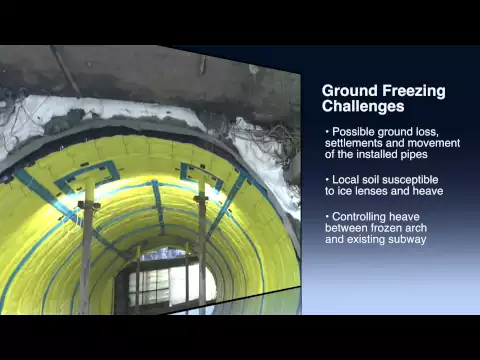

This fluid can be a brine cooled to negative temperatures or liquid nitrogen in more extreme applications. As it circulates, it removes heat from the surrounding soil, freezing the water present in the soil pores.
The result is the formation of a continuous cylinder of frozen soil, which can completely encase the area to be excavated, functioning as a temporary structural wall.
Ice wall blocks groundwater and prevents collapses
One of the biggest risks in mining is the presence of aquifers or flows of groundwater, often invisible on the surface.
When an excavation intercepts these uncontrolled zones, water can quickly flood the open space, compromising the safety of the operation. Ground freezing solves this problem by turning water into ice, interrupting its flow.
This frozen barrier acts as a practically impermeable seal, preventing water entry throughout the excavation phase.
Additionally, the ice increases soil cohesion, reducing the risk of collapses in materials that would normally be unstable.
Method allows excavation in areas that would be unfeasible
In sandy, saturated clay soils or highly fractured formations, conventional excavation methods may be insufficient.
In these cases, soil freezing makes it possible to carry out works that would otherwise be considered unfeasible.

The technique has already been used in mining projects, subway construction, road tunnels, and urban infrastructure works in different parts of the world.
Without this type of stabilization, many of these projects simply could not be executed safely.
Process can take weeks or months to achieve complete stability
Soil freezing does not occur instantly. Depending on geological conditions, depth, and the volume to be treated, the process can take weeks or even months until the ice barrier is fully formed.
During this period, sensors are used to monitor soil temperature and ensure that the freezing is uniform.
The integrity of the frozen wall is critical to the success of the operation, and any failure can compromise the entire excavation.
Technique is used in deep mines and complex urban tunnels
The artificial soil freezing method is well documented in deep mining projects, especially in regions with significant groundwater presence.
In China, for example, the technique has been applied in wells with depths between 400 and 1,000 meters, allowing the opening of shafts in challenging geological conditions.
In addition to mining, the method is also used in large urban works, such as the construction of subway lines in cities with saturated soils.
System requires high energy consumption and strict control
Despite its effectiveness, soil freezing is not a simple or cheap solution. The system requires high-capacity refrigeration plants, significant energy consumption, and continuous monitoring.

Maintaining the frozen ground throughout the excavation is essential, which implies constant operation of the cooling systems. This makes the technique more suitable for high-value projects or in situations where there are no viable alternatives.
Technique is temporary and soil returns to original state after use
An important characteristic of the method is its temporary nature. After the excavation is completed and permanent structures are installed, the freezing system is turned off.
Gradually, the soil thaws and returns to its natural conditions. This differentiates the method from permanent solutions, such as concrete injection or retaining walls, which permanently alter the geological environment.
Soil freezing represents an unusual approach in engineering: instead of adding materials to the ground, a physical property — the change of state of water — is used to create stability.
This strategy allows for transforming an unstable environment into a temporarily solid structure, without the need for major chemical or structural interventions.
It is an example of how simple physical principles can be applied on an industrial scale to solve complex problems.
Technique reveals little-known side of modern mining
For those outside the industry, mining is still often associated with explosives, excavators, and large trucks.
However, methods such as soil freezing show that the engineering involved is much more sophisticated.
The ability to transform the underground into a controlled frozen structure reveals a level of precision and planning that rarely appears in popular representations of mining.
Did you imagine that mines can be excavated within “ice walls”
The idea of freezing the soil to allow safe excavations challenges the common perception of how underground works are carried out.
If techniques like this continue to evolve, new possibilities may arise for projects in increasingly complex environments.
In light of this, how far can engineering go by using the natural environment itself as a construction tool?


