Portuguese
  Spanish


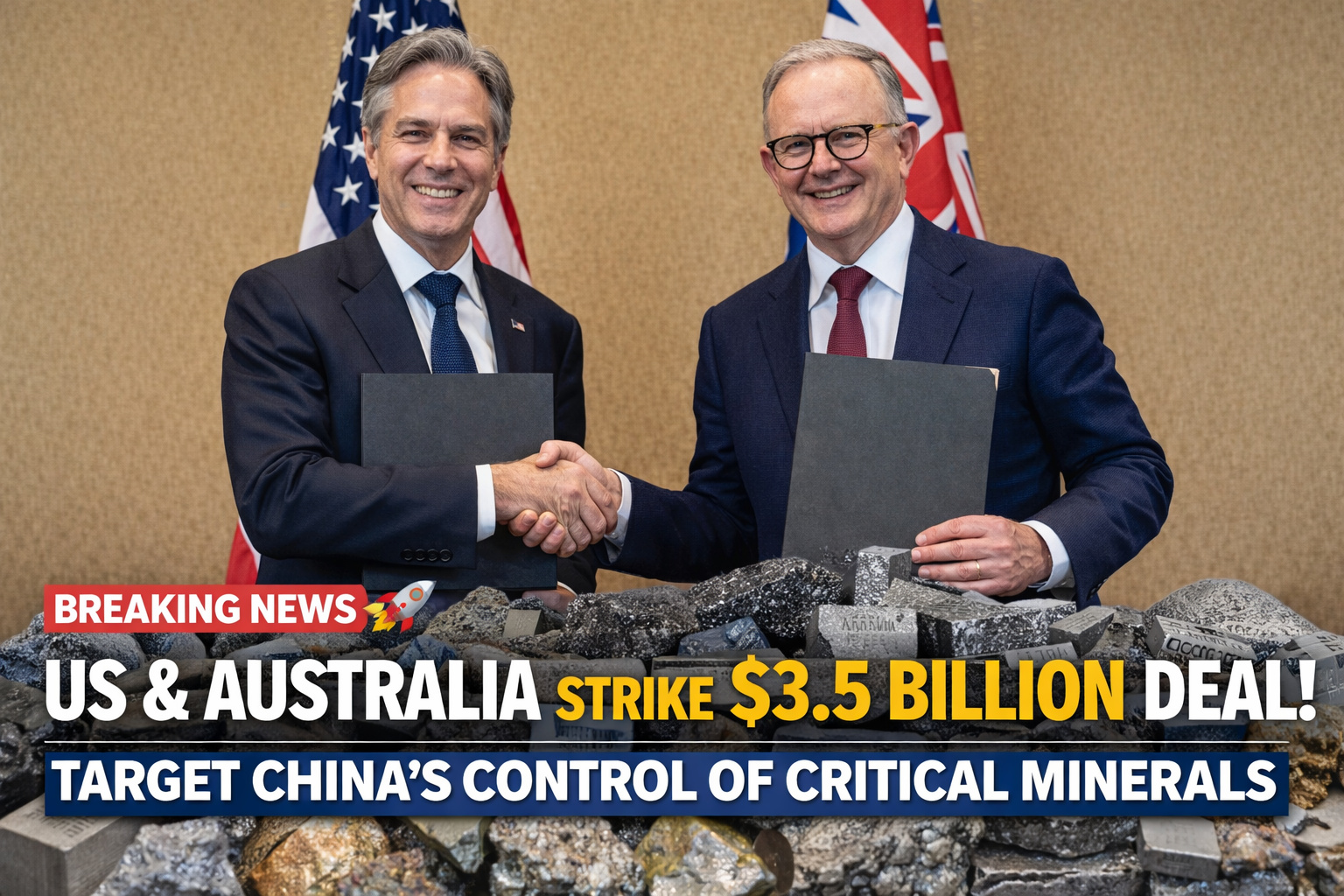

New package between Washington and Canberra expands support for mining and refining projects of strategic metals, targets rare earths, nickel, gallium, graphite, magnesium, and tungsten, and places the competition for supply chains at the center of the new global economic war.
The United States and Australia have decided to escalate their tone in the global competition for critical minerals. The two countries announced a package of over A$ 5 billion, about US$ 3.5 billion, to support Australian projects related to the mining, processing, and refining of metals deemed vital for defense, advanced manufacturing, and energy transition. This move nearly doubles the initial commitment made in the bilateral agreement signed about six months ago and makes it clear that Washington and Canberra want to reduce Western dependence on China.
The message is clear. It is not just about opening mines. The goal is to strengthen the entire value chain, including separation, processing, and refining, precisely the stage where China has built its greatest strategic advantage. The official framework signed by both governments speaks of ensuring security and resilience of supply chains for critical minerals and rare earths for commercial and defense uses.
Billion-dollar package targets the most sensitive point of the sector: refining
The major turning point of this agreement lies in its focus. Australia already has a vast supply of critical minerals and rare earths, but the historical bottleneck has always been in processing, a technically complex and environmentally delicate stage that China has dominated for years. This is precisely why the new package was designed to support Australian projects for the development and refining of strategic metals.
-
Brazilian Workers and Instructors to Train in China on Electric Car Technology Ahead of New Factory Opening in Brazil

-
Viral Message Claiming Government Will Deposit Money for Registering CPF as Pix Key Debunked

-
Embraer Acquires Full Control of Mexican Aircraft Interiors Manufacturer EAI to Reduce Supplier Dependence and Protect Margins Amid Global Aviation Competition

-
Controversial Amazon Highway BR-319 to Receive $1.3 Billion for Road Upgrades and $570 Million for Territorial Governance in Brazil


Australian Resources Minister Madeleine King stated that Australia and the United States are fulfilling the commitments made in the White House agreement and that the priority projects support the production of rare earths and critical minerals. According to her, the country wants to lead the diversification of these supply chains, considered essential for the economic and national security of Australia and its partners.
China becomes the central target of the West’s new mineral offensive
The backdrop of the partnership is the West’s dependence on China. The agreement was presented by both countries as a tool to counterbalance China’s dominance in exports and help ensure resilience in Western supply chains. This point appears in both official statements and reports about the announcement.
This is the real center of the dispute. Critical minerals and rare earths are behind turbines, batteries, semiconductors, military systems, advanced electronics, and energy infrastructure. Whoever controls the refined production of these inputs gains economic, industrial, and geopolitical power. That is why the new agreement between the U.S. and Australia goes far beyond traditional mining. It directly enters the strategic competition between powers.
Rare earth refinery and nickel project lead the list of giants
Among the largest projects supported by the new framework is a rare earth refinery from Tronox Holdings. According to the announcement, Export Finance Australia and the U.S. EXIM Bank issued letters of support and interest totaling A$ 849 million for the project, which is expected to leverage existing operations in Western Australia and the United States to produce mixed rare earth carbonate with light and heavy elements.
Another heavyweight is the Kalgoorlie Nickel Project from Ardea Resources, which received a combined commitment of up to A$ 1 billion. Also on the list are Alcoa’s Gallium Recovery Project, Arafura’s Nolans Rare Earth Project, and ventures related to graphite, magnesium, and tungsten. According to Madeleine King, additional projects for vanadium and scandium have also received indications of support.
U.S. EXIM and Export Finance Australia become the engine of the new strategy
The funding will be channeled primarily through two institutions: the U.S. Export-Import Bank and Export Finance Australia. The two are already working together in a fast track called Single Point of Entry, created to facilitate the referral and joint financing of eligible transactions in critical minerals.
This financial mechanism is essential because it allows for the transformation of geopolitical discourse into real support for specific projects. By the end of 2025, EXIM had already announced over US$ 2.2 billion in commitments related to critical minerals within the partnership with Australia, highlighting the strengthening of the allied supply chain.
Agreement grows rapidly and shows strategic urgency
When the bilateral agreement was signed in October 2025, the official goal was for each side to take steps to provide at least US$ 1 billion in funding for projects located in both countries in the following six months. Now, the announced package already exceeds this floor and shows that the partnership has gained momentum.
This leap has political weight. It shows that both governments have begun to treat critical minerals not as a secondary industrial agenda, but as strategic infrastructure of the new economy and national security. The size of the funding and the choice of projects make it clear that the dispute has moved from discourse to heavy execution phase.
Rare earths, nickel, and gallium become weapons of the new industrial war
The minerals included in the agreement explain why the partnership has gained so much attention. Rare earths are vital for magnets and advanced systems. Nickel is central to various industrial and energy chains. Gallium has important applications in semiconductors and sophisticated technologies. Graphite, magnesium, tungsten, vanadium, and scandium also appear in strategic sectors, from defense to energy transition.
In other words, what is at stake is not just exporting raw ore. It is about deciding who will dominate the material base of the 21st century. And, at this point, the U.S. and Australia are trying to build an alternative route to Chinese power before dependence becomes even harder to break.
The West reacts to prevent China from being alone in command of the metals of the future
The US$ 3.5 billion agreement between the United States and Australia shows that the competition for critical minerals has entered a new phase. Now, the focus is not only on extracting more but on financing, refining, and industrializing quickly enough to sustain defense, technology, and energy without relying on the model dominated by China.
By placing refineries, rare earths, nickel, gallium, and other metals at the center of this offensive, Washington and Canberra are trying to redefine the global map of refining strategic metals. And this could disrupt the industry, geopolitics, and the balance of power for many years to come.
If you believe that this war for critical minerals will define the next decade, leave your comment and share this post.