






 Portuguese
  Spanish


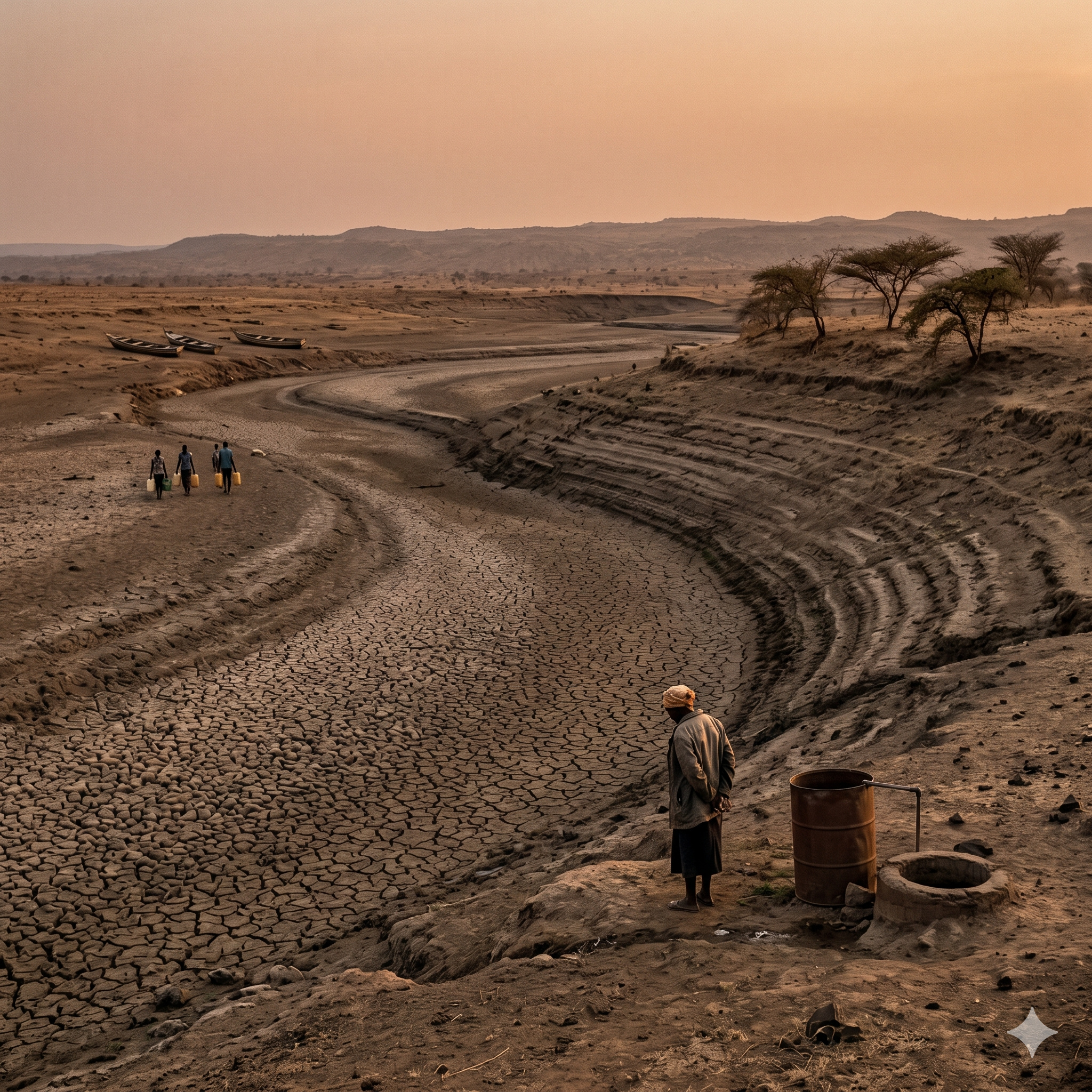

UN report states that the world is already experiencing water bankruptcy, with aquifers collapsing, lakes disappearing, and billions facing water scarcity.
According to the United Nations University, in a report published on January 20, 2026, by the Institute for Water, Environment and Health, the world has already entered a condition defined as water bankruptcy. The document, titled Global Water Bankruptcy: Living Beyond Our Hydrological Means in the Post-Crisis Era, presents the most comprehensive diagnosis ever produced by the organization on the state of global water resources.
The central concept combines two simultaneous factors: insolvency, when water withdrawal and pollution exceed the natural replenishment capacity, and irreversibility, when water systems are permanently or economically unfeasibly damaged to recover.
Difference between water crisis and water bankruptcy redefines how governments should deal with water scarcity
The report proposes a fundamental shift in how water scarcity is interpreted. While water stress and crises are considered reversible phenomena, water bankruptcy represents a structural state in which the original balance can no longer be restored.
-
Over 2,000 Tons of Discarded Fishing Nets Since 2020 Repurposed into Durable Caps, Fins, and Parts

-
Seals and Sea Lions Lose Habitat and Food as Climate Change Advances, Impacting Ice, Prey, and Coastal Communities

-
Brazilian Innovator Uses 3D-Printed Device to Cool Two Rooms with One Air Conditioner
-
China Uses 432 Robots to Move a 7,500-Ton Historic Building in Shanghai, Preserving Architecture While Creating Space for Underground Center


This distinction implies profound changes in resource management, as it eliminates the expectation of returning to historical patterns.
When an aquifer is exploited beyond its recharge rate for long periods, soil compaction and collapse of water storage spaces occur.
This process permanently reduces underground storage capacity, making system recovery unfeasible on a human timescale. The loss is not merely temporary but structural.
Global data shows aquifer decline, land subsidence, and disappearing lakes
The report presents indicators that highlight the scale of the problem. Approximately 70% of the world’s major aquifers are in long-term decline. More than 6 million square kilometers of the Earth’s surface show subsidence caused by groundwater extraction.
More than 50% of the planet’s large lakes have lost significant volume since the 1990s, and approximately 35% of wetlands have disappeared since 1970.
More than 2 billion people live without safe access to water while three-quarters of the population face water insecurity
The impacts of water bankruptcy directly affect the global population. Approximately 2.2 billion people still lack access to safely managed drinking water. At the same time, almost three-quarters of the world’s population live in countries classified as water-insecure or critically water-insecure.
This scenario indicates that scarcity is no longer localized but has become systemic. The report uses the Aral Sea as a historical example of water bankruptcy.
In the 1960s, it was the world’s fourth-largest lake, covering 68,000 km². After rivers were diverted for agricultural irrigation, it lost about 90% of its area by 2007.
The disappearance of the lake altered the regional climate, destroyed local fisheries, and created a saline desert that affects the health of nearby populations.
Management based on historical averages exacerbates crisis by ignoring new climatic and hydrological reality
One of the central criticisms of the report is the use of historical averages for water planning. These averages no longer reflect current conditions, marked by climate change, increased demand, and environmental degradation.

Maintaining this model increases the risk of water system collapse.
Water bankruptcy demands a model change with legal extraction limits and natural capital accounting
The report proposes a structural change in water governance. Among the recommendations are the adoption of legal limits for extraction, the accounting of natural capital, and the protection of vulnerable communities. These measures aim to adapt water use to the real capacity of natural systems.
Agriculture is responsible for about 70% of the world’s freshwater withdrawals.
At the same time, food production needs to grow to feed an estimated 10 billion people by 2050. This scenario creates a structural conflict between food security and water availability.
Solutions such as water efficiency, desalination, and reuse are still insufficient in isolation
The report points to technical alternatives to address scarcity. These include improvements in irrigation efficiency, the use of reused water, desalination, and changes in agricultural crop types.
However, none of these solutions are sufficient in isolation to reverse the global situation.
The main change proposed is the transition from a crisis response model to a permanent scarcity management model.
This implies accepting that some water systems will not be recovered and that management should focus on preserving what still exists.
Now we want to know: does the world still have time to reverse part of the water bankruptcy or has it already reached a point of no return?
The UN’s diagnosis indicates that the problem is no longer future, but present.
In your view, is it still possible to reverse part of this scenario, or is the trend towards worsening in the coming decades?









