Portuguese
  Spanish


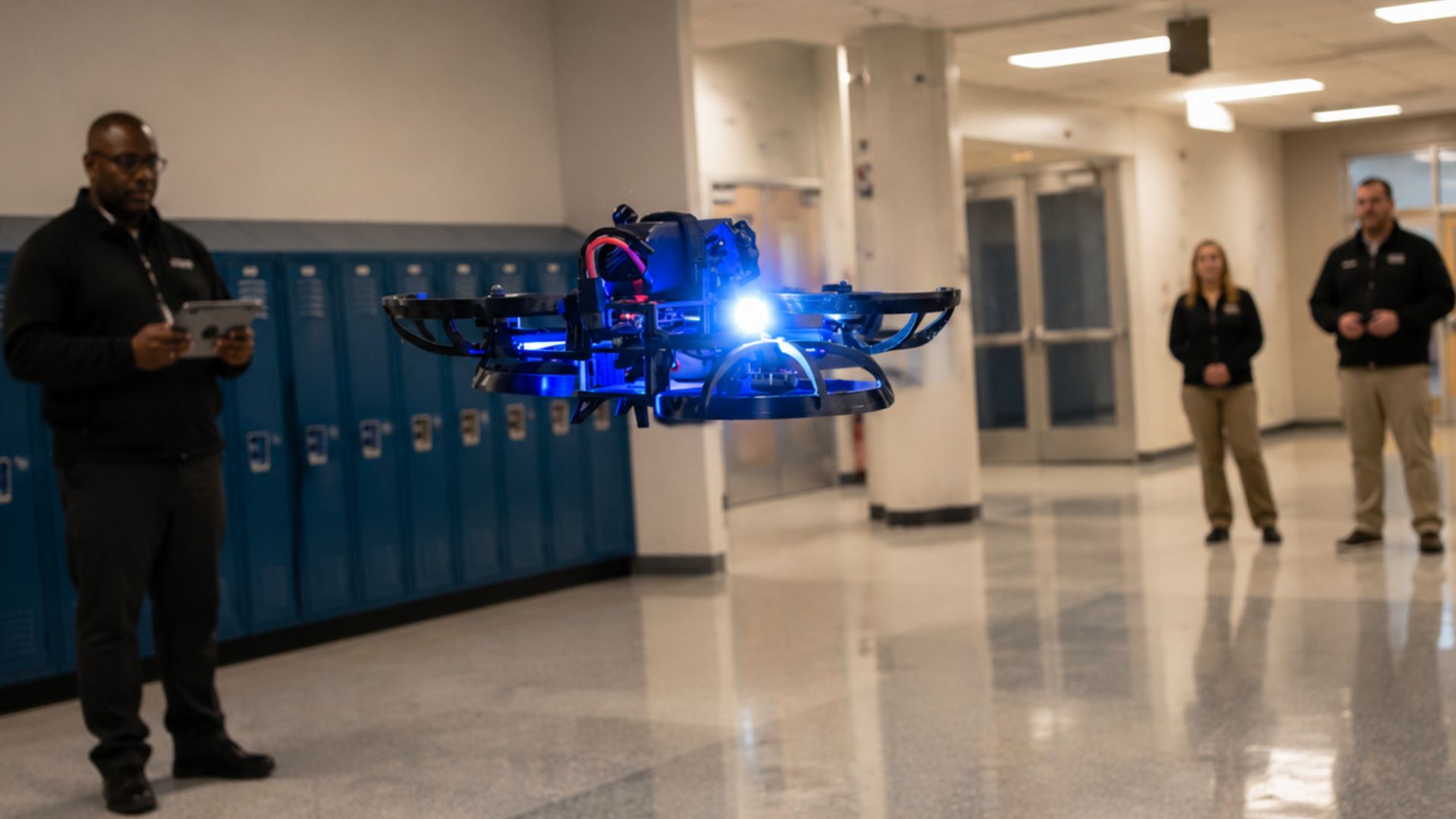


The United States is testing human-controlled drones that can neutralize shooters in schools in less than a minute, using non-lethal pepper gel or kinetic impacts according to the suspect’s actions. The technology was developed by the company Campus Guardian Angel, which already has pilot projects in schools in Florida and Georgia and has its operations center in Austin, Texas.
The system was developed by Campus Guardian Angel, a company co-founded by Bill King, a former member of the U.S. Navy SEALs. When the drones began to be tested: pilot projects with public resources are already underway in schools in two American states, Florida and Georgia, and in Houston, parents want to cover the costs of implementation. How the system works: the company maps each school in 3D, installs mini-hangars with squadrons of three drones at strategic points inside and outside the building, and when a teacher activates the alarm via cell phone, the equipment takes off remotely piloted by operators in Austin and reaches the suspect within the first 15 seconds. Why the idea arose: the tactical operations director, Khristof Oborski, explained that the concept was born from observing how first-person piloted drones were effective and difficult to avoid on the battlefield in Ukraine, and the company decided to adapt this technology to combat the growing problem of school shootings in the United States.
According to the portal IntelliSee, in 2025 alone there were 233 firearm incidents on educational campuses in the United States. In May 2022, in the tragedy of Uvalde, Texas, 19 students and two teachers were murdered by a shooter who was only neutralized 77 minutes after the attack began. It is precisely this time gap between the start of an attack and the arrival of the police that the drones from Campus Guardian Angel aim to fill.
15 seconds: the time that separates the alarm from the arrival of the drones

The interval between the alarm activation and the drones’ arrival at the suspect is the most impressive data point of the system. The company positions squads of three drones in mini-hangars spread across strategic points of the school, determined after the complete three-dimensional mapping of the campus. The flight routes are pre-programmed based on this mapping, allowing the equipment to take off and move to the crisis point without wasting time calculating routes in real-time.
-
China to Drill 15 Kilometers into the Earth, Set to Break Russia’s Record for Deepest Man-Made Hole

-
Researchers Use Algae to Enhance 3D-Printed Walls, Boosting Strength by 25% and Speeding Construction by 33%

-
Drill Uncovers Freshwater Rivers Hidden Beneath the Ocean Floor
-
3,000-Ton, 81-Meter Attack Submarine Begins Sea Trials, Equipped with Heavy Torpedoes and Anti-Ship Missiles


The drones weigh less than one kilogram, measure about 25 centimeters, and can reach the suspect flying at 65 kilometers per hour. For comparison, the average police response time to a school incident in the United States varies between 5 and 15 minutes, depending on location and team availability. The 15 seconds promised by the drones do not replace police action but create a first line of defense that can interrupt or delay the attack until security forces arrive on the scene.
Pepper gel, kinetic impact, or just presence

The drones’ response is not standardized. The type of intervention is determined in real-time by the human operator who remotely pilots the equipment, based on the suspect’s actions at that moment. If the individual is a minor walking with a weapon without having started shooting, the presence of drones equipped with bidirectional audio may be sufficient to give voice commands and dissuade the action. Operators can speak to the suspect through the drones and try to convince them to drop the weapon.
If the individual is already attacking children, the company foresees two levels of physical intervention: the use of non-lethal pepper gel and kinetic impacts. The pepper gel is designed to temporarily incapacitate the shooter, causing eye irritation, breathing difficulty, and disorientation. Kinetic impacts involve the drone itself colliding with the suspect at high speed, functioning as a guided projectile that hits the body and causes imbalance or momentary incapacitation. Neither option is lethal, but both aim to interrupt the attack in the critical seconds before police arrival.
From the war in Ukraine to American schools
The connection between the Ukrainian battlefield and United States schools may seem unlikely, but it is the guiding thread of Campus Guardian Angel’s drone technology. Khristof Oborski explained that the company’s CEO observed how first-person piloted drones were devastatingly effective in the Ukraine war, being able to pursue moving targets, operate in confined spaces, and accurately hit objectives that soldiers could not reach. The natural question was: if this technology works on the battlefield, can it work inside a school?
The adaptation of the military concept to the school environment required fundamental changes. The drones used in Ukraine carry explosives and are designed to destroy. The drones from Campus Guardian Angel carry pepper spray and are designed to incapacitate without killing. The size was reduced to operate in hallways, classrooms, and cafeterias. And the control remains entirely human, with no artificial intelligence making engagement decisions, a deliberate choice that the company considers essential for public acceptance of the system.
Drone pilots who look like gamers, not soldiers
The operators piloting the drones from the central hub in Austin are not military. Alex Campbell, one of the program’s pilots, competes in professional drone leagues and describes himself more as a video game “nerd” than a soldier. The skill to pilot drones at high speed through enclosed environments, dodging obstacles and chasing moving targets, is exactly the type of dexterity that racing drone competitions develop.
Bill King, co-founder of the company and former SEAL, states that the fact that the drones do not operate with artificial intelligence reassures parents and educators. Every engagement decision is made by a human who assesses the situation in real-time through the equipment’s cameras. There is no algorithm deciding whether a student with a backpack is a threat or not. Campbell sums up the personal motivation: “It’s gratifying to know that you can help agents do their job, return home safely, and ensure that all these kids also return home safely.”
233 incidents in 2025 and the tragedy that could have been different
The numbers of armed violence in schools in the United States are the strongest argument in favor of solutions like the drones from Campus Guardian Angel. In 2025, there were 233 incidents involving firearms on American educational campuses, a volume that turns school shootings from tragic exceptions into a statistical standard. Each incident represents destroyed families, traumatized communities, and an educational system operating under the shadow of violence.
The tragedy in Uvalde, Texas, in May 2022, is the case the company cites most to justify the existence of the system. The 77 minutes between the start of the attack and the neutralization of the shooter represent more than an hour in which 19 children and two teachers were killed while the police hesitated outside. If the drones had arrived in 15 seconds and incapacitated the shooter with pepper spray before he entered the classroom, the outcome could have been different. It’s impossible to say for sure, but the company argues that 15 seconds are infinitely better than 77 minutes.
Drones in schools: solution or symptom
The United States tests drones capable of reaching a shooter in 15 seconds, neutralizing them with pepper gel or kinetic impact, and keeping the situation under control until the police arrive. Pilot projects are already operating in Florida and Georgia, parents in Houston want to fund the system, and the company dreams of installing it in all schools across the country. Co-founder Bill King sums up the ideal scenario: “Install this system in all schools in the United States and never need to use it.”
What do you think about using drones to protect schools against shooters? Tell us in the comments if you believe this technology is a valid solution or if it only addresses the symptom of a larger problem, how you evaluate the adaptation of military technology for school environments, and if Brazil should consider similar systems. We want to hear your opinion.