Portuguese
  Spanish


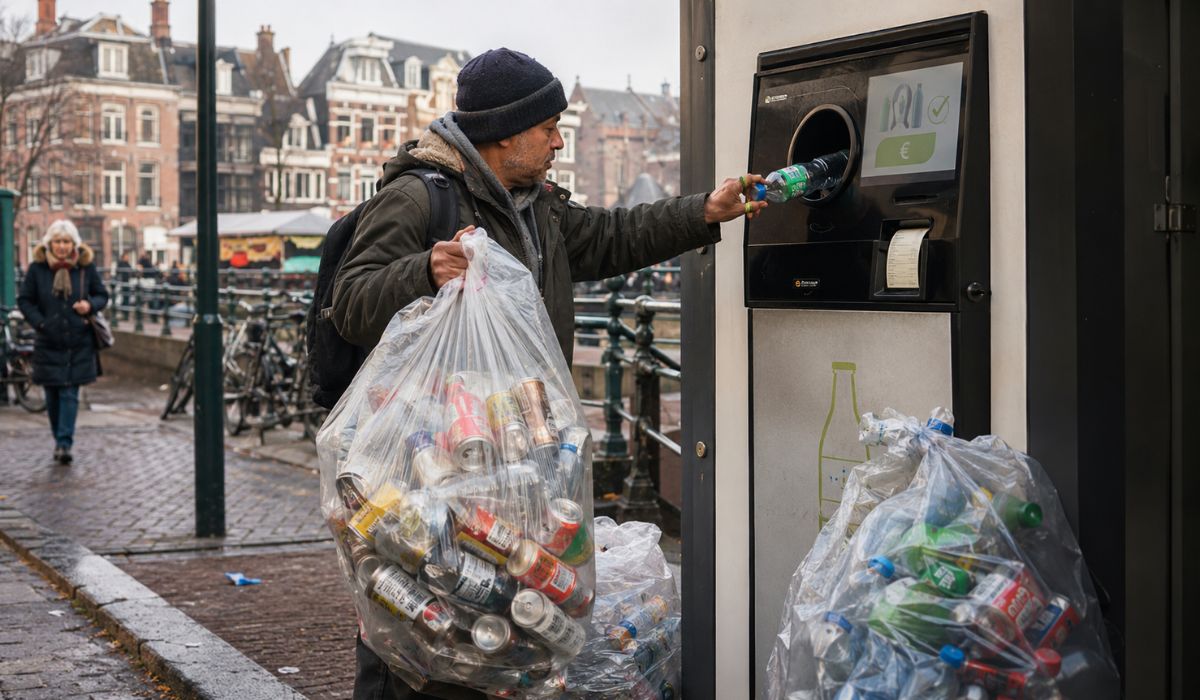


In the Netherlands, specialized packaging return stores show how used bottles and cans can circulate between consumption, income, recycling, and environmental goals, in a system that mixes technology, behavior, and public policy.
Stores created exclusively to receive plastic bottles and cans with deposits have started to be used in the Netherlands as an alternative to increase packaging returns and reduce dependence on machines installed in supermarkets.
The system allows consumers to return used containers, receive back the amount paid at the time of purchase, and contribute to the country’s legal goal of collecting 90% of the bottles and cans sold.
The model, known in Dutch as statiegeld, operates from a deposit charged when purchasing drinks in cans, plastic bottles, or glass bottles.
-
3,000-Ton, 81-Meter Attack Submarine Begins Sea Trials, Equipped with Heavy Torpedoes and Anti-Ship Missiles

-
Boat Made from 10 Tons of Plastic and 30,000 Discarded Flip-Flops Sails Along African Coast, Serving as a Floating Classroom on Ocean Pollution
-
Welder Discovers 16th-Century Diamond Ring in England After 7 Hours with Metal Detector; Gold Jewel Linked to Edward I Pattern Auctioned for £17,000
-
Former Merchant Marine Captain Invents Fuel-Free Barrier, Removes 20,000 Tons of Trash from Chennai Rivers



The amount usually varies between 15 cents and 25 cents of euro, depending on the size and type of packaging.
The amount can be recovered when the container is returned in a reverse vending machine.
In practice, an empty package gains economic value.
For consumers, the return may mean just recovering a small expense.
For people who collect cans and bottles on the streets or for small businesses that accumulate large volumes, the deposit can represent supplementary income or a boost to the cash register.
How statiegeld works in the Netherlands
In Amsterdam, one of the Statiegeld stores operates on Nieuwezijds Voorburgwal, a busy area in the Dutch capital.
It was there that Mariama Kamara arrived with three large blue bags full of cans and bottles.
She had received the task from her aunt, who owns a nearby restaurant.
In about seven minutes, Mariama placed approximately 350 cans in the return machine and received more than 50 euros, an amount that would be allocated to the family business.
“It’s a really cool idea, and so convenient,” she stated in the original account.
The main difference between these stores and traditional points is the volume that can be delivered.
In supermarkets, consumers usually insert bottles and cans one by one.
There are also cases where the machines are out of operation, have limited capacity, or refuse packaging from brands not sold by the chain.
In the centers dedicated to statiegeld, the process was structured to receive larger quantities of packaging.
The goal, according to Verpact, the organization responsible for the system on behalf of the packaging industry, is to facilitate returns and increase the return rate of containers covered by the deposit.
Why the Netherlands created stores for bottles and cans
The Netherlands already had a deposit system before the opening of these stores.
The mechanism was expanded over the years to include different types of containers, such as plastic bottles and cans.
The advancement occurred amid legal collection targets and policies aimed at recycling and reducing waste in public spaces.
Despite having rates considered high compared to many countries, the Dutch system has not yet reached the level required by national legislation.
According to Verpact, 77% of plastic beverage bottles and 84% of cans were returned in the last balance mentioned in the original material.
The target, however, is at least 90%.
The gap between the result obtained and the legal obligation led to the creation of specialized points.
The first store of this type was opened in Rotterdam, in May, with a machine capable of processing up to 200 bottles and cans at once.
According to Verpact, more than a million deposit-packaged items have been delivered since then in this operation model.
Amsterdam now has two Statiegeld stores.
Due to their central location, these points attract residents, tourists, merchants, and people who collect packaging for several hours to exchange the containers for money.
An employee of Kiepe Safety Group, the company responsible for the store staff, summarized the difference in perception about the collected material: “For some people, it’s trash; for others, it’s something to eat.”
Packaging recycling and industry responsibility
Companies that place packaged products on the Dutch market have a legal obligation to participate in the collection and recycling of these packages, including the operation of the deposit system.
Verpact acts on behalf of the packaging industry and reports the results annually to the government.
Once collected, the packaging goes through sorting, cleaning, and processing.
Part of the material is transformed into new raw material and can return to the production chain.
According to Verpact, recycled PET is used in the manufacture of new PET bottles.
In the report mentioned in the original material, the organization stated that, in 2023, PET bottles already contained, on average, 44% recycled PET.
The Netherlands also began to require that, by 2025, 25% of the material in a PET bottle be composed of recycled material.
This process is part of circular economy policies, where used materials are reused in production instead of being discarded after a single consumption cycle.
In the case of bottles and cans, the deposit acts as a financial incentive for the container to return to the collection system.
Impact of return stores on urban waste
Deposit systems are associated by governments and environmental organizations with the reduction of irregular disposal of packaging.
A study by the Ministry of Infrastructure and Water Management of the Netherlands, consultancy CE Delft, and Utrecht University pointed to a 69% decrease in the presence of small plastic bottles and cans in litter scattered in urban areas since the opening of the stores, although the survey does not attribute the result exclusively to these points.
At the same time, experts point to unintended effects.
In some cities, people collecting packaging to obtain the deposit have started rummaging through trash bins in search of bottles and cans.
This behavior can spread other waste and increase the need for public cleaning in certain areas.
Martin Calisto Friant, from the organization Circle Economy, stated that the problem was observed especially around trash bins.
According to him, in some cities there was an increase in litter in these areas, with additional costs for urban cleaning.
The expert also mentioned cases where broken packaging attracts animals.
The cost of operation is another point mentioned by those who follow the topic.
Reverse vending machines, transportation, processing centers, and maintenance require constant investment.
Hester Klein Lankhorst, CEO of Verpact, acknowledged that the system is expensive but stated that it helps reduce irregular disposal.
Deposit value and consumption of disposable packaging
Part of the criticism of the model focuses on the amount paid to the consumer.
Thomas Morgenstern, from Tomra, a Norwegian company that provides reverse vending machines for various deposit systems, assessed that the financial incentive for small packaging is low.
For him, this is one of the main weak points of the Dutch model.
The discussion also involves the impact of the system on the consumption of disposable packaging.
For Calisto Friant, the deposit can help with collection, but it does not necessarily reduce the production or use of single-use containers.
In his assessment, reducing the consumption of this type of packaging should be among the priorities of environmental policies.
Similar experiences already work in other countries.
The Canadian province of British Columbia created a mandatory return system for beer and soda bottles and cans in 1970.
Sweden adopted its own model in 1984.
In Europe, countries like Norway, Germany, and Ireland also operate deposit systems.
The topic gained additional weight with European rules that set collection targets for single-use plastic bottles and cans.
Therefore, other countries have started to create or expand return models, with different payment formats, operation, and industry responsibility.
Specialized stores as support for the collection system
For Verpact, the desired scenario would be for points of sale to have collection units operating properly and with the capacity to accept the packaging provided for in the system.
While this structure does not fully meet the demand, specialized stores are treated by the organization as a complementary measure to facilitate the return.
The experience also changes the circulation of these wastes in cities.
Bottles and cans with deposits are collected by consumers, merchants, and people seeking income from the return.
The financial return, even if small per unit, creates a collection network involving different user profiles.
For Mariama Kamara, the difference lies in practicality.
Before, she had to go to supermarkets and manually insert each container, a time-consuming process when there was a large quantity of packaging.
“If I had to do all the work manually, my back would hurt,” she said.
Amid legal goals, reverse machines, and consumers who accumulate bags full of cans, the Dutch experience shows how the financial value attributed to packaging can influence disposal behavior.