






 Portuguese
  Spanish
  5 min of reading
  0 comments


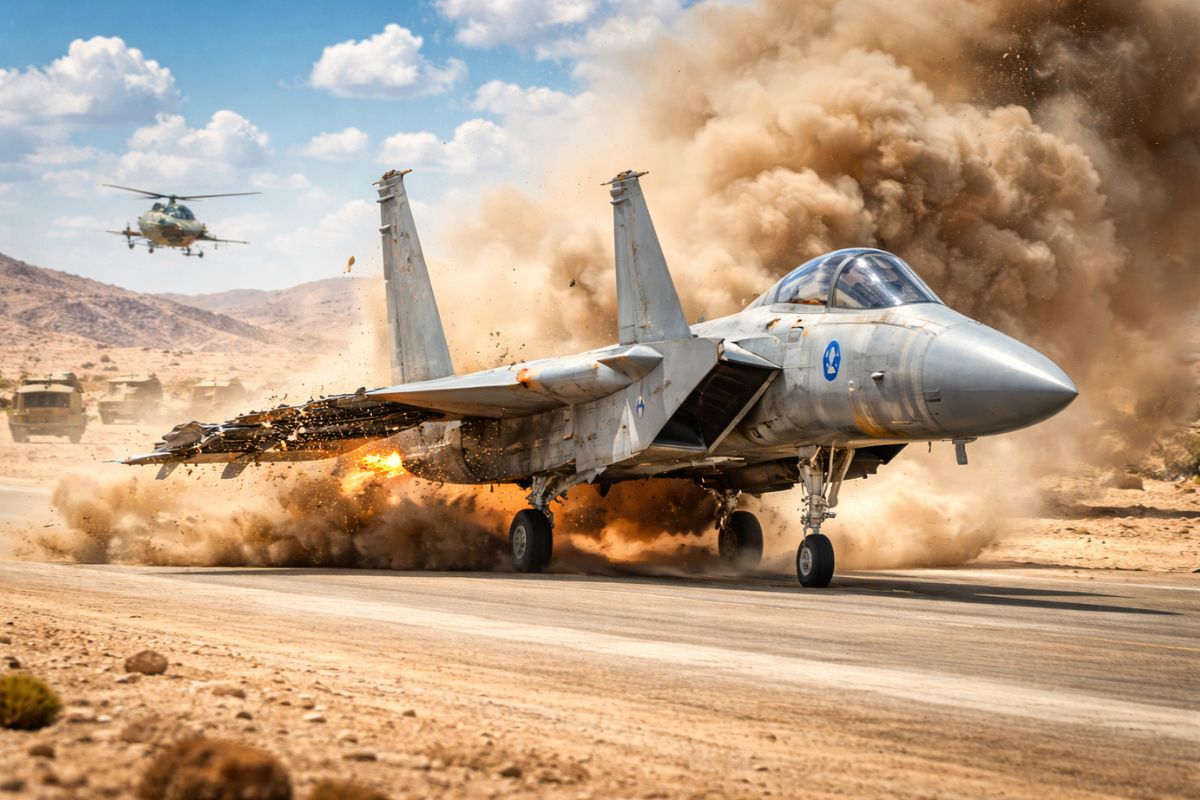
Created after Pentagon alarms about Soviet fighters, the F-15 Eagle experienced an extreme episode in Israeli Air Force training when it lost its right wing and still landed at 480 km/h
The F-15 did not emerge as just any project. It was born from a strategic scare: the American reading that the Soviet MiG-25 would be a “superfighter” fast, aggressive, and capable of dominating air combat. The pressure increased when Israeli radars detected, in 1971, an aircraft flying at Mach 3.2 at altitudes that the F-4 Phantom could not reach.
However, the F-15 ended up going beyond the original objective. Even after the United States discovered that the MiG-25 was, in practice, an interceptor and not a maneuverable fighter, the result of the program was one of the most efficient fighters ever put into service, with a record of victories and a real case that seems to challenge the theory.
The panic of the MiG-25 and the decision to create a “made to dominate” fighter

In the 1950s and 60s, the Soviet Union accumulated symbolic and technological advantages, and the perception of superiority extended to the skies. Fighters like the MiG-23 were already seen as very advanced, but the trigger for concern within the Pentagon was the emergence of the MiG-25 at the end of the 1960s.
-
Helicopter Drops 180 Tons of Sand and Gravel on Swedish River to Revive Ecosystem Damaged by Decades of Exploitation

-
Brazilian Company Launches Retro Smartphone with 48 MP Camera, T9 Keyboard, and Privacy Features for Social Media-Free Use

-
Self-Taught Chinese Farmer Builds 5-Ton Submarine from Scrap, Launches It in Anhui River
-
Invisible Induction Technology Enables Wireless Power for Blenders, Coffee Makers, and Air Fryers, Reducing Countertop Cables





When the U.S. had the first indications about the MiG-25, the initial analysis interpreted the aircraft as a highly maneuverable and extremely fast air superiority fighter, thanks to its large wing area and two powerful engines. In March 1971, the Israeli detection of an aircraft at Mach 3.2 reinforced the sense of urgency, as interceptions failed and missiles fired did not reach the target.
F-15 Eagle enters service and becomes a performance benchmark

In this context, the development of the F-15 Eagle began. The goal was clear: to dominate air combat and directly face what was believed to be the profile of the MiG-25. About five years after the encounters, the F-15 entered service in 1976.
The project was described as performance-focused. The F-15 received two engines capable of generating up to 22 tons of thrust with afterburner combined and a decisive feature: thrust-to-weight ratio greater than 1, allowing acceleration even in a vertical climb. The aircraft was designed for close combat, dogfighting, exactly as it was expected to be necessary.
The turn of 1976: the MiG-25 was not what it seemed
On September 6, 1976, Soviet pilot Victor Belenko landed a MiG-25 in Japan, allowing Americans to dismantle and analyze the aircraft. The revelation was uncomfortable: the MiG-25 was indeed fast, above Mach 3, but had significant limitations.
It was not an air superiority fighter. It was an interceptor, designed to reach high-altitude bombers, not for maneuverable duels against other fighters. The initial fear that accelerated the F-15 program had been inflated by a misinterpretation, but the result remained: an extremely capable fighter.
Israel and the history of the F-15 in air combat
The base content indicates that the first air kill with the F-15 occurred in 1979, carried out by Israeli pilots. From there, Israel would accumulate over 60 aerial victories with the F-15 in real operations, consolidating the platform’s reputation.
But the story that turned the F-15 into an almost unbelievable case did not come from real combat. It came from a training exercise, in which the aircraft was taken to its structural limit.
The shock of 1983: collision in training and the right wing ripped off

The episode occurred on May 1, 1983, during an exercise of the Israeli Air Force over the Negev desert. Two F-15Ds were acting as defenders against A-4N Skyhawks in a simulated attack. There was a concept of a “safety bubble” that required a minimum separation of 500 feet, about 152 meters, to avoid collisions, but this separation was not maintained.
The F-15 involved was piloted by Ziv Nedivi, in operational training, with instructor Eroar Gul in the back seat. In a sequence of maneuvers, an A-4N performed an inverted maneuver and began climbing without noticing the F-15 in position. The aircraft collided, and the impact struck the junction between the right wing and the fuselage of the F-15.
The A-4 disintegrated, and the pilot ejected safely. The F-15, on the other hand, suffered extreme damage: the right wing was completely torn off, and the aircraft entered an uncontrolled spin towards the ground.
Afterburner, control at the limit, and landing at 480 km/h

Inside the cockpit, the situation was critical. The directive was to prepare for ejection as soon as conditions allowed, but the pilots still did not have a full understanding of the damage. Nedivi made a decision outside the standard instinct: instead of reducing power, he activated the afterburner.
The increase in thrust slowed the spin and allowed him to reduce the rotation enough to regain some control. When trying to decrease power afterward, the F-15 began to spin again, making it clear the central point: the aircraft could only remain stable at high speed and high thrust.
About 16 km from an airbase, Nedivi decided to try to get the plane there. The next challenge was landing. An F-15 typically approaches for landing at around 240 km/h, but reducing to that speed would mean losing control. The final approach happened at around 480 km/h, almost double the standard.
The pilot lowered the emergency arresting hook to catch the arresting cables, and the hook managed to catch one of the cables in the first third of the runway, but was almost immediately torn off by the extreme load. Even so, the F-15 slowed down enough and stopped about 6 meters from the end of the runway.
Why the impossible happened, according to the technical analysis

When the information reached the United States, there was skepticism. Engineers from McDonnell Douglas considered the possibility of a misinterpretation and sent a team to Israel to inspect the aircraft. The analysis confirmed the incident and pointed to the explanation as a combination of design factors of the F-15.
The wide fuselage would generate significant lift, partially functioning as a wing. And the available thrust would allow maintaining speed and control even in extreme conditions. This combination would have made it possible to keep a fighter with only one wing in the air, something that, from a theoretical standpoint, did not seem viable.
What this story says about the F-15 and decisions under pressure
The F-15 was born from a fear that later proved to be exaggerated, but the design delivered a real performance margin. And in 1983, that margin turned into survival, with a series of quick decisions in a scenario that should not allow for a “plan B.”
In the end, the episode became a practical demonstration of how far the F-15 could be pushed under extreme conditions, and why it entered the history of military aviation.
Do you believe that the decisive factor for the F-15’s survival was more the aircraft’s design or the pilot’s decision to maintain afterburner and high speed until landing?




-

1 person reacted to this.