






 Portuguese
  Spanish
  4 min of reading
  0 comments


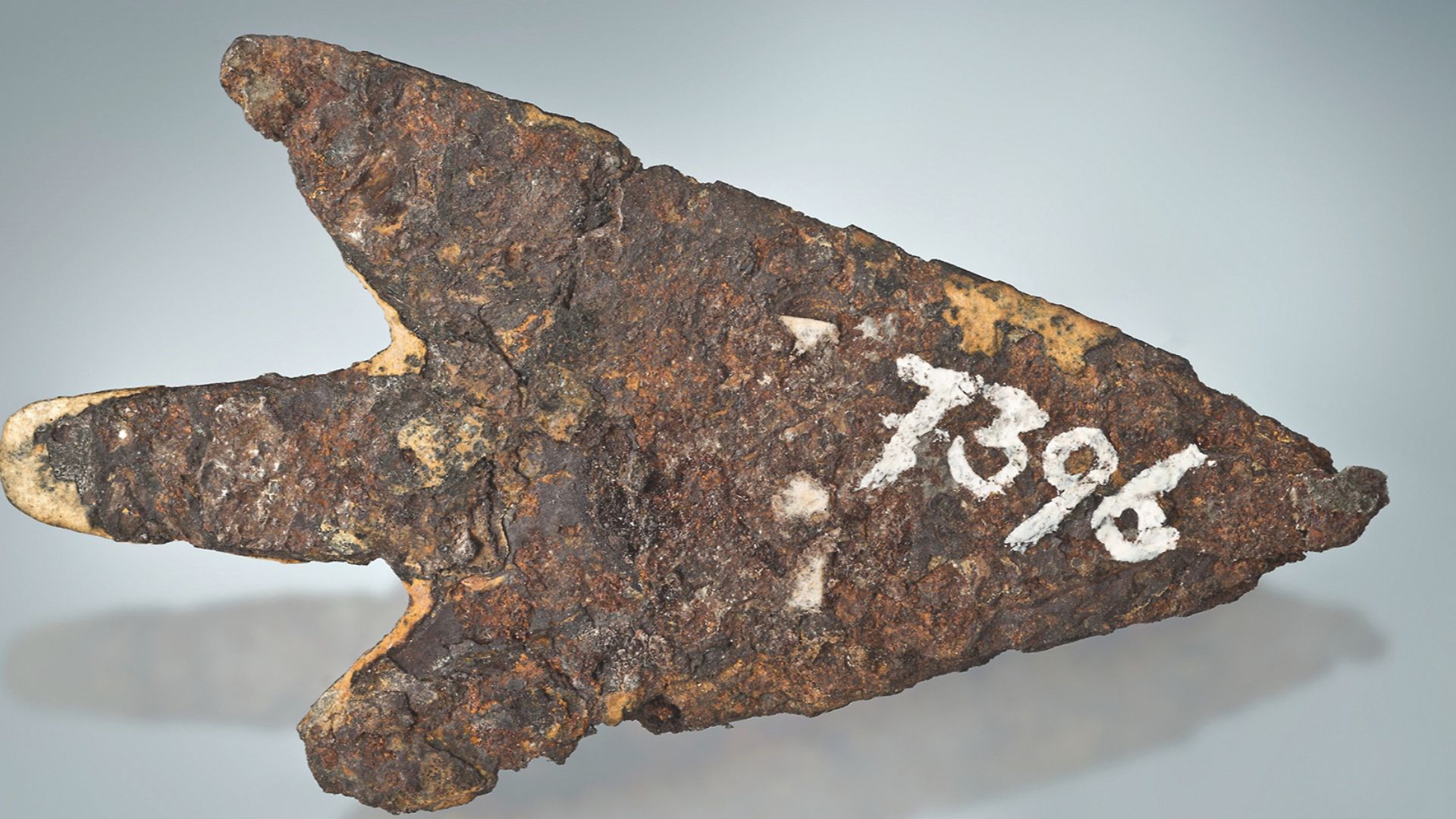
Scientists discovered that a Bronze Age arrowhead found in Switzerland was made with meteoritic iron and may have originated from an impact in Estonia.
For over a century, it seemed just like another rusty arrowhead stored in a Swiss archaeological collection. Small, discreet, and weighing less than a modern coin, the piece remained practically ignored since its discovery in the 19th century. But analyses conducted by researchers in Switzerland revealed that the object concealed an extraordinary origin. The arrowhead was not produced with ore extracted from the Earth. It was forged with iron from space, the result of a meteorite that fell thousands of years ago and possibly traveled through a vast prehistoric trade network before reaching the hands of Bronze Age craftsmen.
A piece of just 39 millimeters revealed one of the rarest materials used by Bronze Age peoples
The arrowhead was found in Mörigen, on the shores of Lake Biel, Switzerland, during excavations conducted in the 19th century at a settlement dated between 900 and 800 BC.
The artifact measures only 39 millimeters in length and weighs approximately 2.9 grams, but its archaeological importance is disproportionate to its size.
-
Survivor of 1966 SS Daniel J. Morrell Shipwreck in Lake Huron Recounts 38-Hour Ordeal in Extreme Cold

-
The Greatest Hoax in World Cup History? The Film That Denied Brazil’s 1958 Victory and Exposed How Fake Evidence Can Seem Convincing on TV
-
Fake South Korean Online Stores Offer Shopping Thrill Without Spending Money or Receiving Products
-
The War of Jenkins’ Ear: How a Severed Ear Sparked One of the 18th Century’s Most Unusual Conflicts


When researchers from the Natural History Museum of Bern decided to reexamine the piece with modern techniques, they discovered it contained the typical chemical signature of meteoritic iron.
The scientists used non-destructive methods to preserve the object and confirmed without a doubt that the metal did not have a conventional terrestrial origin.
High levels of nickel and cobalt revealed the extraterrestrial origin of the metal
The major clue appeared in the chemical composition. Analyses identified concentrations of 7.1% to 8.28% nickel, in addition to cobalt and germanium, elements found in typical proportions of metallic meteorites.
These characteristics act as a kind of chemical fingerprint capable of differentiating meteoritic iron from iron produced from terrestrial ore.
The researchers also detected traces of cosmogenic aluminum-26, further reinforcing the space origin of the material.
The meteorite did not come from the most obvious place
Initially, the researchers imagined that the raw material had come from the Twannberg meteorite, found relatively close to the region. But the results didn’t match.
The Twannberg meteorite has about 5.1% nickel, a value much lower than that found in the arrowhead. This difference led scientists to look for another source.

After comparing known chemical signatures, the researchers concluded that the most likely origin was an IAB-type meteorite associated with the famous Kaali impact, in present-day Estonia.
If the hypothesis is correct, the metal traveled more than 1,600 kilometers
The scenario reconstructed by the researchers is impressive. If the Estonian origin is confirmed, the material would have traveled more than 1,600 kilometers to reach the region of present-day Switzerland. This would mean that meteorite fragments were already circulating through European trade networks long before the emergence of the great classical empires.
The discovery reinforces the idea that Bronze Age societies maintained much broader contacts than previously imagined.

Today iron is one of the most abundant metals in the industry. But during the Bronze Age, the situation was completely different.
The technology for extracting iron from ore was not yet widespread in Central Europe. Before the beginning of the Iron Age, around 800 B.C., practically all available metallic iron came from meteorites. Therefore, objects produced with this material were extremely rare and likely associated with prestige, power, or religious symbolism.
Researchers believe that the arrowhead was hardly a common object for everyday hunting or warfare.
There are only a few dozen similar objects known to archaeologists
The rarity of the discovery helps explain the scientific impact. According to researchers, only about 55 artifacts made of meteoritic iron are known throughout Eurasia and Africa. Many of them belong to the collection of objects found in the tomb of Pharaoh Tutankhamun.
This places the small Swiss arrowhead in an extremely select group of objects produced with extraterrestrial material before the mastery of iron metallurgy. Analyses revealed more details about the artifact’s manufacturing.
Researchers found grinding marks and traces of plant tar used to attach the tip to the wooden shaft. They also observed internal structures compatible with mechanical deformation caused during the forging process.
This demonstrates that Bronze Age craftsmen not only had access to meteoritic metal but also mastered sufficient techniques to transform it into sophisticated objects.
A tiny piece revealed a story that began in space and ended in prehistoric Europe
For almost 150 years, the arrowhead remained stored without revealing its secret. Today it is seen as extraordinary evidence that Bronze Age peoples valued materials fallen from the sky and were capable of transporting them over great distances before transforming them into rare and valuable objects.
With only 39 millimeters in length and 2.9 grams in mass, the small artifact managed to tell a story that spans continents, millennia, and even the boundaries of the planet itself.


Be the first to react!