






 Portuguese
  Spanish


The US military successfully tested the JDAM bomb with a jet engine. Understand how the new range of 550 km changes the long-range attack strategy.
The landscape of modern conflicts, marked by the intensive use of guided munitions, has just gained a new technological protagonist. In recent tests completed by the US Navy and Boeing, the new version of the JDAM bomb with a jet engine (JDAM-LR) proved capable of hitting targets over 550 km away.
The success of the trials at Point Mugu, California, comes at a critical moment: in recent operations against Iran, the United States and Israel employed over 350 JDAM bombs in 36 hours, reinforcing the urgency for weapons that combine long range and economic viability.
The major strategic advantage of this innovation is the so-called standoff capability. By allowing a fighter to launch munitions hundreds of kilometers from the target, the US ensures that its aircraft operate outside the range of enemy surface-to-air missiles.
-
U.S. Air Force Launches Air-to-Air Missile Project with Range of Up to 1,850 km for Indo-Pacific Operations

-
Australia to Deploy Up to 8 Nuclear-Powered Submarines in Indo-Pacific, Establishes Billion-Dollar Naval Chain Through AUKUS, Joining Elite Group Capable of Extended Underwater Missions

-
Indonesia Begins Construction of 2,000-Ton Scorpène Stealth Submarines with Advanced Weaponry and French Steel

-
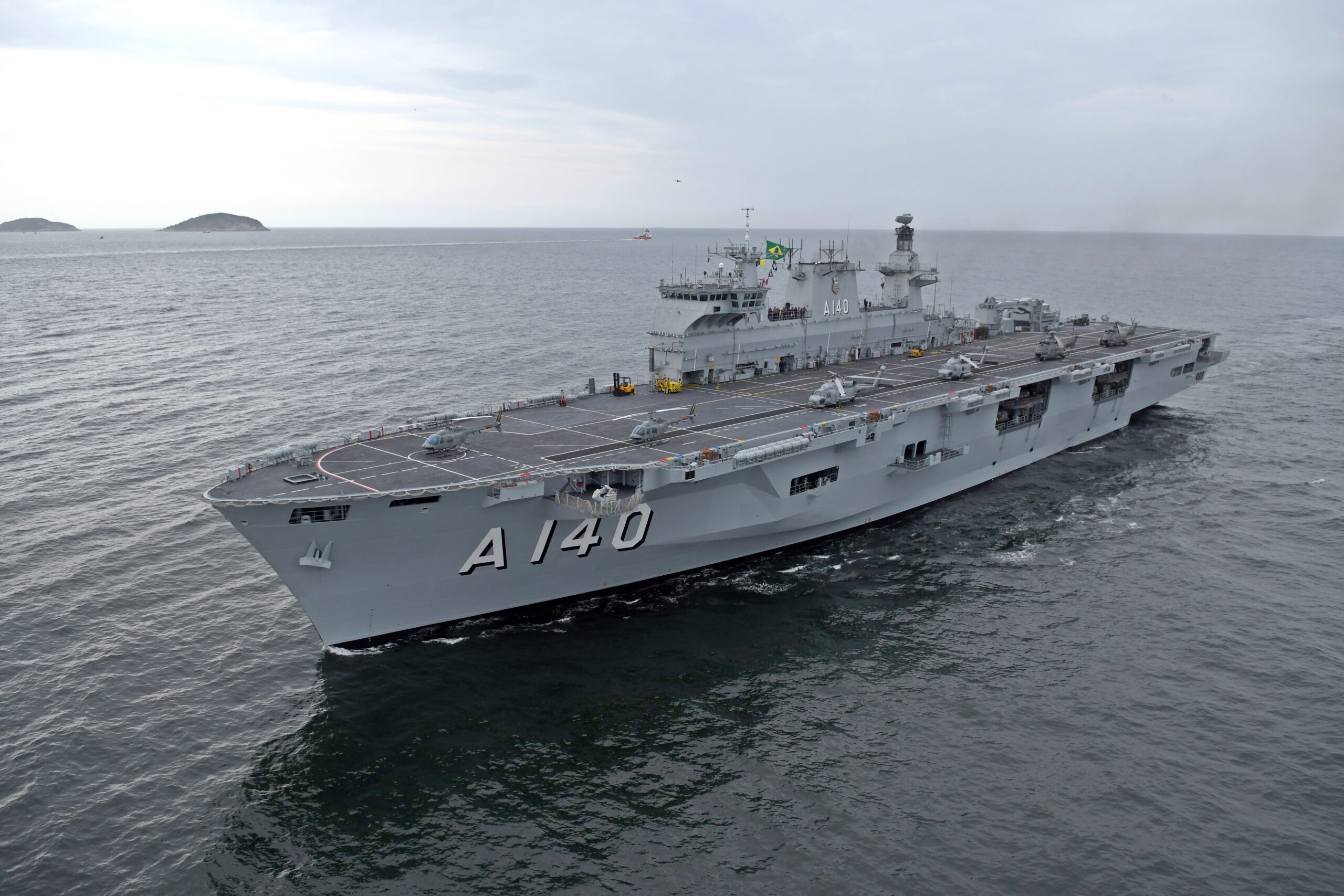
Brazil’s Largest Navy Ship, NAM Atlântico, Transforms into Field Hospital During National Crises




According to Captain Sarah Abbott, manager of the Precision Strike Weapons program, the expansion of range has become an operational necessity to preserve tactical advantage in contested environments, where the survival of combat platforms is a priority.
The bomb that turned into a missile
One of the pillars of the project is to transform the JDAM bomb with a jet engine into a cost-effective alternative to traditional cruise missiles.
While dedicated missiles have extremely high costs and complex logistics, the new variant — designated as GBU-75 — leverages the existing infrastructure of JDAM bombs, which are widely used by air and naval forces around the world.
This hybridization offers clear benefits for the US arsenal:
- Simplified Logistics: Utilizes platforms and software already compatible with the JDAM family.
- Reduced Cost: Avoids the need for integration of entirely new and expensive munitions.
- Production at Scale: Relies on components already manufactured on a large scale.
- Superior Range: Jumps from 24 km (conventional model) or 72 km (ER model) to over 580 km.
Therefore, the new kit allows for sustainable and deep strikes without exhausting the military budget with luxury munitions.
Performance in tests and propulsion technology
During the evaluations in early April 2026, F/A-18 Super Hornet fighters conducted launches that validated the concept. In the first test, the JDAM bomb with a jet engine traveled 370 km in powered flight, maintaining stability for 34 minutes until precise impact.

In the second test, the weapon was subjected to more aggressive maneuvers and altitude changes, confirming the robustness of the terminal guidance system and the engine. The technological heart of this evolution is the TDI-J85 engine, developed by Kratos Defense.
Weighing only 13 kg and providing a thrust of 200 pounds, this micro propulsor is responsible for elevating the GBU-75 (derived from the 230 kg bomb) to a new level of performance. This propulsion allows the device to not only rely on gravity but to execute a level cruise flight, correcting its trajectory via GPS until final impact.
Naval integration and operational future
With the separation and powered flight phase successfully completed, Boeing and the U.S. Navy are now focusing on the full integration of the JDAM-LR into naval platforms. The data collected at Point Mugu will be used to finalize hardware adjustments and refine the flight software.
The goal is for the system to be ready for operational exercises soon, providing a new layer of defense and attack for the fleet. Thus, the arrival of the JDAM-LR bomb with a jet engine redefines the balance of power in the air.
Source: TecnoDefesa







