






 Portuguese
  Spanish


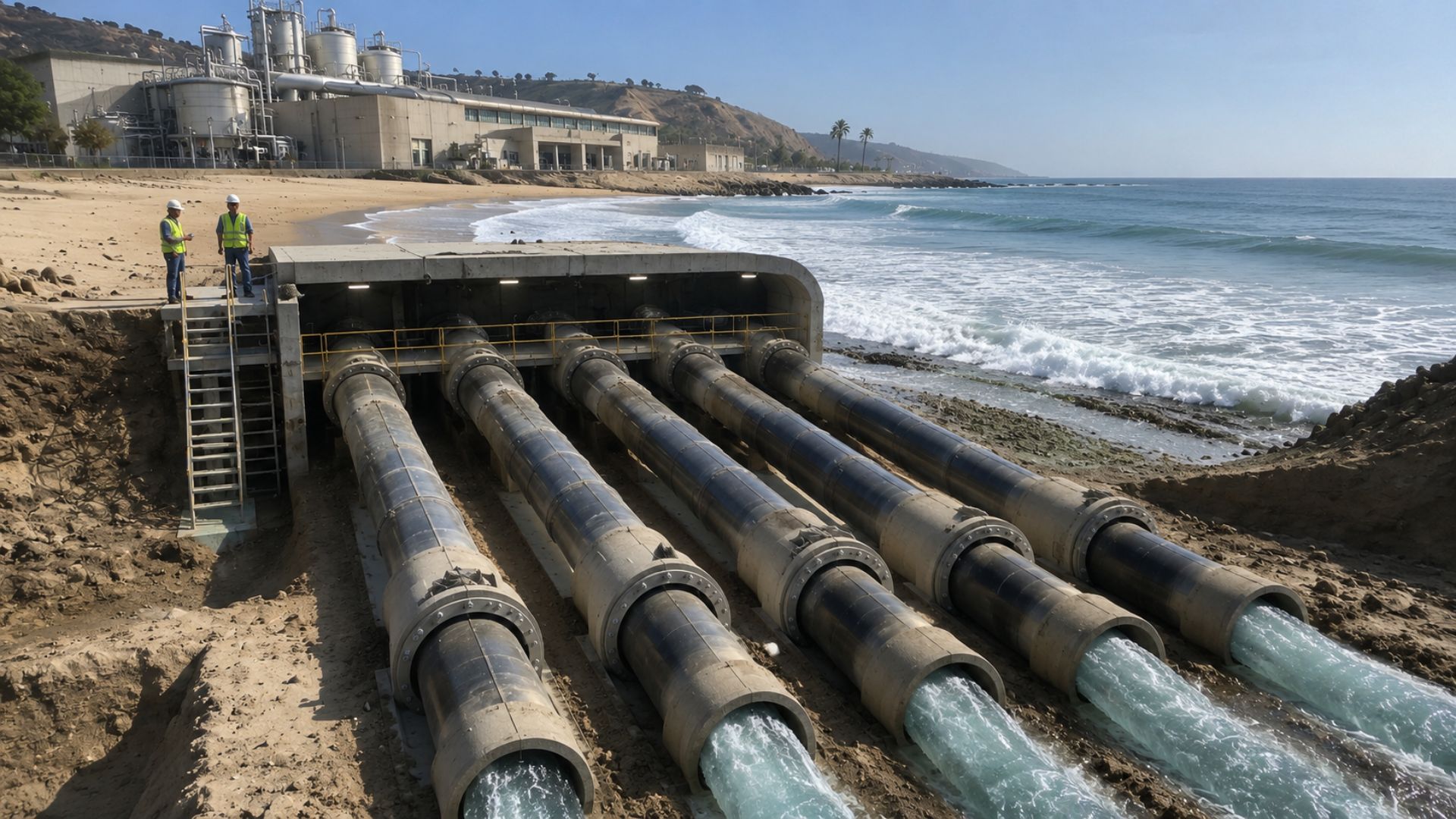

Desalination project in Southern California bets on underground capture under the Pacific to transform saltwater into local supply, with buried inclined wells, controlled brine disposal, and operation planned to reinforce the region’s water security.
The United States is advancing with a desalination project in Southern California that plans to capture saltwater through up to five inclined wells installed under Doheny State Beach and the Pacific Ocean floor, in Dana Point, Orange County.
Planned to produce up to 5 million gallons of potable water per day, the Doheny Ocean Desalination Project is conducted by the South Coast Water District and will have a capacity equivalent to approximately 18.9 million liters daily.
Instead of resorting to an open ocean intake, common in some desalination systems, the proposal adopts a subsurface intake, where water enters through buried wells before reaching treatment.
-
Workers renovating a playground in northern England uncover 176 World War II bombs buried underground; training artifacts still contained explosives.

-
Brazilian Architect Transforms Waste into Sustainable Homes with Solar Power and Rainwater Systems for 40 Years

-
Security Guard Becomes Doctor at Louisiana Hospital Where He Once Worked, Studied Chemistry Between Shifts

-
Woman Rescued from Luxury Complex in Brazil Worked Without Pay for 55 Years, May Be Entitled to Over $300,000




In this model, the sea feeds the inclined wells below the ocean bed, while the water passes through soil and sediments before proceeding to the land unit responsible for salt removal.
According to the responsible district, the solution is considered environmentally preferred because it reduces direct suction on marine organisms and decreases the need for visible intake structures within the ocean.
Planned for Dana Point, near Doheny State Beach and San Juan Creek, the project will be in an area already connected to the regional water infrastructure, an important factor for distributing the treated water.
The California State Lands Commission describes the initiative as an ocean desalination facility composed of underground intake, conveyance pipelines, treatment plant, brine disposal, and other associated structures.
How the underground intake will capture water from the Pacific
From two or three access points at Doheny State Beach, the inclined wells are expected to advance towards the sea and form the underground intake used to capture the saltwater.
According to a report by the California State Lands Commission, these structures are expected to extend from 600 to 900 feet from the well heads and end between 75 and 130 feet below the ocean floor.
With this configuration, the saltwater intake will be hidden under the beach and under the seabed, without a visible intake tower in the ocean or an open structure subject to direct suction.
After collection, the water will proceed to the desalination plant, where it will undergo treatment stages aimed at removing salts and other components before being integrated into the supply as drinking water.
In the initial phase, the planned capacity is 5 million gallons per day, a volume that positions the project as a relevant local source for a region pressured by drought, water importation, and seismic risks.
The same report states that the operation will require about 10 million gallons of feed water daily, with an approximate recovery of 50%; the remainder will be brine and process flows intended for controlled disposal.
Desalination in California seeks to reduce dependence on imported water
For the South Coast Water District, the main justification for the project is to enhance water security in a region vulnerable to droughts, interruptions in imported supply, and earthquake impacts on distribution systems.
The agency states that the plant should create a local, sustainable source more resilient to periods of scarcity, as well as serve as a backup in emergencies affecting supply from other regions.
Also in the report from the California State Lands Commission, the strategic role of the enterprise appears associated with the dependence on imported water and the forecasted increase in demand in the district’s serviced territory.
The document notes that the district imports most of its water and projects an 11% increase in demand, along with a 7% population growth over 25 years.
Still, desalination was not presented as a substitute for efficiency, conservation, or reuse measures, but as an additional piece within a broader supply strategy.
The report states that the project was proposed alongside conservation, use of recycled water for irrigation, automated leak detection, and a brackish groundwater recovery unit.
Brine will have mixed disposal before returning to the sea
Among the most sensitive points in desalination projects is the fate of the brine, a more concentrated residue left after salt removal that requires environmental control before returning to the ocean.
In the case of Doheny, the South Coast Water District reports that this flow will be mixed with treated effluent in the San Juan Outfall and released about two miles from the coast.
By combining brine and treated effluent, the involved agencies advocate for disposal with greater dilution before returning to the sea, within the applicable requirements for ocean desalination facilities in California.
The California State Lands Commission states that the combined disposal is compatible with the California Ocean Plan amendment for seawater desalination facilities.
As part of state regulation, the San Diego Regional Water Quality Control Board approved in 2022 a permit that requires compensation for potential impact of brine discharge on the coastal environment.
This compensation includes the creation of 7.45 acres of wetland mitigation in the South Los Cerritos Wetlands Restoration project, a measure linked to the potential impacts of combined ocean discharge.
In addition to mitigation, the authorization provides for water quality monitoring near the outfall, tracking of the discharge plume, and technology to identify fecal markers related to potential health risks in recreational areas.
Doheny Desalination Plant is scheduled to operate by 2029
In the official schedule of the South Coast Water District, the stages of design, construction, and performance testing appear between 2023 and 2028, while the plant’s operation is scheduled for 2029.
Permits and easements appear on the 2022 calendar, and the development of the project design, construction, operation, and maintenance model was recorded between 2023 and 2024, according to the district’s schedule.
The project received US$ 40.1 million in grants, according to the South Coast Water District, in a combination of federal and state resources aimed at supporting the implementation of the structure.
Among the reported amounts, there is an additional portion of US$ 7.749 million obtained in June 2024 through the WaterSMART Grants for Desalination Construction Projects program, linked to the Bureau of Reclamation.
The Doheny plant is described by the district as the first fully compliant ocean desalination facility with the California Ocean Plan amendment to use subsurface intake and mixed brine discharge.
This state plan establishes location, technology, design, and mitigation measures to reduce impacts on marine life, as well as imposing criteria for controlling ocean discharges associated with desalination.
In a future stage, the project has regional expansion potential to up to 15 million gallons per day, although any expansion depends on new technical, environmental, and regulatory phases.
The authorization reviewed by the California State Lands Commission addresses the initial phase of 5 million gallons per day, and any growth beyond that will require additional evaluation under California’s environmental legislation.
Out of public view, the most unusual part of the project will be under the beach and under the ocean, where slant wells buried beneath the Pacific seabed will form the underground intake of saltwater.
This solution connects an almost invisible surface work to a land-based treatment plant, with the aim of reinforcing the potable water supply in Southern California without relying solely on imported sources.


