






 Portuguese
  Spanish


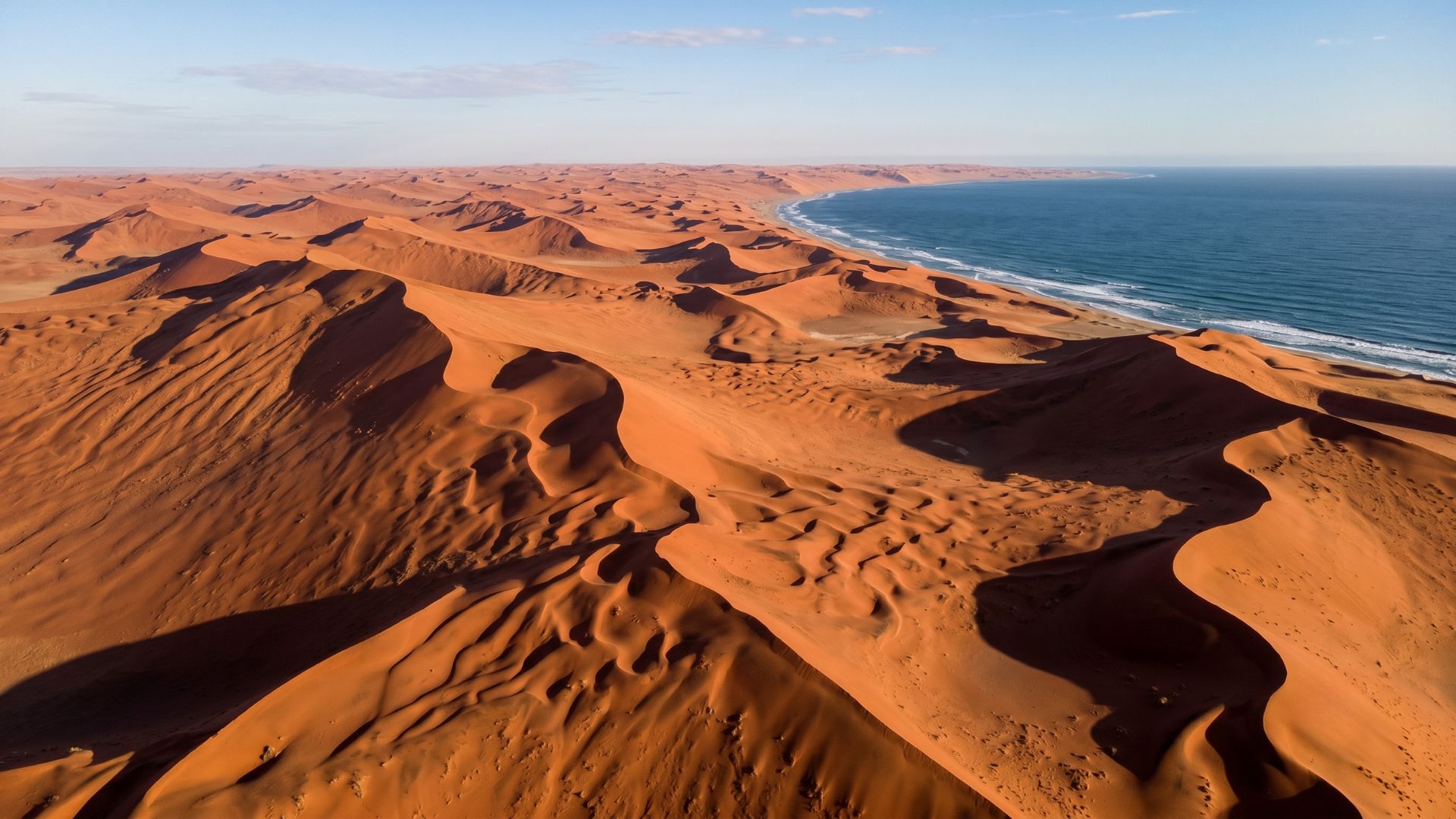

The Namib Sand Sea combines giant dunes, oceanic fog, and millions of hectares of landscapes that make it one of the most extraordinary places on Earth.
Between the Atlantic Ocean and the arid interior of Namibia lies a landscape so unusual that UNESCO has classified it as unique on Earth. At first glance, the Namib Sand Sea appears to be just a vast desert of red dunes. But the scale and formation of this scenery place the area among the most extraordinary natural environments on the planet. According to UNESCO, the protected site occupies 3,077,700 hectares, along with a buffer zone of 899,500 hectares, forming the world’s only coastal desert with extensive dune fields influenced by oceanic fog.
The strength of the place lies precisely in the combination of elements that do not usually appear together in this way. UNESCO describes the Namib Sand Sea as a system built by a kind of three-step natural conveyor belt, where sediments are transported by rivers, ocean currents, and winds over thousands of kilometers to form this sea of sand on the African coast. It is not just a beautiful desert. It is a geological machine that has been in operation for a long time.
A desert of more than 34 thousand km² was assembled grain by grain by rivers, ocean, and wind
The size of the Namib Sand Sea impresses even on a geological scale. According to the IUGS, the area covers about 34 thousand km² along the coast between Lüderitz and Walvis Bay, in a strip that varies from 50 to 160 kilometers wide. This places it among the largest and most expressive coastal dune systems in the world.
-
Billionaire says the most valuable skill will help overcome job elimination caused by AI, following Bill Gates’ fears

-
A Dutchman created a ‘box’ that makes trees grow in the desert almost without water and without irrigation: the invention has already brought seedlings to dozens of countries and achieves up to 90% survival where common planting did not exceed 10%.

-
Abandoned warehouse hid a giant collection of rare computers, with over 2,000 artifacts from the 1930s to the 1980s.
-
Scientists warn that melting ice is triggering an alarming chemical transformation in preserved areas, and the first signs are already concerning researchers worldwide.




The origin of the sand helps explain why the place is so special. According to UNESCO and the IUGS, the material that forms the dunes did not originate just there.
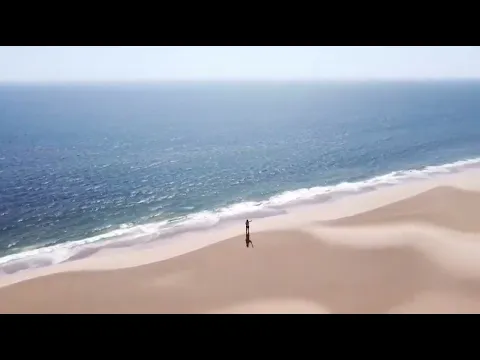

The sand originated in distant areas of Southern Africa’s interior, was carried by rivers to the Atlantic, redistributed by ocean currents along the coast, and then pushed inland by the desert’s persistent winds.
This process gives the location a rare character. Instead of a desert formed solely by local sand, the Namib Sand Sea functions as a gigantic sediment depot traveling through different natural systems until accumulating in one of Africa’s most striking landscapes.
Some dunes exceed 300 meters and are among the largest on the planet
The relief of the Namib Sand Sea also helps explain its worldwide fame. According to the IUGS, the linear dunes exceed 150 meters in height, while some star dunes surpass 300 meters. This places several of them in the category of sand mountains comparable in height to very tall buildings.
The IUGS itself highlights that the location presents an unparalleled wind-shaped landscape, marked by a great diversity of dune forms and a visual scene dominated by monumental red dunes. This combination has made the Namib Sand Sea an international reference for studies of desert geomorphology.
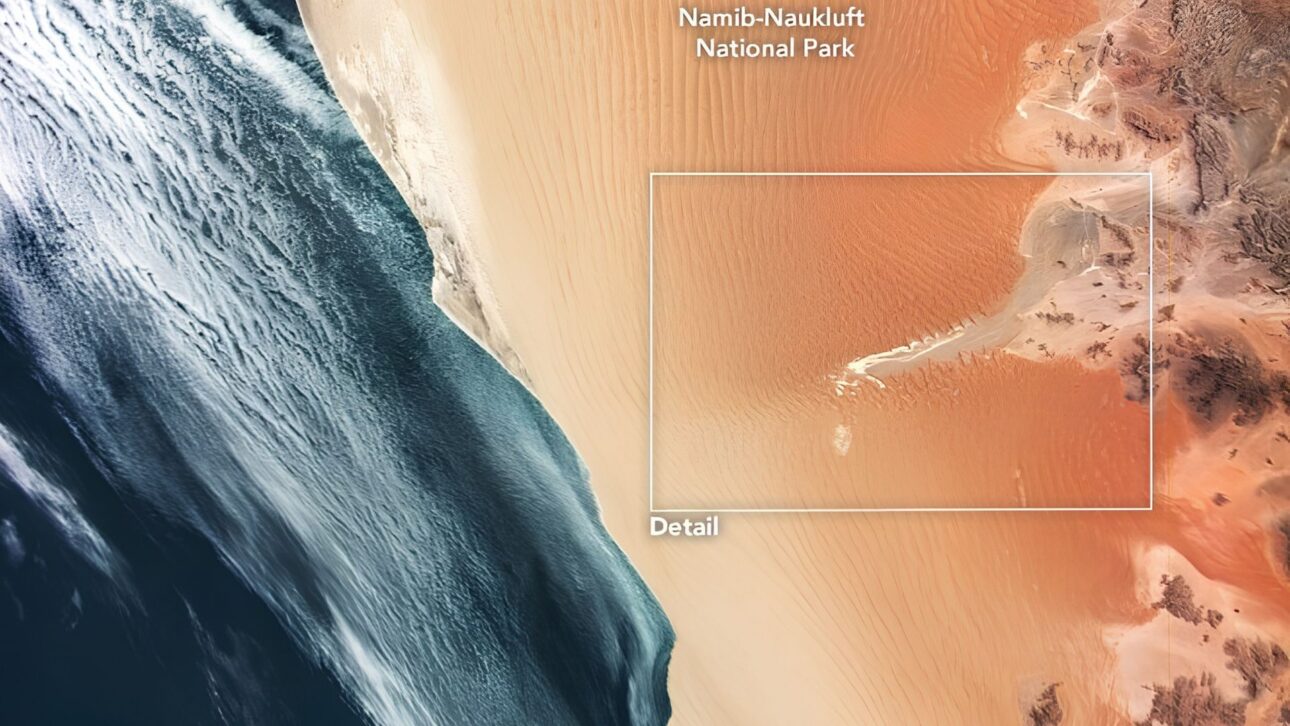
It’s not just an aesthetic matter. The height and variety of the dunes show that there is a very active system of sediment transport and reorganization, continuously shaped by the action of the wind over a geological time scale.
The fog coming from the Atlantic is what makes the Namib Sand Sea unique in the world
The rarest point of the Namib Sand Sea is not just the size of the dunes. According to UNESCO, the site is the only coastal desert on the planet with extensive dune fields influenced by fog. It is this combination of sand, ocean, and mist that sustains the exceptional value of the site.
The IUGS reinforces this point by stating that the fog is an essential source of moisture over the dunes of the Namib. In an extremely arid environment, where rain is limited, this moisture coming from the ocean plays a central role in maintaining ecological processes and the survival of life adapted to the desert.
This detail completely changes the reading of the landscape. The Namib Sand Sea is not just a dry desert of sand and wind. It is an environment where the oceanic atmosphere directly enters the functioning of the terrestrial system, influencing both the shape of the landscape and the possibility of life in one of the most extreme scenarios on the continent.
Landscape began to be formed over 1 million years ago
According to IUGS, new chronological references based on cosmogenic dating indicate that the Namib Sand Sea is over 1 million years old. Additionally, the current dune field overlaps with an older fossil desert linked to the Tsondab Sandstone Formation, which shows that the region carries an even deeper geological history.

UNESCO also highlights that the current system combines two generations of dunes, one older and semi-consolidated, and another younger and active. This reinforces the idea that the place is not a static landscape, but a living geological archive, with layers of formation accumulated over an enormous time scale.
It is precisely this temporal depth, combined with the continuous action of wind, fog, rivers, and ocean currents, that makes the Namib Sand Sea seem less like a common Earth setting and more like a natural masterpiece slowly built over millions of years.
Why the Namib Sand Sea is one of the most extraordinary landscapes on Earth
The Namib Sand Sea challenges almost everything typically associated with a desert. It does not rely solely on rain but on ocean fog.
It is not formed only by local sand but by sediments transported over vast distances. And it does not feature just isolated dunes but a colossal landscape shaped by geological and atmospheric processes that have worked together for a long time.
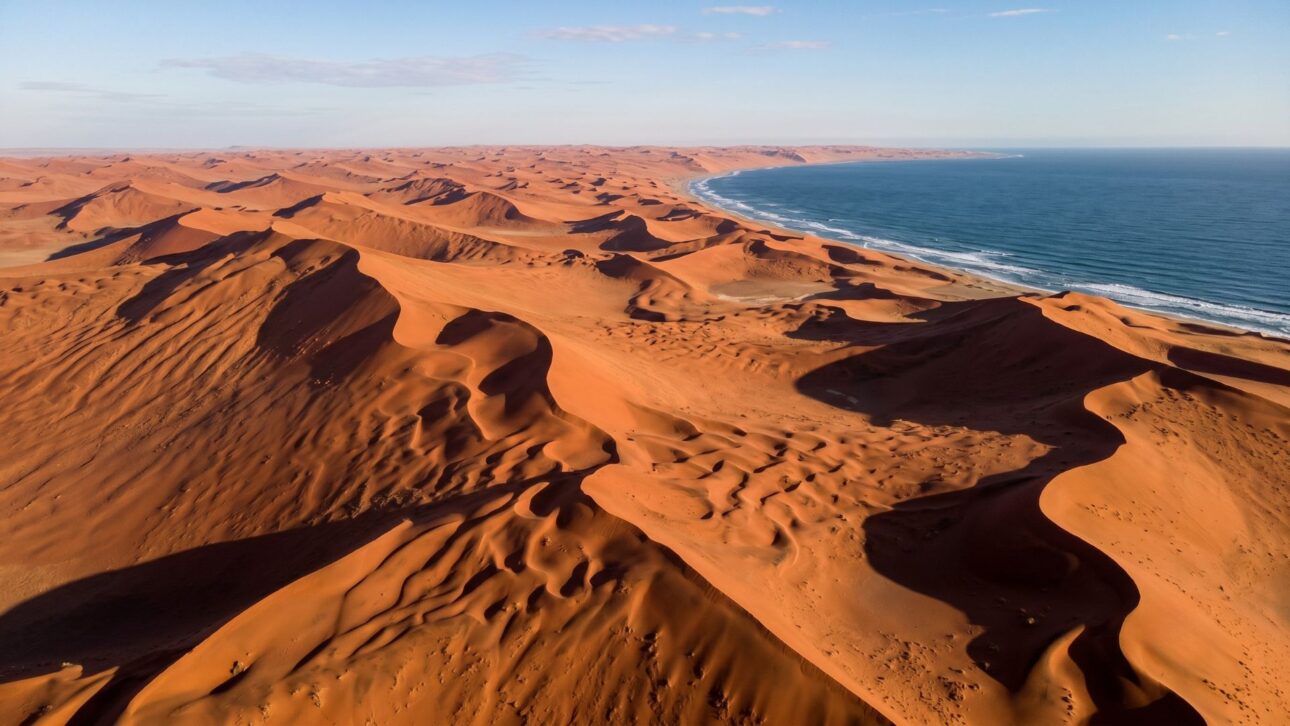
According to UNESCO, this combination simply does not exist anywhere else on the same scale. Meanwhile, IUGS treats the site as an unparalleled aeolian geomorphological landscape, with exceptional dune diversity and global scientific value.
That is why, seen from above, the Namib Sand Sea seems less like a coastal strip of Africa and more like a gigantic natural system where ocean, wind, sediment, and geological time have worked together to create one of the most unlikely and impressive landscapes on the planet.





