






 Portuguese
  Spanish


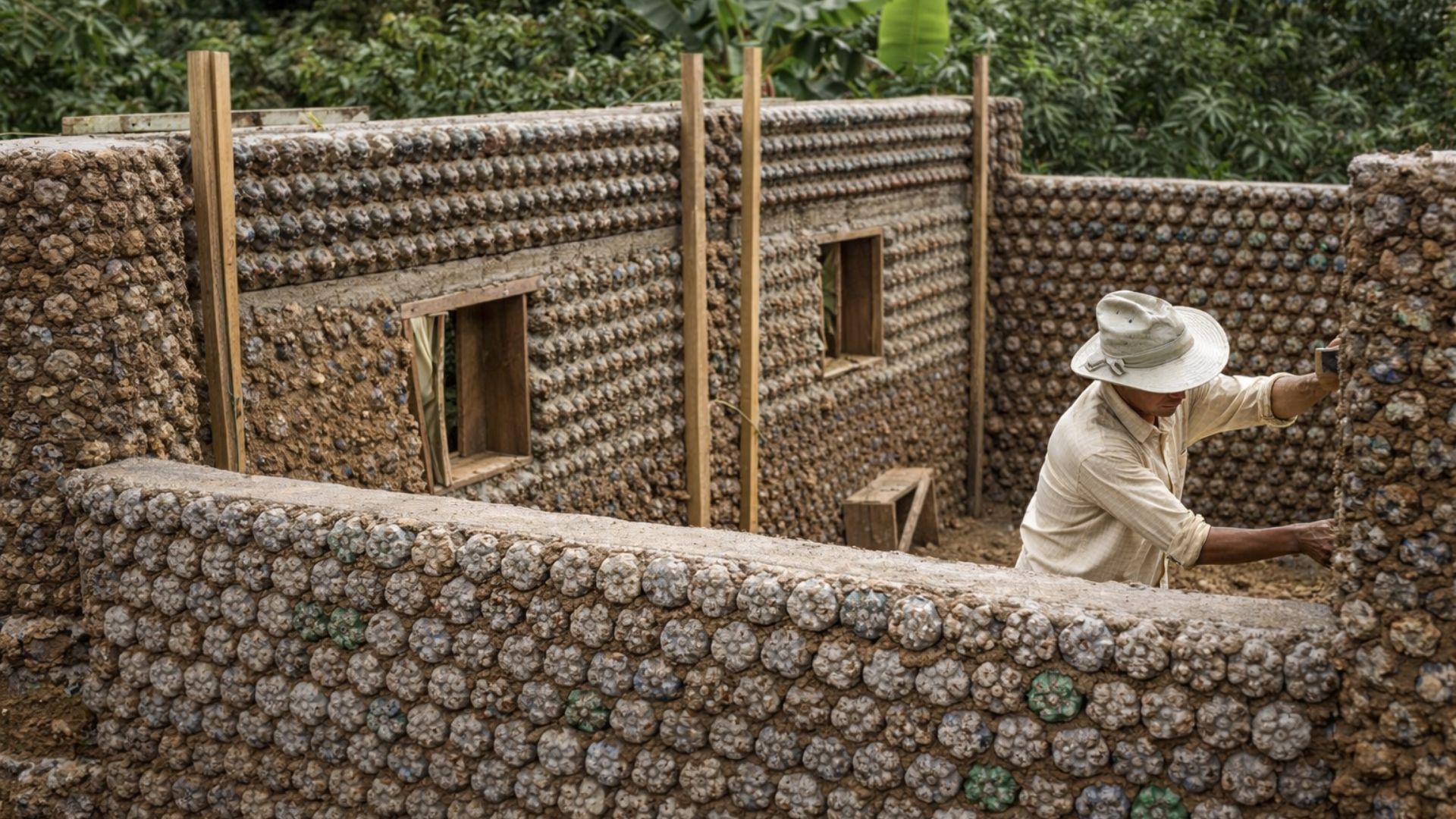


System Developed at UFSC Proposes Replacing Bricks with Prefabricated Panels Made from PET Bottles in the Structural Core, Allowing Construction of a 39 m² Low-Cost House in About 48 Hours, with a Raft Foundation, Reinforced Concrete and Focus on Waste Reuse.
A study developed at the Federal University of Santa Catarina (UFSC) proposes replacing bricks with PET bottles incorporated into prefabricated panels, allowing the structure of a house to be assembled in about 48 hours, based on an initial plan of 39 m².
The system, known as Casa PET, was developed in the Laboratory of Constructive Systems (Labsisco) and follows a logic of off-site manufacturing, with ready modules arriving for positioning, fastening, and locking.
Modular Construction Replaces Traditional Masonry
In the configuration disclosed by UFSC, the 39 m² plan provides for two bedrooms, a bathroom, and an integrated kitchen and living room, as well as a reserved space for a balcony and service area, designed to accommodate a roof.
-
Californian gives up on buying a house, purchases a roughly 1-hectare island for $31,000 in Finland, learns construction from scratch, and begins building a refuge without running water or electricity.

-
A 3-year-old deaf student received the first white belt in Jiu-Jitsu and understood the achievement because the teacher learned Libras to communicate with him, in a video that surpassed 7 million views and moved social media by showing inclusion happening on the mat.

-
Miguel Krigsner opened a small compounding pharmacy in Curitiba in 1977, turned Brazilian fragrances into a national success, and created O Boticário, now one of the largest beauty networks in the world.

-
Meet the charming parrot grandpa, who became known for hugging free birds and revealed how he gained their trust over the years.




Instead of building walls piece by piece, the method organizes itself through panels that act as both enclosure and structural components, replacing ceramic blocks, concrete, or bricks.

The university itself associated the speed with the standardization of the set, and the laboratory coordinator, Fernando Barth, stated that the accelerated assembly is feasible because the blocks arrive ready on-site.
How the Panels with PET Bottles Work
The core of the panel is made up of plastic columns of polyethylene terephthalate bottles prepared with cutting and fitting, so that the units connect and create a continuous sequence within the piece.
In UFSC’s institutional description, manufacturing starts in a mold with an initial layer of concrete of about 2 centimeters, followed by the arrangement of the bottles, the placement of iron reinforcement, and the final filling with concrete.
The Virtuhab portal, linked to UFSC, describes a similar process in reinforced mortar, with a 20 millimeter layer on one side, metal reinforcements around the perimeter, and closure that brings the total thickness of the panel to approximately 14 centimeters.
According to Virtuhab, the bottles can be used upside down to facilitate the passage of installations, and the curing of the panel should occur in a saturated environment, using plastic tarps over the exposed surfaces.
Standardized Dimensions and Embedded Installations
When presenting the system, the magazine Pesquisa FAPESP described panels with 65 and 85 centimeters wide by 265 centimeters tall, composed of vertical columns of bottles, reinforced with flat steel trusses, and coated with mortar.
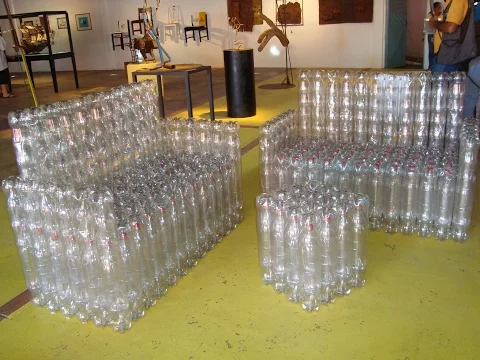

The same publication noted that electrical and plumbing installations are placed during the manufacturing of the panels, which reduces the need for cuts and interventions on-site when assembly begins.
This design attempts to combine material reuse with constructive gains, as UFSC indicated improvements in thermal performance, increased thickness and rigidity, as well as lower weight when compared to massive solutions.
In one of the press releases from Pesquisa FAPESP, architect Thaís Lohmann Provenzano, author of a dissertation related to the topic, summed up the idea in one sentence: “The lightness and rigidity of prefabricated panels facilitate the manufacturing, transportation, and assembly of the dwellings.”
Raft Foundation and Structural Locking System
The proposal suggests that the panels be positioned on a type of raft foundation, with temporary shoring until the final tying, maintaining joints of about 10 millimeters to accommodate expansions or contractions of the set.
The upper locking, according to Virtuhab, is done with a perforated metal sheet screwed along the entire perimeter, functioning as a tie that integrates the walls and helps stabilize the assembly.
On the roof, the same material describes horizontal panels positioned over the vertical panels, unified by pouring the top covering, indicated with a thickness of 4 centimeters, closing the solution in a logic compatible with prefabrication.

Waste Reuse and Application Potential
Besides the speed, UFSC presented the reuse of bottles as an environmental argument, relating the application to encouraging selective collection and reducing waste disposal in landfills and dumps.
In the same institutional text, the university cited data from 2002 on the consumption and recycling of PET packaging in Brazil to contextualize the abundance of waste, although these numbers do not necessarily represent the current scenario.
When describing the project, Pesquisa FAPESP recorded that the research also aimed for a single-story house of 57 m² with two bedrooms and the possibility of expansion, indicating that the system can accommodate variations in size and arrangement according to the panel designs.


Há uma vila na Praia do Sahy em Mangaratiba – RJ, que as casas eram todas de garrafas pet. Há 27 anos atrás fiquei hospedada, gostei muito!
Não é um comentário é sim uma pergunta
Quantas garrafas usaram para construir e quantos cômodo
O título do vídeo é “Casa construída com 8 mil garrafas!” 😅
Muito bom fica ainda mais resitente