Portuguese
  Spanish


Researchers from the University of Hawaii discovered the Bone Collector, a carnivorous caterpillar that lives in spider webs and uses parts of dead insects as camouflage to escape predators.
A newly discovered caterpillar in Hawaii is intriguing biologists for doing something that seems straight out of a science fiction movie: it constructs a type of armor using parts of the bodies of insects it feeds on or finds along the way, creating a macabre camouflage that helps it survive in one of the most dangerous environments for a small insect.
Nicknamed “Bone Collector”, the species was described by researchers from the University of Hawaii at Mānoa in a study published in April 2025 in the journal Science. Scientists discovered that the caterpillar lives inside spider webs and covers its portable silk cocoon with heads, wings, legs, and fragments of exoskeletons from other insects, making it practically indistinguishable from the prey remains abandoned by the spider itself.
Besides the unusual behavior, the discovery revealed another impressive detail: this is one of the rarest carnivorous caterpillars known to science, belonging to a group that represents less than 0.13% of all existing moth and butterfly species.
-
She heard for decades that space was not a place for women, became a pioneer in aviation, was part of the Mercury 13, and at 82, finally traveled with Jeff Bezos before dying at 87.

-
Scientists investigate microplastics in the airways of patients with sleep apnea and reveal a new focus for research on environmental pollution, human exposure, and possible impacts on breathing quality.
-
For the first time, scientists have seen the ocean floor open up in real-time—plates moving apart by two meters in a few days and 160 million cubic meters of lava emerging on the seafloor.
-
Iraq floats and sinks under an arm of the Euphrates 10 giant concrete boxes of 46,000 tons and 125 meters each to assemble a 2.4 km submerged tunnel and open a new land route between Asia and Europe.





A survivor that lives in the predator’s house
Most caterpillars live on leaves, feeding on plants and avoiding predators. The Bone Collector does exactly the opposite. It spends practically its entire life inside spider webs installed in tree cavities, rock crevices, and hollow trunks on the island of Oʻahu, Hawaii.
This environment offers constant food but also represents a huge risk. Any small movement is usually enough to attract the spider’s attention, which quickly captures anything caught in the web. To survive, the caterpillar developed an extremely unusual strategy.
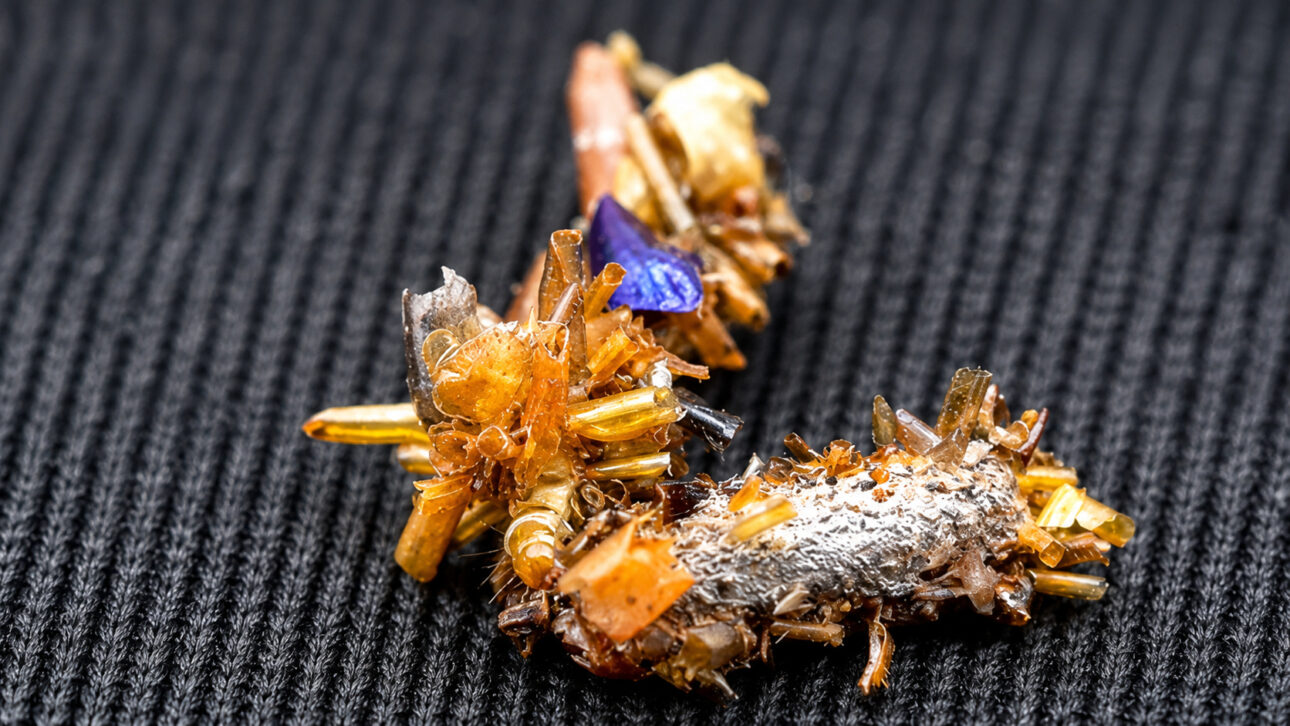
An armor made with insect remains
Instead of hiding its own body, the caterpillar transforms its portable cocoon into a collection of insect remains. Researchers found individuals carrying fragments of different animals, including ant heads, fly wings, beetle pieces, spider legs, and parts of weevils. These fragments are carefully attached to the silk cocoon where the caterpillar lives and moves.
The result resembles a small pile of biological waste lost in the web. It is precisely this appearance that seems to protect it. According to the researchers, spiders probably confuse the caterpillar with remnants of old meals or debris accumulated in the web itself, refraining from attacking it. So far, during years of observation, scientists have never recorded a spider capturing a Bone Collector.
One of the rarest carnivorous caterpillars on the planet
Almost all known caterpillars feed exclusively on leaves. The Bone Collector completely defies this rule. It belongs to an extremely rare group of carnivorous caterpillars, representing less than 0.13% of the approximately 200,000 known species of moths and butterflies.
Its main food source is dead or weakened insects caught in spider webs. In some cases, it even gnaws parts of the web’s silk to reach the prey remains. This behavior allows it to take advantage of a constant food source without needing to venture out in search of food through the forest.
A discovery that took almost two decades
Although the species was introduced to the world only in 2025, its discovery began many years earlier. Researchers spent approximately two decades searching for enough individuals to understand their behavior and confirm that it was indeed an unknown species.
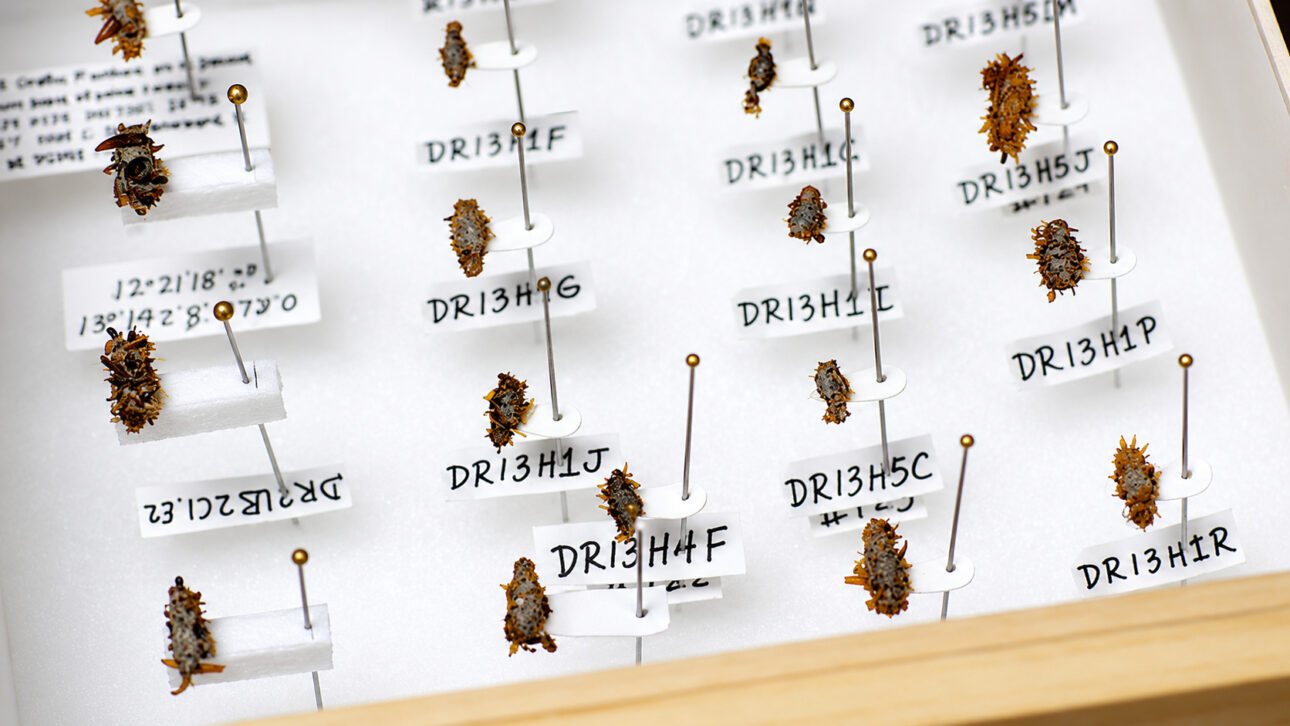
Even after this long fieldwork, only 62 specimens were found. All lived in a small region of the Waiʻanae mountain range, on the island of Oʻahu, occupying an area estimated at only 15 square kilometers. This isolation makes the Bone Collector one of the rarest species ever described in the Hawaiian archipelago.
A lineage older than the island where it lives
Genetic analyses revealed another surprising detail. The ancestors of this caterpillar probably emerged at least 6 million years ago. This means that its lineage is much older than the island of Oʻahu itself, whose geological formation began about 3 million years ago.
According to scientists, the ancestors of the Bone Collector likely lived on older Hawaiian islands that, with the movement of tectonic plates, eventually disappeared beneath the ocean. The species would have gradually migrated between the islands over millions of years, surviving while other forms of life vanished.
The species is already at risk of disappearing
Despite being recently discovered by science, the Bone Collector already faces serious threats. Researchers warn that invasive species introduced to Hawaii, such as ants and parasitic wasps, pose an increasing risk to its survival. Since the entire known population lives in an extremely small area, any change in the environment can jeopardize the species’ existence.
For scientists, protecting this habitat means preserving not just an unusual caterpillar, but also an evolutionary lineage that has traversed millions of years practically hidden from the eyes of humanity.
A survival strategy unlike any other
The Bone Collector shows how far evolution can go when a species needs to survive under extreme conditions. Instead of fleeing from predators, it started living inside their homes. Instead of hiding its presence, it turned insect remains into an almost perfect camouflage.
This combination of behavior, carnivorous diet, and use of “armor” made from prey fragments makes the small caterpillar one of the most curious discoveries in zoology in recent years. It is also a reminder that, even in places studied for decades, nature still holds survival strategies capable of surprising even the scientists themselves.