Portuguese
  Spanish


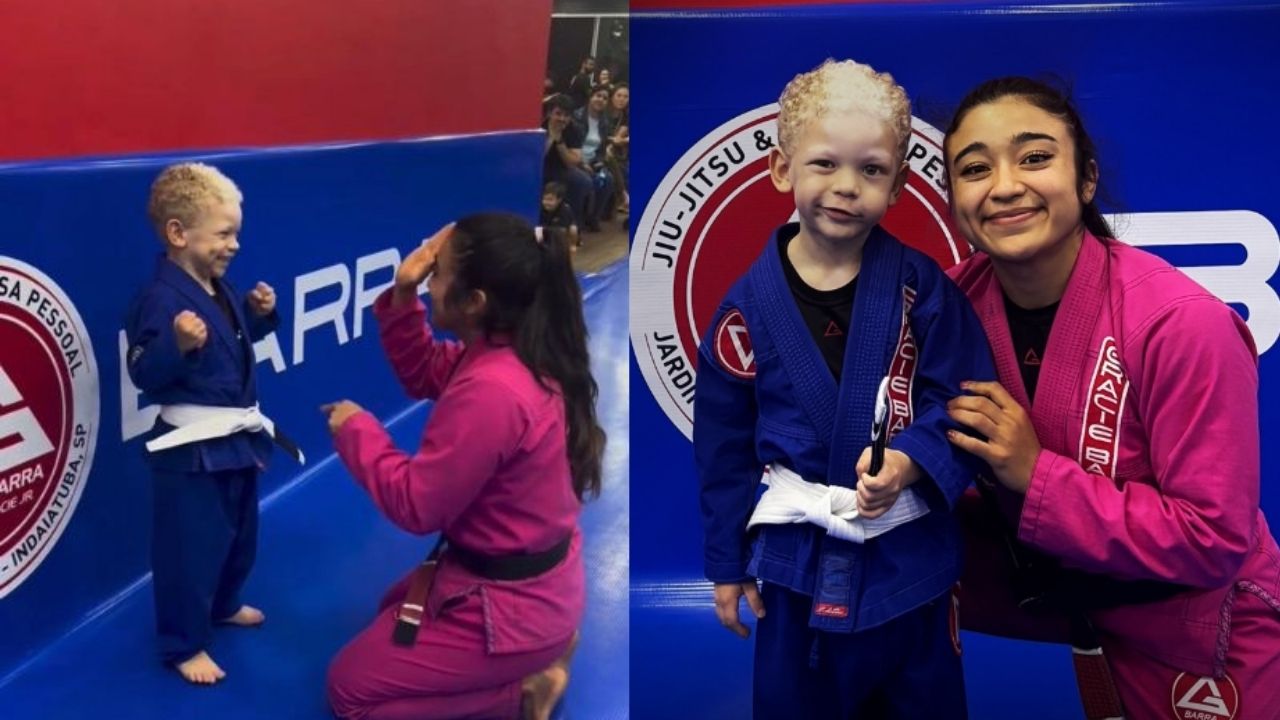

According to Só Notícia Boa, Filipi, a 3-year-old deaf student from Campinas, received his first white stripe in Jiu-Jitsu after teacher Beatriz Sayuri Kamozaki learned Libras to explain the achievement, in a video published on social media that surpassed 7.1 million views and expanded the debate on inclusion.
The deaf student Filipi, aged 3, received his first white stripe on the Jiu-Jitsu belt in Campinas, in the interior of São Paulo, in a class conducted by teacher Beatriz Sayuri Kamozaki, who learned Libras to communicate better with him on the mat.
The scene was published on social media and, according to Só Notícia Boa, surpassed 7.1 million views. The central point of the video is not the child’s difficulty, but the teacher’s adaptation so that the student understood the meaning of the stripe received in Jiu-Jitsu.
Teacher learned Libras to explain the belt
Beatriz Sayuri Kamozaki stated that she had never worked with deaf people before meeting Filipi. Even knowing only a few words in Libras at the beginning, she decided to learn to guide the student during Jiu-Jitsu classes.
-
Miguel Krigsner opened a small compounding pharmacy in Curitiba in 1977, turned Brazilian fragrances into a national success, and created O Boticário, now one of the largest beauty networks in the world.

-
Meet the charming parrot grandpa, who became known for hugging free birds and revealed how he gained their trust over the years.
-
After 18 years of development, Bridgestone launches the AirFree airless tire, which requires no inflation and is puncture-proof, into daily service in Japan, starting with autonomous vehicles up to 20 km/h, used for transporting elderly people.

-
Couple buys 1905 colonial house, plans to tear down walls to unite three rooms, but finds hidden service staircase and rethinks the entire renovation to preserve details that have survived for over a century.



The attitude had a direct effect at the moment of graduation. Upon receiving the first white stripe, Filipi was able to understand the achievement because the teacher explained the belt in Libras, using accessible language for the student within the sports routine itself.
White stripe marked evolution within Jiu-Jitsu
In children’s Jiu-Jitsu, the white stripe on the belt functions as a signal of progress in the learning process. For Filipi, the moment was recorded during class and gained repercussion because communication happened clearly between teacher and student.
The source reports that the boy appears happy when receiving the stripe. Beatriz also reported that she followed his progress day by day, reinforcing that the video shows a concrete stage of sports practice: presence in classes, learning, guidance, and recognition on the mat.
Inclusion happened in the adaptation of the class
Inclusion, in this case, does not appear as a distant discourse. It happened when the teacher changed her own way of teaching so that the deaf student could follow the instructions, understand the grading, and participate in the class with more autonomy.
Beatriz’s gesture shows that accessibility can also be in simple communication adjustments. Instead of waiting for the student to adapt to the environment on his own, the teacher sought a tool to make the training more understandable.
Video exceeded 7 million views
The video of the white belt awarding surpassed 7.1 million views on social media, according to Só Notícia Boa. The repercussion highlighted the relationship between sports, communication, and inclusion in children’s classes.
The case also drew attention because it involves a teacher who learned Brazilian Sign Language for a specific need of the student. The viralization came less from the spectacle and more from the clarity of the scene: a child receives a grading, understands what it means, and participates in the moment with equal communication.
Campinas became the scene of a possible practice
The story happened in Campinas, São Paulo, during Jiu-Jitsu classes. The location is relevant because it shows that inclusion can be applied in common sports training spaces, such as gyms, children’s projects, and extracurricular activities.
The case of Filipi and Beatriz also opens space for a discussion about the training of teachers and instructors. When professionals learn communication resources, like Brazilian Sign Language, they can increase the participation of students who often depend on simple adaptations to better follow the activities.
What the mat taught beyond technique
The first white belt of Filipi showed a stage of learning in Jiu-Jitsu, but also highlighted the teacher’s role in the process. The evolution was not just in the belt: it went through the way of teaching, the choice to learn Brazilian Sign Language, and the construction of more direct communication.
The practical question remains: should gyms, schools, and sports projects encourage more teachers to learn sign language and other forms of inclusive communication? Do you think small adjustments in teaching methods can change students’ participation in sports? Leave your opinion in the comments.