






 Portuguese
  Spanish


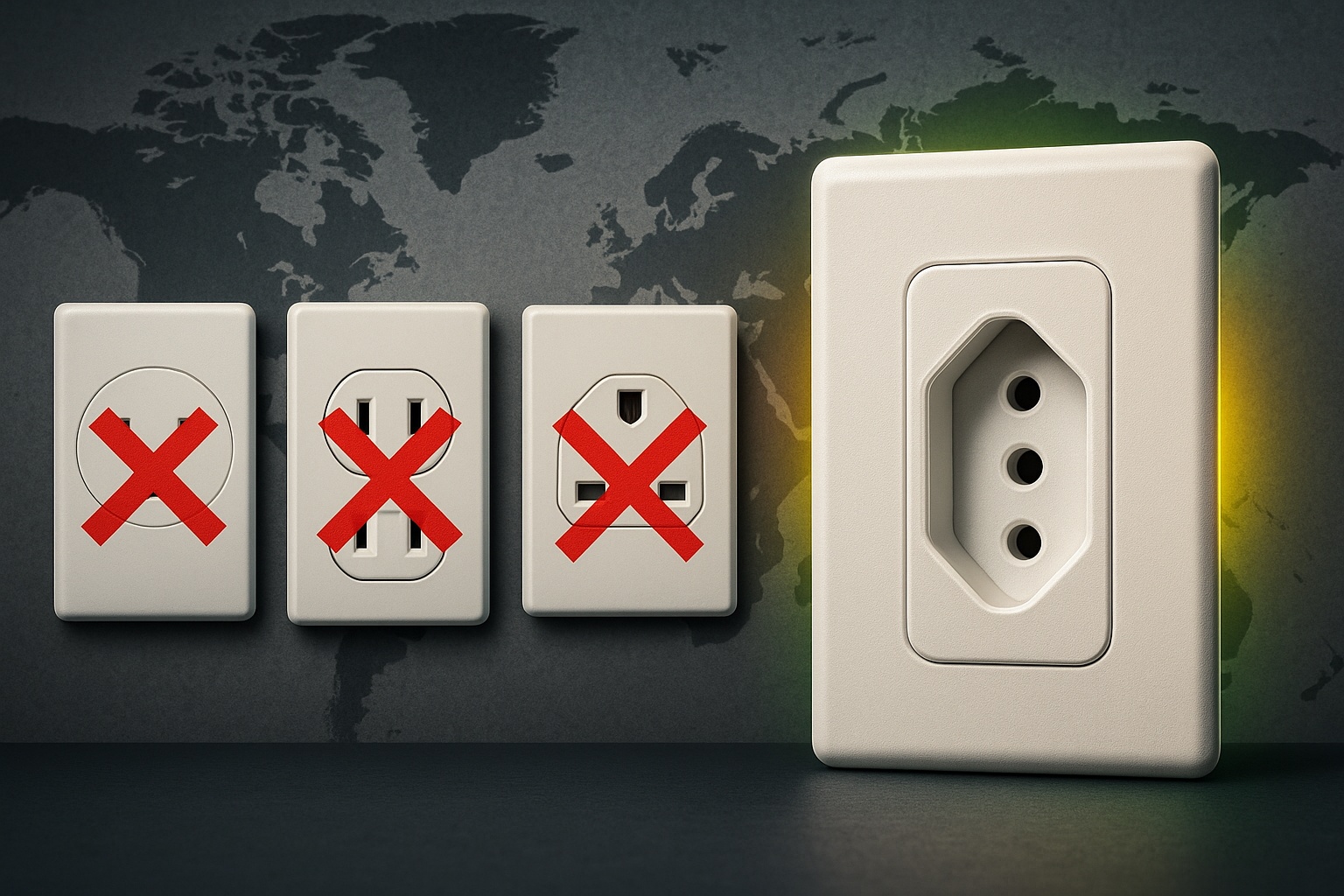


The Three-Pin Plug Was Meant to Be a Global Standard, It Failed Globally and Is Now Only Used in Brazil, Present in Millions of Homes.
Few stories in electrical engineering are as curious as that of the Brazilian three-pin plug. Created with the ambition of standardizing the entire world, the solution became an international rarity. While countries in Europe, North America, and Asia maintained their own standards, Brazil went solo in this choice, making NBR 14136 mandatory starting in 2011.
The initial promise was grand: to adopt a model inspired by the international standard IEC 60906-1, launched in 1986, which aimed to unify the different types of plugs and sockets existing on the planet. However, the proposal never gained traction outside Brazil. Here, it became law and began to equip millions of homes, offices, and industries, even facing resistance from consumers and criticism from experts.
The Scenario Before Standardization: Chaos of Sockets and Adapters
Before the mandate, Brazil coexisted with at least 12 different types of plugs and sockets, a result of decades of importing appliances from multiple origins.
-
She spent 73 years breathing inside an iron lung, survived the aftereffects of polio, and became the last woman in the United States dependent on the equipment before dying at 78 years old.

-
Brazilian students created a $1 filter using pine bark, cotton, and 3D-printed parts to clean cassava wastewater, reduce the toxicity of a hazardous waste, and transform contaminated water into biofertilizer.

-
Astronaut from Artemis II steps down after mission to the Moon and decision surprises after a record of 406,771 km, a historic 10-day journey, and an unprecedented achievement for Canada.

-
A fossil kept for years in a small museum in Montreal concealed 450-million-year-old soft tissue, a discovery that has only happened once before in history.


This “electric chaos” forced consumers to accumulate adapters and increased the risks of shocks and fires.
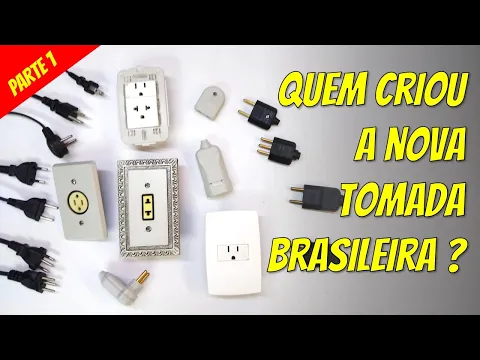

The Brazilian Association of Technical Standards (ABNT) advocated for the creation of a unique standard that would ensure more safety and efficiency.
The federal government accepted the proposal, and in 2006, through the Inmetro Ordinance 51, established a transition schedule that culminated in the mandatory requirement starting in January 2011.
NBR 14136: Safety as the Central Justification
The model adopted in Brazil is practically identical to the international IEC standard, but with slight adaptations for current and voltage.
The three rounded pins allow for better fit and integrated grounding, increasing protection against electric shocks and overloads.
The industry argued that the new standard would reduce the number of domestic accidents and facilitate future compatibility with imported equipment.
However, since other countries never adopted this standard, the result was the opposite: the Brazilian consumer became isolated with a type of plug that does not exist anywhere else on a large scale.
The Failure of the Idea of Global Standardization
Despite being conceived as a “universal plug,” the IEC 60906-1 standard never gained international traction.
European countries continued using their traditional models, such as the Schuko (Germany and Spain) and Type C (France and others), while the U.S. maintained Type A/B.

In practice, only Brazil embraced the idea on a large scale, becoming the only country to officially implement the standard.
The result was a feeling that Brazilians were left with an exclusive and often inconvenient model, as the import of equipment still requires adapters.
Costs, Criticism, and Controversies
The change did not go without controversy. Critics pointed out that the mandatory requirement brought additional costs for consumers and manufacturers, who were forced to adapt millions of products.
The price of adapters skyrocketed during the transition period, and even today many people complain about the difficulty of using older appliances with the new standard.
Moreover, the promise of international unification did not materialize, and global standardization remains distant. Today, it is estimated that there are more than 14 different types of plugs in the world, with no convergence in sight.
Lessons from Engineering and Public Policy
The story of the three-pin plug in Brazil reveals the challenges of aligning public policy, engineering, and the global market.
On one hand, the country sought to solve a real problem of electrical safety. On the other hand, it got stuck with a model that did not find resonance in the rest of the world, creating technological isolation and popular dissatisfaction.
Still, advocates argue that the change brought concrete gains in electrical safety, reducing domestic accidents and fires caused by poor installations.
Symbol of a Country That Tried to Innovate Alone
The three-pin plug is now a curious symbol of Brazilian engineering: born with the ambition of standardizing the world, but transformed into a national exclusivity.
Present in almost all homes and businesses in the country, it represents both the pursuit of modernization and the risks of adopting isolated solutions.
Meanwhile, Brazilians continue to cope with adapters and memories of a time when every appliance came with its own plug—a reminder of the chaos that NBR 14136 attempted to resolve but ended up creating another challenge: the challenge of being unique in a world that followed a different path.








Esse modelo de tomada torno os lares mas seguros e melhorando a vida útil dos plug já que metade dele fica inserido na tomada melhorando a resistência mecânica.
Se os pinos fossem invertidos (110v fosse mais grosso que o 220v) evitaria a queima de aparelhos e, consequentemente, maior segurança
É o chamado “mata ****”
Foi a melhor decisão, definir um padrão de tomada seguro para o país.
Nada no mundo possui padrão, nem as pessoas, kkkkkk. Se as tomadas fabricadas no Brasil não são resistente, a culpa é da indústria nacional e dos consumidores que só exigem baixo preço.